[ad_1]
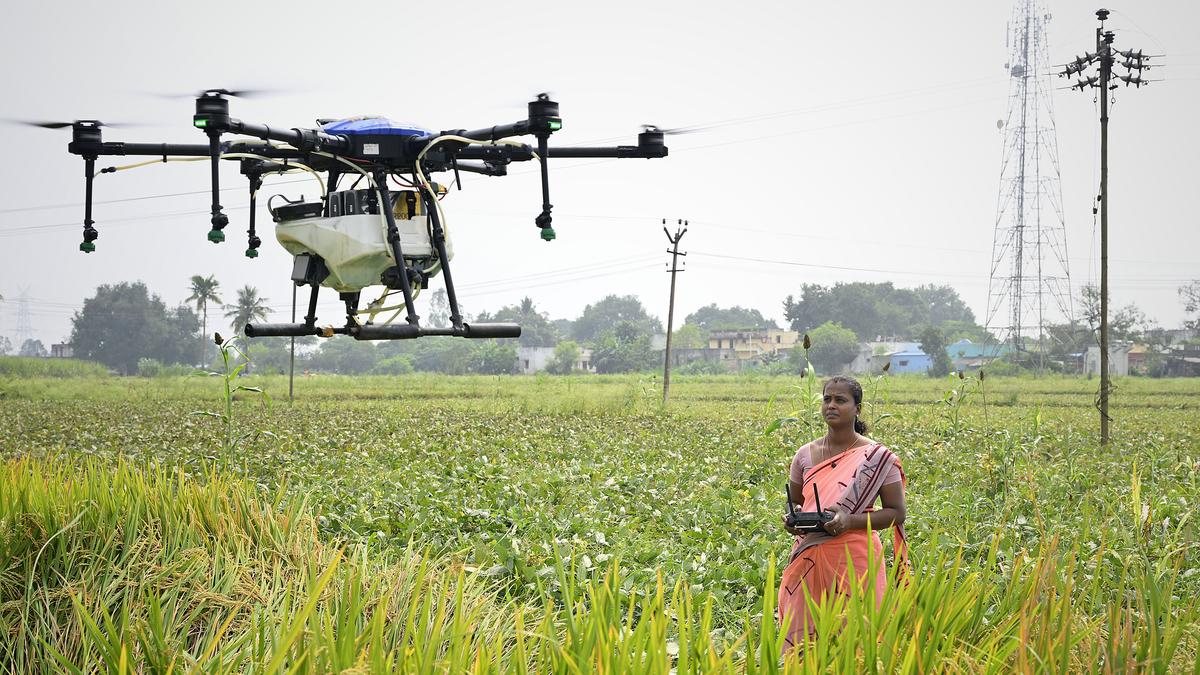
V. Saranya operating a drone on a paddy field at Kommasamuthiram in Kallakurichi district
| Photo Credit: S.S. Kumar
Nandini Sugumar, 27, a postgraduate in mathematics, has always had a fascination for drones.
Having only seen the gadget whirring overhead at weddings, she is now one among the women drone pilots who have been trained to expertly manoeuvre drones to assist farming operations in the predominantly agrarian Kallakurichi district.
A fortnight before Pongal, residents of Devapandalam, a non-descript village near Sankarapuram watched in awe as a drone hovered above a sugarcane field spraying fertilisers from its payload. The typical sortie covered the entire sugarcane field in just seven minutes before returning to earth amid loud cheers from the villagers.

Having graduated as a skilled drone pilot, Nandini is excited over embracing technology to meet a wide range of farmers’ requirements, whether it is the use of fertilisers, pesticides or watering.
Nandini is among the first batch of women self-help group members from Tamil Nadu selected under the Central government’s ‘Namo Drone Didi’ scheme.
The scheme is aimed at empowering rural women by training them to be drone pilots and making them integral stakeholders of the local farming supply chain.

V. Saranya from Kommasamuthiram near Eraiyur in Kallakurichi district is among the first batch of women in Tamil Nadu trained on the use of drones for farm operations
| Photo Credit:
S.S. Kumar
Nandini learnt about the Drone Didi scheme through a fertiliser supply chain in Kallakurichi and applied without a second thought. After being identified as a woman SHG member by the Tamil Nadu Corporation for Development of Women, she was shortlisted among the clusters in Kallakurichi district.
She underwent a five-day hands-on training workshop on the operation and maintenance of drones held by Garuda Aerospace Private Limited in Chennai. After completing the Remote Pilot Training Classes, Nandini was supplied with a drone costing ₹7 lakh free of cost for providing rental services to farmers for spraying of liquid fertilisers and pesticides.
With the successful completion of training, Nandini is now making use of technology to meet a broad set of farmers’ requirements.

“I feel very excited over flying a drone. I have given my contact details with the local fertiliser units and have been touring nearby villages to help farmers. The spraying of liquid fertilisers and pesticides through a drone is very cost-effective and takes around 7 minutes to cover an acre of farmland,” Nandini says.
Most of the farmers at Devapandalam and surrounding areas own small landholdings ranging between one and four acres. The labour cost per acre is ₹400. The drone is equipped with two tanks and a battery set.
Nandini is helped by her husband Sugumar who also completed the drone assistant training to operate the device.
“My first visit was to a sugarcane field owned by a farmer in Devapandalam. It was my first sortie and I did not charge anything as I wanted to ensure that the service had the required result for the farmer,” Nandini said.
Like Nandini, V. Saranya of Kommasamuthiram near Eraiyur in Kallakurichi district is also a trained drone pilot. Saranya has studied till class X and with few job opportunities for women, she currently works as a beautician.

Having completed the drone pilot training in Chennai, Saranya is now crisscrossing the villages in Ulundurpet block on call to execute flight runs that have ensured her an assured monthly income.
“The most common demand from farmers is spraying of fertilisers and pesticides. As soon as I cover an acre, I have to charge the battery as it runs out quickly. I have applied for a loan with the panchayat-level federation to buy two more batteries.”
There have been unforeseen challenges as well.
“Though I get calls from farmers from nearby blocks, transporting the drone is a problem as it weighs nearly 30 kg after being loaded with fertiliser and water.”
“It takes two people to carry it and a second-hand vehicle for transporting the drone costs nearly ₹3 lakh. However, my new occupation supplements my income and hope it is beneficial in the long run,” says Saranya.
Published – January 16, 2025 05:15 pm IST
[ad_2]
IThe Hindu