[ad_1]
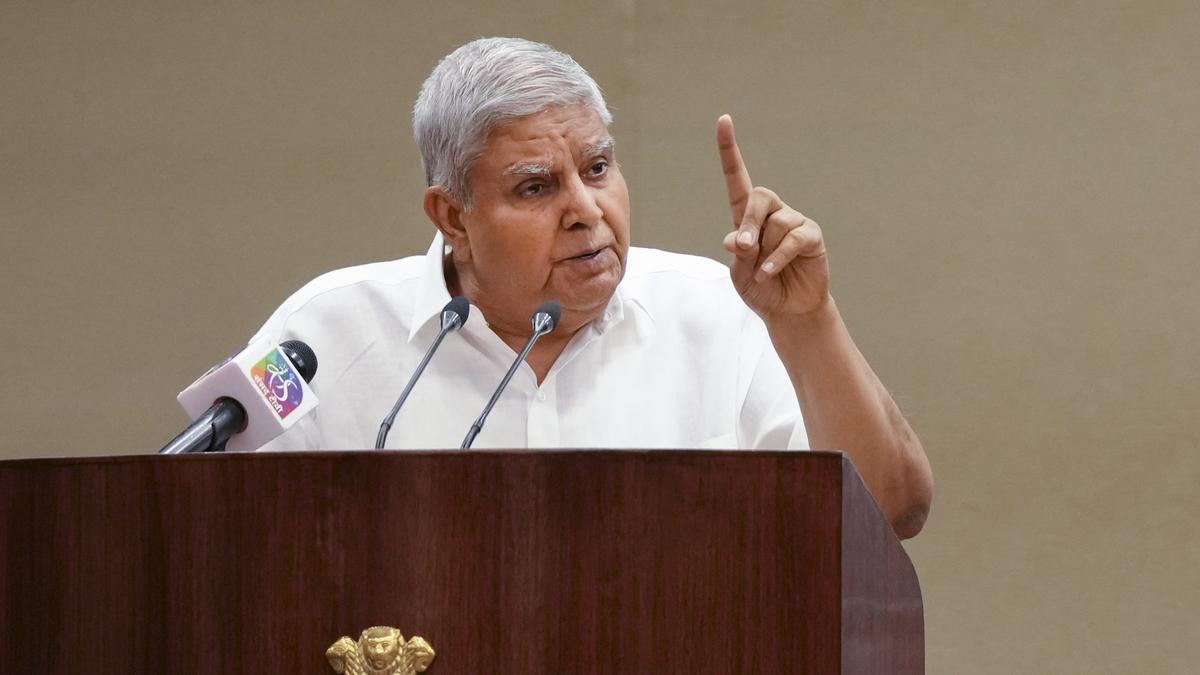
Voicing concern over a recent Supreme Court ruling prescribing a timeline for the President to decide on bills, Vice President Jagdeep Dhankhar on Friday (April 17, 2025) said India had not bargained for a democracy where judges will legislate, perform Executive functions.
| Photo Credit: PTI
Voicing concern over a recent Supreme Court ruling prescribing a timeline for the President to decide on bills, Vice President Jagdeep Dhankhar on Friday (April 17, 2025) said India had not bargained for a democracy where judges will legislate, perform Executive functions and act as a “super Parliament”.
Last week, the Supreme Court had, for the first time prescribed that the President should decide on the bills reserved for her consideration by the governor within three months from the date such reference is received.

“There is a directive to the President by a recent judgement. Where are we heading? What is happening in the country? We have to be extremely sensitive. It is not a question of someone filing a review or not. We never bargained for democracy for this day. President being called upon to decide in a time-bound manner, and if not, becomes law,” Mr. Dhankhar said here.
Addressing a group of Rajya Sabha interns, he said, “So we have judges who will legislate, who will perform executive functions, who will act as super Parliament, and absolutely have no accountability because law of the land does not apply to them”.

Mr. Dhankhar said his worries were at a “very highest level” and he had never thought in “my life” that he will have the occasion to see it.
He reminded the audience that the President of India is a very elevated position. President takes oath to preserve, protect and defend the Constitution.
Others, including ministers, the vice president, parliamentarians and judges take oath to abide by the Constitution.
“We cannot have a situation where you direct the President of India and on what basis? The only right you have under the Constitution is to interpret the Constitution under Article 145(3). There it has to be five judges or more …,” he said.
Supreme court to President on state bills
The SC judgement came in response to a November 2023 petition filed by the Tamil Nadu government against the State’s Governor indefinitely withholding assent to ten Bills passed by the State Assembly, some as early as 2020.

The Supreme Court has put the President on a three-month deadline to decide whether or not to assent to State Bills referred to her by a Governor. The clock would begin ticking from the day the Governor referred the Bill to the President for her consideration.
“In case of any delay beyond this period, appropriate reasons would have to be recorded and conveyed to the State concerned,” the apex court held in an April 8 judgment. The States, in turn, must be cooperative to any queries or suggestions from the Centre on the Bills.
A Bench of Justices J.B. Pardiwala and R. Mahadevan declared that the President ought to, as a measure of prudence, seek the Supreme Court’s advice on Bills reserved by a Governor for her consideration on grounds of perceived unconstitutionality.
(With inputs from PTI)
Published – April 17, 2025 05:14 pm IST
[ad_2]
The Hindu