[ad_1]
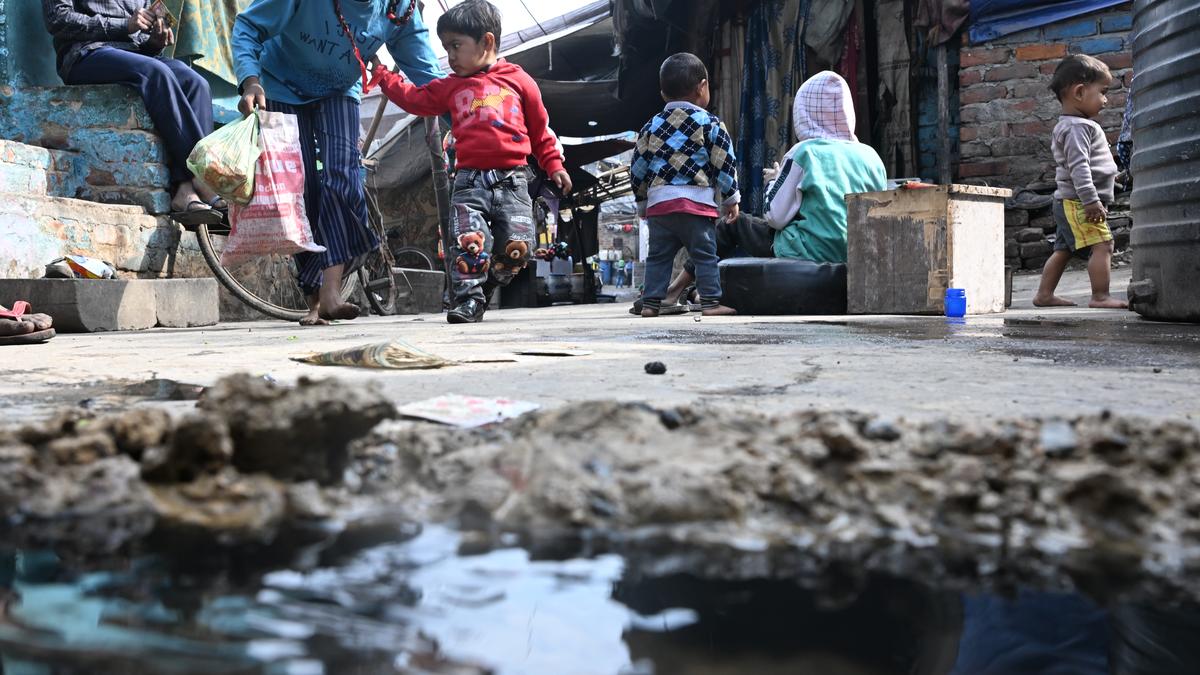
Children at the Bhalswa Dairy slum cluster often complain of skin diseases and stomach infection
| Photo Credit: Sushil Kumar Verma
The trash mountain in Bhalswa Dairy towers above the jhuggis, feasted upon by crows, vermin, cows, and flies, emitting a stench that never stops reminding its residents of the inescapable rot around them.
Living under the shadow of the 62-metre-high landfill, almost every other resident suffers from respiratory problems, skin diseases and stomach ailments. Mostly rag-pickers and factory workers, those who reside in the north-west Delhi area survive on meagre earnings of not more ₹7,000-8,000 a month, leaving them with little to spend on medical treatment.
Surai Bano, 25, a domestic help, says that living near the landfill has not only left her sick but also disrupted her menstrual cycle.
“I have been diagnosed with an infection of reproductive organs. According to doctors, the main cause for my state is the unhygienic conditions around my house. There is no one to help improve our lives. We are treated like trash,” she told The Hindu. Ms. Bano, who lives in a jhuggi near the landfill, said nothing has changed at Bhalswa Dairy over the years.
“I can’t even afford a sanitary napkin. We depend on an NGO for free sanitary pads and receive no help from the government,” she said Ms. Bano, who also suffers from skin ailments, including blisters on the face.
A putrid smell remains in the air around the landfill. The narrow lanes at the slum cluster remain littered with garbage, cow dung and urine.
“As there is no drainage system, the sewer water gets accumulated. My son has fallen sick multiple times. I had to take him to a private clinic nearby as the government hospital was far away, and getting there was not easy. If my son falls ill again, I don’t have money to take him to the clinic,” said Ali Hussain Khan, a 32-year-old scrap dealer.
Even clean drinking water is a dream for the Bhalswa Dairy residents who depend on tanker water supply. Keriman, a mother of four, said she sometimes has no option but to fill buckets from a water tap at public toilet.
“My children often fall sick. But what option do I have? I procured some tablets from a government hospital and gave them to my kids. But what can I do about mosquitoes or viral infections? the 25-year-old woman complained.
While the ruling AAP and the BJP, which ruled the Municipal Corporation of Delhi for 15 years, blame each other the mess, the residents have little option. Dr. Balbeer Chand, who runs a private clinic near the slum cluster, said, “Every day I see around 50 patients. Cough, fungal infections, stomach aches, diarrhoea, and fever are common here. People here fall sick frequently. Nothing can change unless the living condition improves.”
There are a few more clinics near the slums. The nearest government dispensary is at Swaroop Nagar, which is over 4.5 km away from the slum. A Mohalla Clinic is within walking distance, but it was found to be closed.
Dr. C.S. Bhogal at Babu Jagjivan Ram Memorial Hospital said many patients with skin problems come from the localities around the Bhalswa landfill. The government hospital is at Jahangirpuri, over 6 km away from the landfill. “The polluted water may not harm their skin overnight, but over a period of time, the skin starts peeling out from the infected area and later ends up in allergies. Many of these patients often scratch the area which soon starts bleeding,” Dr. Bhogal explained.
Bhalswa Dairy is part of Badli Assembly constituency, which has been represented by AAP’s Ajesh Yadav since 2015. Mr. Yadav will take on Congress’ Devender Yadav and BJP’s Deepak Chaudhary.
Published – January 25, 2025 01:52 am IST
[ad_2]
The Hindu