[ad_1]
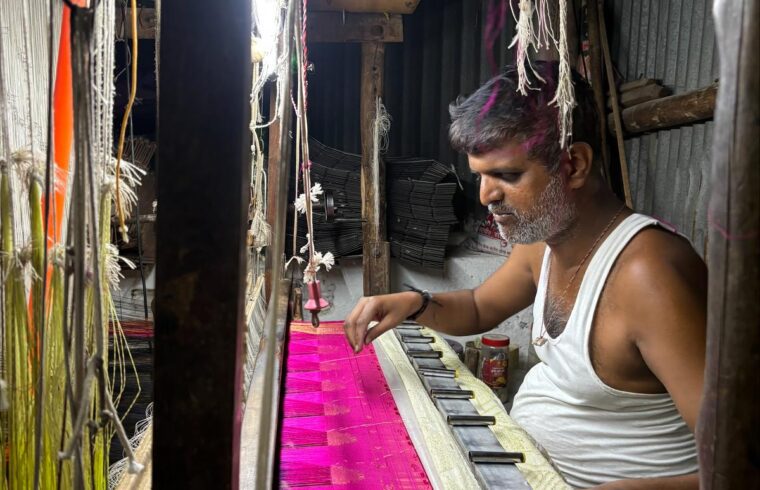
In one of the lanes of Solapur district’s Shiv Ganga Nagar, where every house is adorned with a rangoli, one such one-room house is of the weaver of Suvarna Madgundi (54), where she weaves silk sarees and cooks in the same room. “We put in hours of work into weaving, but our effort lacks recognition. This prevents us from getting any benefits,” she says, weaving the zari into the blue-green saree on her brightly lit loom in her dim room. The weaving of Solapuri silk sarees is deteriorating by the day, but this has come to the attention of hardly anyone, the weaves believe.
Suvarna and her spouse have been weavers since their childhood. They belong to the Kuruhinashetty community, and migrated from the neighbouring State of Karnataka. A few families from the Padmashali community migrated from Telangana. The 350-odd families weave silk sarees and form the handloom industry in Solapur, which is highly known for its textile industry, producing terry towels and chaddars.
The weavers have been demanding the inclusion of their product, what they call the ‘Solapuri silk saree’, in the list of traditional textiles under the Maharashtra government’s textile policy of 2023, so that they can avail themselves of the benefits of the old age pension scheme, acquire job of master trainers at the various government-run handloom institutes, and receive yearly festival of allowance of ₹15000 for female weaver and ₹10,000 for male weavers.
“Why the government is discriminating among the weavers? Himru is hardly woven in the State, yet the product is reserved, and the grant is being misused. Why not give the benefits to those who need it,” says Ashok Indapure, a trader of handloom products, who also represents the weaver’s community.
Another weaver, Magnat Mudgundi (34) claims that he submitted over 300 pension forms three months ago, taking regular follow-ups, but to no avail. Recalling one of the follow-up meetings, he said, “The concerned person at the office said such issues don’t resolve without the opposition pestering the ruling party.”

Solapur in Maharashtra is known for its handlooms.
| Photo Credit:
Special arrangement
The traditional textile list includes khan fabric from South Maharashtra, Himru and Paithani saree from Ahilyanagar, Karvat Kathi saree from Vidharbha, and Ghongdi from Western Maharashtra. The community demanded to recognise their sarees under the Paithani sarees as they weave sarees out of silk and zari (material used in paithani) and the process is also similar.
Weaver’s ID Card and loans
Suvarna received her Pehchan Card number (Weaver’s ID) six months ago. The ID is required as a criterion to avail of the schemes under the National Handloom Development Programme (NHDP) such as MUDRA loan and workshed. She applied in 2015 and the card was issued in 2018, but received only six months ago. Her spouse is yet to receive the card. “We can’t get any central government benefits,” they say.
Like Suvarna’s spouse, many are waiting for their cards. The card provides benefits like access to credit facilities of up to ₹2 lakhs through the ‘Weavers Mudra Scheme’ at subsidised interest rates for working capital, and machinery. With the card, they can also get access to the NHDP Scholarship Component, where the children of the weavers can get financial assistance of up to ₹2,00,000 annually, covering fees at recognized textile institutions and a monthly stipend of ₹5,000.
Magnat has been applying for a Mudra loan but the bank’s denied him saying, “We won’t give loans as there are many defaulters”. Magnat points out there are off days when the sales are zero. The boom is in festive seasons (August to February), “We require money to meet ends in the off-season,” he adds.
One loom produces one or two sarees per month and it is sold off for ₹12000 to ₹15,000 in the festive season
“Government says don’t stop the handlooms, but they are only killing it with poor implementation of the schemes,” he says, who worked as a tailor for six years in a garment factory before he entered weaving.
Collective Workshed and yarn bank
Among 350 families, at least one family owns two looms. A few families work at looms owned by private owners, but the setup is at their home. Pawani Venkatesh (35) and her family have two handlooms and one beam machine in a single-hall house and the sides of the room are her kitchen area. While winding the silk threads of purple and red on the beam, Pawani says, “I love to do this, but I wish we made a little more to have a stable life. Working inside the house is congested. We have raised demand for a dedicated collective workshed, so that we can have our homes for ourselves.” Workshed place is a common setup, where handlooms of various owners can be installed as one big factory and weavers can collectively work there.

Solapur in Maharashtra is known for its handlooms.
| Photo Credit:
Special arrangement
The community has been demanding a yarn bank to receive a 15% subsidy from the Central Government on yarn under the Raw Material Supply Scheme (RMSS) on silk and blended yarn of natural fibres. According to them, the middlemen and the agents take the benefit of the subsidy.
Marketing and future
The market for these sarees is Maharashtra’s Pune district. Every month, the weavers take at least two sarees to the bustling market of Laxmi Road in Pune city and sell to the local stores. However, sometimes the buyers refuse to buy, citing the low demand and off-season. The community claimed buyers take advantage of their helplessness. “We don’t have to hold capacity, if we sell one saree then only, we could eat for the entire month. Buyers ask for a discounted price, our ₹15000 sarees are sold at ₹10,000/-, leaving us with no margin, says Chandrashekhar Malayakhune (40), a weaver, living in Vishnu Nagar.
The community is exploring new markets and marketing techniques for their product and looking for the government support. So far, the government has not been successful. The governmenthas resolved to establish Urban Haat, a dedicated place for marketing opportunities for handloom weavers to showcase and sell their products. However, the experts don’t find implementation feasible as the financial assistance is low and infrastructure requirements are high.
The weavers also expressed their insecurities about their children carrying their legacy. Pawani says, “Our children don’t want to work here, seeing me work day and night.” Chandrashekhar said, “Who will come here without any social security? I had a heart attack three months back, I spent ₹5 lakhs in the hospital. No weavers policy came to rescue me of my financial burden.”
Published – March 12, 2025 05:41 pm IST
[ad_2]
The Hindu