[ad_1]
For a poet, whose lyrical imagination is often imbued with a spiritual impulse, Arundhathi Subramaniam’s latest work is a deep dive into uncharted waters — an anthology of sacred verse, an evocation of “haunting voices of, by and for women across the Indian subcontinent”.
“For me, personally, it has addressed a deep, unspoken longing for a female spiritual ancestry. I love the male mystic poets – from St. John of the Cross to Kabir, from Hafez to Tukaram. But in some unconscious way, I felt the absence of women acutely,” Ms. Subramaniam told The Hindu.
“By seeing them as human beings – real, bewildered, yet committed to their inner journeys – we do not deprive them of their sainthood. Instead, they become even more inspirational. They remind us that you cannot attain the divine by bypassing the human,” she said.
The Mumbai-based poet, recipient of the Sahitya Akademi Award for Poetry (2020), Mystic Kalinga Literary Award (2017), was in the city recently to introduce her new book, “Wild Women: Seekers, Protagonists and Goddesses in Sacred Indian Poetry”.
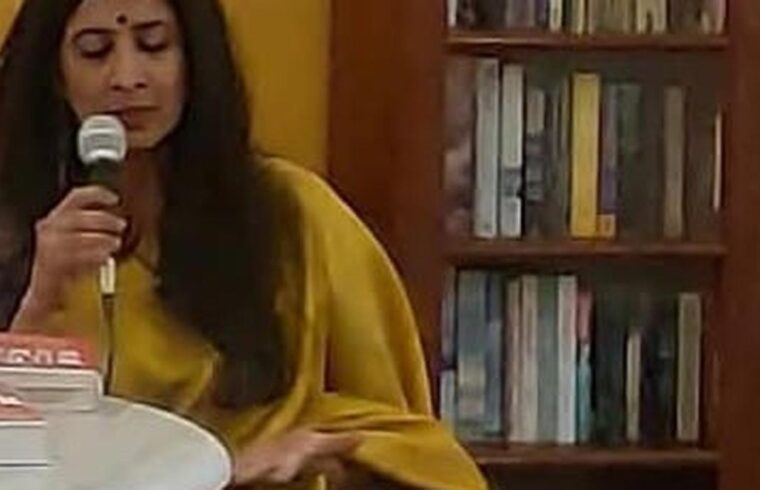
At a session hosted by The Brown Critique and People for Pondicherry’s Heritage (PPH) at the Palais de Mahe, Ms. Subramaniam sat down with poet and Brown Critique founder Gayatri Majumdar to discuss her work’s five-year toil that was “a mix of focused research and serendipity”.
The women-centred anthology delves into a diverse lineage and across a distant timespan — from early Buddhist nuns (6th to 4th Century BCE) to Bhakti and Sufi mystics, tantrikas and Vedantins.
“So, that meant casting a wide net across faith traditions. Also, I wanted women who embraced plural life choices. Which is why you’ll find all kinds of women here: monks, householders, solitary travellers, even courtesans! What unites them is a deep, urgent quest for the sacred. They are women who dare to demand personal answers to ultimate questions,” says Ms. Subramaniam.
“I read furiously, and had long email exchanges with scholars, seekers, translators and musicians from different regions. But there were also wonderful moments of synchronicity: a book about the work of the 18th century mystic, Dayabai (authored by Osho), falling into my hands in a bookstore, for instance! Or the tantric poets, Jira Dei and Lakshminkara, emerging through a series of tantalizing leads”, says the poet, who was on the shortlist for the TS Eliot Prize for Poetry 2015.
What makes these fifty six poets inspirational is the fact that their poems return us to their humanness, says Ms. Subramaniam, adding: “They acknowledge their bodies, and a great appetite for the sacred. Both are true. They don’t allow one to cancel the other out. They remind us that the divine is not merely transcendent, but here and now”.
“Janabai, the 13th century Marathi poet, can speak of her God, Vitthala, and of the daily chores of cooking and cleaning in the same breath. Sule Sankavva, the Kannada courtesan-poet, calls her god the Shameless One: she can approach him without a shred of guilt or shame about her profession because he is utterly non-judgmental. Tarigonda Venkamamba, the 18th century Telugu poet, is a widow who wears vermilion, flowers, coloured clothes and flaunts her intellectual brilliance, even as she professes her love of the divine,” Ms. Subramaniam explains.
The author applied two broad criteria — poems that were strong and compelling to read in English, and plurality in terms of the chronological, linguistic, regional, religious and temperamental.
According to Ms. Subramaniam, there are poets like Punnika, the oppressed caste girl-turned Buddhist nun, who outwitted the Brahmin with questions on karma about 2,500 years ago, Rupa Bhawani, the 17th century Kashmiri mystic who declared that “she will never bow before the divine; instead, chooses to embody him! ‘On Shiva’s path,’ she says, ‘become Shiva himself.’
Alongside other well-known mystics, such as Andal, Akka Mahadevi and Meera Bai or contemporary poets like Indira Devi, a disciple of Dilip Kumar Roy, poet-musician and among the earliest followers of Sri Aurobindo, are also several unknown women-saints.
“To hear from readers about how they are encountering many of these poets for the very first time, has been a sure sign that the project was worth attempting”, said Ms. Subramaniam.
Published – March 14, 2025 07:58 pm IST
[ad_2]
The Hindu