[ad_1]
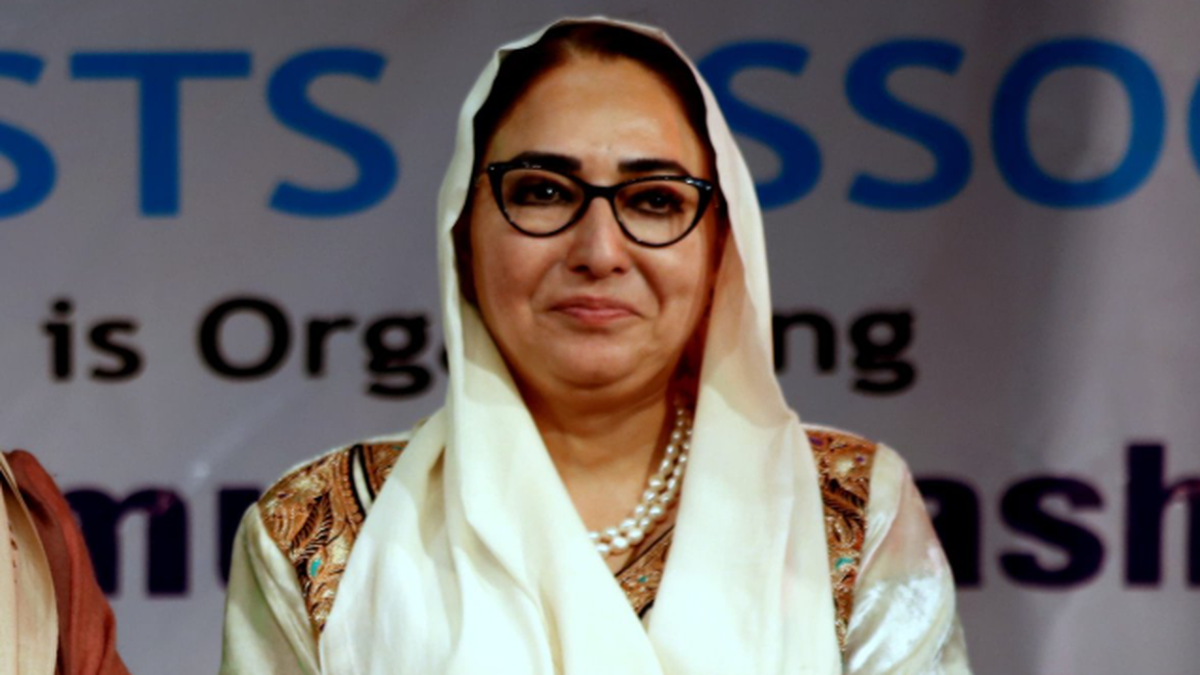
A filr image of BJP leader and Waqf chairperson Darakhshan Andrabi
The ruling National Conference (NC) on Saturday (March 29, 2025) threatened to move privilege motion in the J&K Assembly against BJP leader and Waqf chairperson Darakhshan Andrabi for sidelining elected legislators and naming lower-rung officials on the name plaque of ‘mimber’ (pulpit) inaugurated at Srinagar’s Eidgah a day ago.
“I will submit a privilege motion against the Waqf Board for failing to involve the local MLA in the process, despite the project being situated in his constituency. Such unilateral actions not only violate established protocols but also disregard the sentiments of the local population,” Mubarak Gul, a NC MLA and former Speaker, said.

Ms. Andrabi inaugurated J&K’s biggest pulpit at Eidgah, a ground spread over 600 kanals of land in Srinagar, on Friday (March 28, 2025). The ground would host special prayers, especially Eid nimaz, in the past. Besides Ms. Andrabi, the name plaque had names of two lower-rung officials, including an engineer and tehsildar Ishtiyaq Mohiuddin. Mainstream leaders or elected legislators were neither invited on the occasion nor mentioned on the plaque.
“When Prime Minister Narendra Modi inaugurated Z-Morh tunnel this year in Kashmir, the name of local MLA was on the plaque. Ms. Andrabi needs to understand there is an elected government in place now,” Mr. Gul said.
He said J&K has a democratically elected government and it was imperative for all institutions, including the Waqf Board, to respect the mandate of the people. “Bypassing the local MLA in matters of such importance is unacceptable and undermines the democratic process,” Mr. Gul said.

The NC alleged that “premature inauguration of the pulpit was eye wash aimed at misleading the public”. “Why was there such a rush to inaugurate the mimber when the work is not fully completed? This act reflects a lack of seriousness and disregard for the sentiments of the people,” Mr. Gul said.
Under the J&K Reorganisation Act, the Central Waqf Board rules were extended to J&K in 2019. While all Hindu and Sikh religious places were allowed to be governed by the previous local shrine boards, the local Waqf Board was re-constituted and allowed to takeover 68 shrines and 65 mosques of the erstwhile J&K Muslim Waqf Board by the new body.
The J&K Waqf Board dissolved all local Waqf and Auqaf committees, the caretaker bodies overseeing the functioning of these shrines and mosques in J&K. It ended the practice of donation boxes of the Peer clan, caretakers of these shrines. It also banned turban-tying ceremonies of politicians in Waqf-run shrines and mosques.
Published – March 29, 2025 09:56 pm IST
[ad_2]
IThe Hindu