[ad_1]
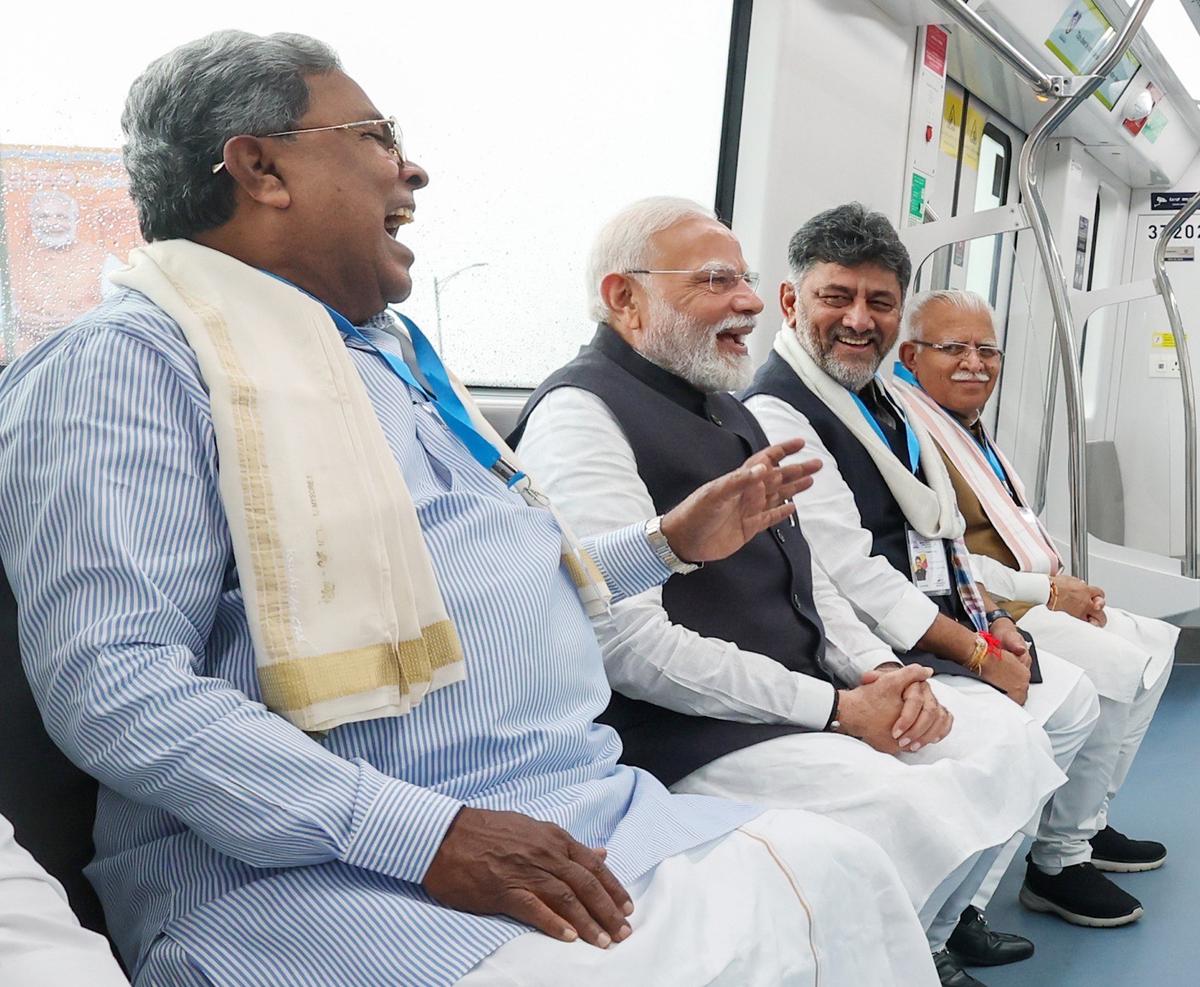
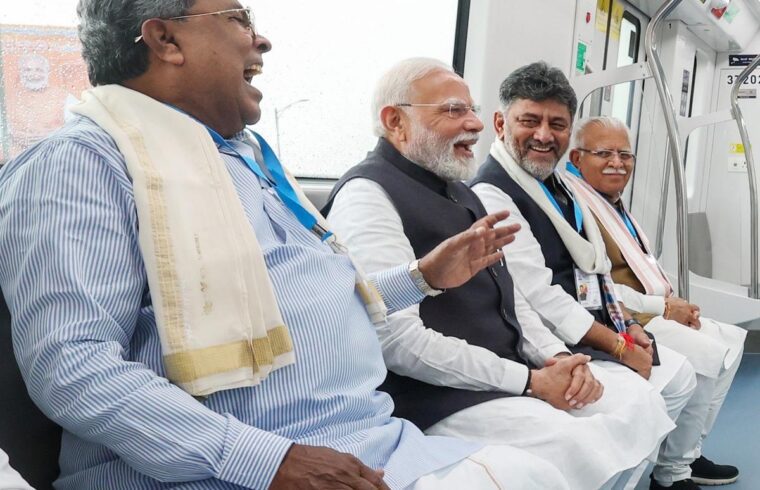
Prime Minister Narendra Modi, along with Karnataka Chief Minister Siddaramaiah and Deputy Chief Minister D.K. Shivakumar and Union Minister Manohar Lal Khattar, taking a metro ride from R.V. Road (Ragigudda) to Electronic City metro station via the newly inaugurated Yellow line in Bengaluru on Sunday.
| Photo Credit:
SPECIAL ARRANGEMENT
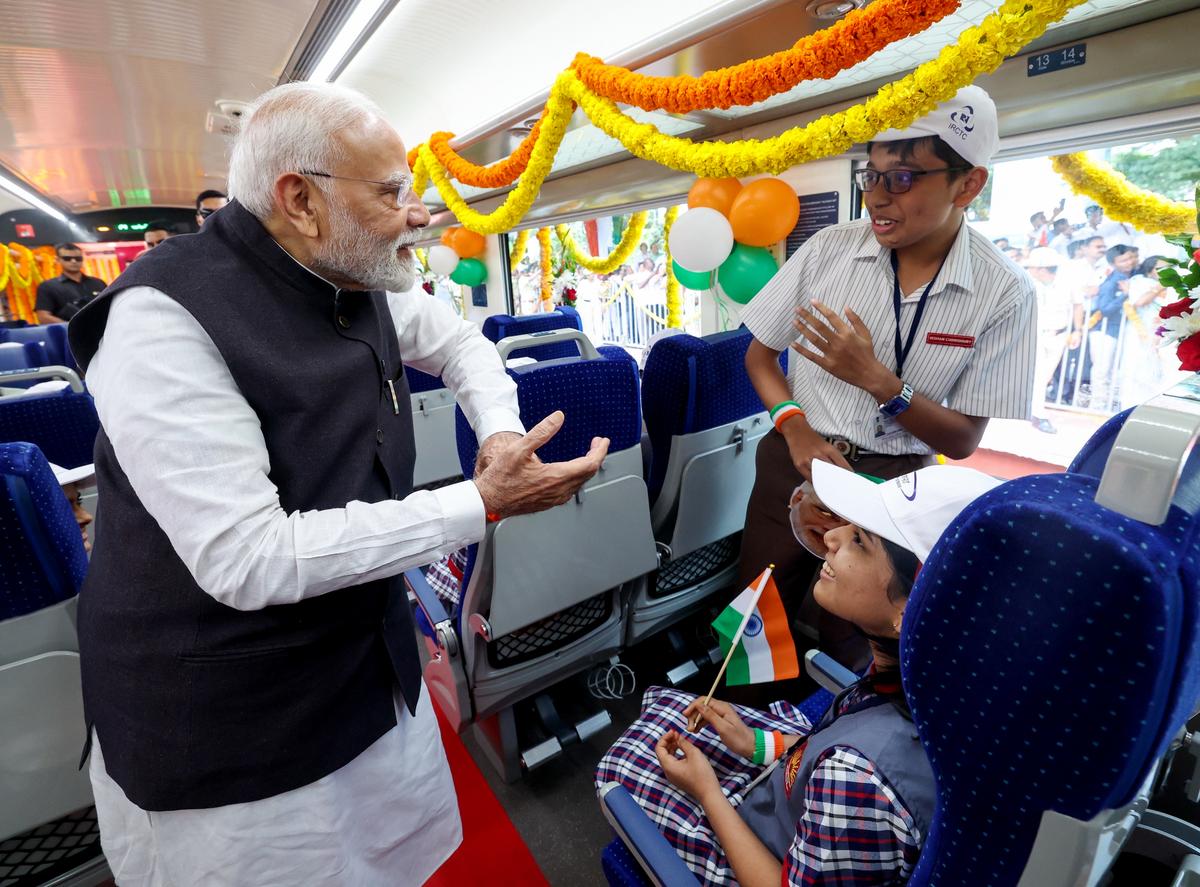
Prime Minister Narendra Modi interacting with children after flagging off Vande Bharat Express trains at KSR Railway Station, Majestic, in Bengaluru on Sunday.
| Photo Credit:
SPECIAL ARRANGEMENT
:
Bengaluru’s long wait for the Yellow Line of Namma Metro finally ended on Sunday, as Prime Minister Narendra Modi inaugurated the 19.15-km corridor linking R.V. Road to Bommasandra.
With this, the metro network in the city went up to 96 km. Bengaluru Metro is currently the second-largest metro network in the country after the Delhi Metro, which covers 353.3 km.
The Prime Minister also flagged off the Vande Bharat Express between Bengaluru and Belagavi, along with two other Vande Bharat services launched virtually.
The Yellow Line, a key metro link connecting the city’s IT hub in Electronics City and expected to significantly ease traffic congestion at bottlenecks, such as the Silk Board junction, has been plagued by delays since construction began in 2017. Originally envisioned in the 2011 Detailed Project Report prepared by the Delhi Metro Rail Corporation (DMRC), the project was initially scheduled for completion by December 2021.
However, setbacks, including protracted land acquisition, disruptions caused by the COVID-19 pandemic, and delays in rolling stock supply from Chinese manufacturer CRRC Nanjing, pushed the timeline by nearly four years.
The Bangalore Metro Rail Corporation Limited (BMRCL) officials expect the Yellow Line to carry over 2.5 lakh passengers daily once the full fleet of trains is delivered and operational. The corridor integrates with major metro lines at key junctions: R.V. Road (Green Line), Jayadeva Hospital (Pink Line), and Central Silk Board (Blue Line, Phases 2A & 2B).
According to officials, the maximum fare on the Yellow Line, which will start revenue services from Monday, will be ₹60.
Packed schedule of PM
Mr. Modi arrived in Bengaluru on Sunday morning at HAL Airport and then travelled by helicopter to the Indian Air Force Training Command in the city, where he was received by Governor Thaawarchand Gehlot and Chief Minister Siddaramaiah. His first stop was the Krantivira Sangolli Rayanna (KSR) Railway Station in Majestic, where he flagged off three Vande Bharat Express trains, the KSR Bengaluru–Belagavi service, the Shri Mata Vaishno Devi Katra–Amritsar service, and the Nagpur (Ajni)–Pune service, the latter two were launched virtually.
With the launch of the Bengaluru–Belagavi Vande Bharat Express, Karnataka now hosts 11 Vande Bharat services. Covering 611 km in just 8 hours and 30 minutes, the new train reduces travel time by about 1 hour and 20 minutes from KSR Bengaluru to Belagavi, and by around 1 hour and 40 minutes on the return trip, making it a faster and more convenient option compared to existing trains, according to railway officials.
Following the event, the Prime Minister proceeded to Ragigudda Metro Station to inaugurate the Yellow Line. There, he flagged off the inaugural service, tried out the QR code-enabled ticket vending machines, and boarded the metro to Electronics City.
Speaking to The Hindu, a BMRCL official said the train was piloted by a woman loco pilot. “Schoolchildren, metro officials, and some members of the public were also onboard, and Mr. Modi interacted with them during the journey,” the official said.
Namma Metro’s Phase 3
At the end of his metro ride to Infosys Foundation Konappana Agrahara Metro Station, the Prime Minister went to the IIIT Auditorium in Electronics City Phase 1. There, he laid the foundation stone for Namma Metro’s Phase 3, also known as the Orange Line, and addressed a gathering.
The Phase 3 will be fully elevated and is planned to serve underserved areas along Magadi Road and the western portion of the Outer Ring Road. Once completed in 2029, it is projected to accommodate 7.85 lakh commuters daily and will extend Bengaluru’s metro network to 222.2 km, according to BMRCL officials. The project has cleared all mandatory hurdles, receiving Union Cabinet approval in August 2024.
Published – August 10, 2025 08:32 pm IST
[ad_2]
IThe Hindu