[ad_1]
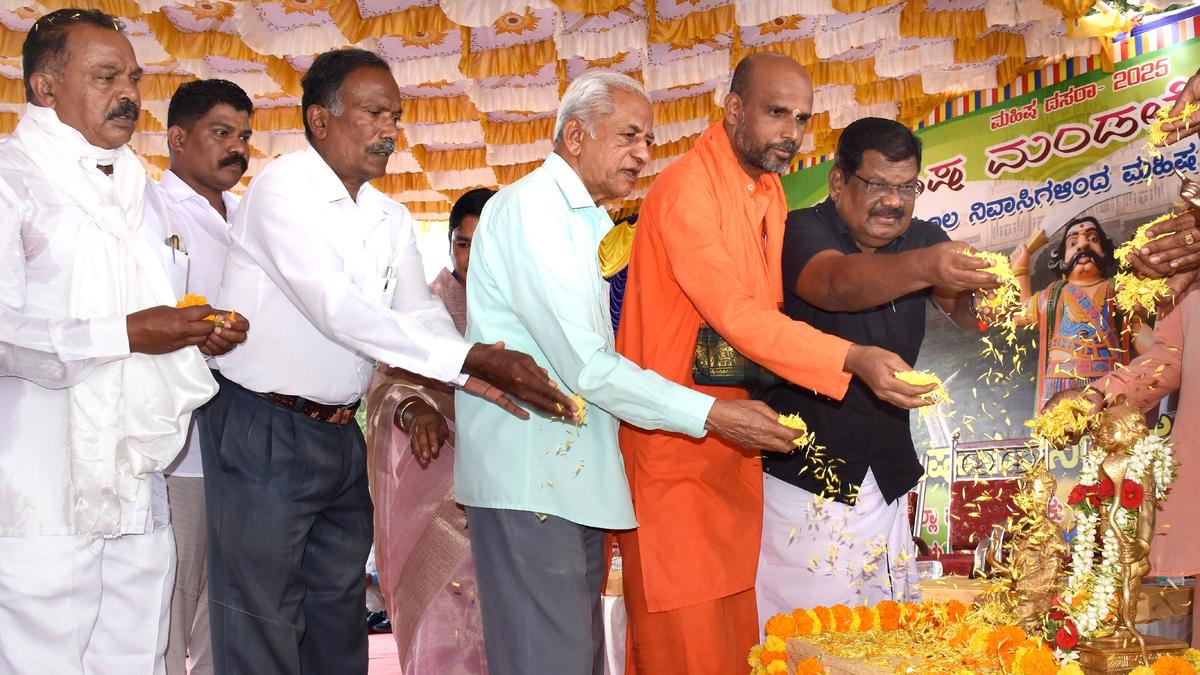
Former Mayor Purushottam (extreme left), writer K.S. Bhagavan (third from right), and seer of Urilinga Peddi Mutt Jnanaprakash Swami (second from right) during the Mahisha Dasara celebrations at Town Hall in Mysuru on Wednesday.
| Photo Credit: M.A. SRIRAM
After celebrating Mahisha Dasara at the Town Hall in Mysuru on Wednesday, the festival’s organising committee adopted three resolutions, including the renaming of Mysuru as ‘Mahisuru’ in memory of Mahisha — the “benevolent Buddhist ruler”.
The Mahisha Mandalotsava Samiti have long held the view that Mahishasura was a “benevolent Buddhist ruler”, whose identity had been “distorted” due to vested interests. They claim that the name Mysuru was derived from the “humanitarian Buddhist ruler Mahisha”, who represented the indigenous people of the region, but wrongly projected as a “demon” vanquished by Goddess Chamundeshwari.
Former Mayor Purushottam, who leads the Mahisha Dasara Organising Committee, told The Hindu that the three resolutions adopted by them on the occasion included the renaming of Mysuru as ‘Mahisuru’, installation of a statue of emperor Ashoka at a suitable place in the city, and the showering of flower petals on the statue of Mahishasura atop the Chamundi Hills every year during the inauguration of the Dasara festival.
Earlier, the Mahisha Dasara was celebrated by offering floral tributes to idols of Buddha, B.R. Ambedkar, and Mahishasura at the Town Hall after the city police imposed prohibitory orders against gathering around the statue of Mahishasura atop Chamundi Hills.
City Police Commissioner Seema Latkar had issued orders imposing prohibitory orders under section 163 of the BNS, 2023, within a radius of 200 metres around the statue of Mahishasura from Tuesday midnight to 6 a.m. on Thursday in view of the Mahisha Dasara celebrations which was scheduled for Wednesday.
The organisers of Mahisha Dasara had sought permission to offer floral tributes to the statue of Mahishasura as part of the celebrations.
The police said prohibitory orders were imposed in view of the difference of opinion among various organisations regarding the celebration of Mahisha Dasara. “If any organisation or member of the public violates this order and attempts to hold a meeting, function, procession, protest, or rally, such gatherings will be treated as unlawful assemblies, and legal action will be taken against violation of this order,” said the city police in its order issued on Tuesday.
The city police also covered the statue of Mahishasura atop the Chamundi Hills and did not allow the Mahisha Dasara Organising Committee members anywhere near it.
Later, the organisers returned to the Town Hall, where a public meeting was held amid police security.
Jnanaprakash Swami, the seer of Urilinga Peddi Mutt, and writer K.S. Bhagavan were among the speakers at the public meeting.
Jnanaprakash Swami opined that dignitaries participating in the inaugural function of the Mysuru Dasara atop the Chamundi Hills should have offered floral tributes to the statue of Mahishasura.
Urging the government to also allocate funds for Mahisha Dasara, the seer said that the celebration of Mahisha Dasara was their “religious right”, and threatened to file cases against district administration officials for denying them their “rights”.
Published – September 24, 2025 08:22 pm IST
[ad_2]
The Hindu