[ad_1]
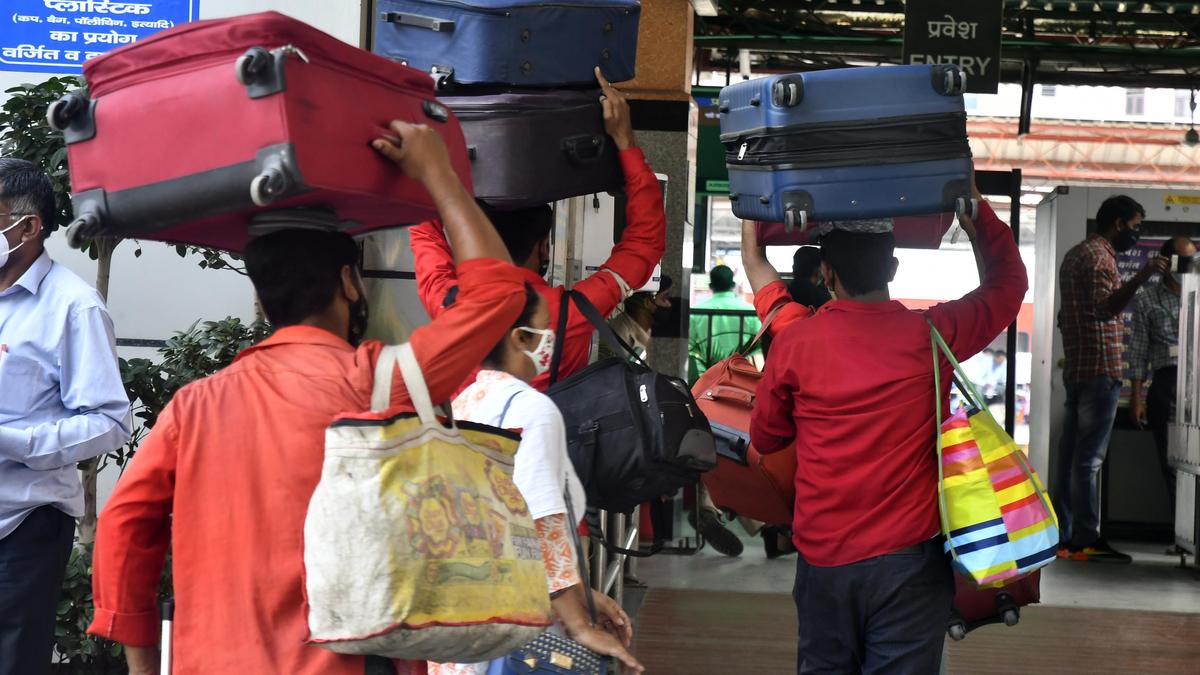
Delhi is home to nearly 2.21 lakh migrants.
| Photo Credit: FILE PHOTO
When the Assembly poll in Jharkhand was held in November last year, 48-year-old Subhash Sahu (name changed), a migrant labourer, went all the way from Delhi to his home State to exercise his right to vote. Two months later, he is back in Delhi and ready to cast his vote on February 5. What allows Mr. Sahu to cast his ballot in two different places are his two voter identity cards, which otherwise is deemed illegal. Mr. Sahu, however, has been using his two cards every election in the two States for two decades now.
He is not alone. A number of migrant workers have been holding on to two voter cards, which, they say, help them avail of welfare schemes in both their home State and their place of employment.
Possessing two or more Electoral Photo Identity Cards, popularly known as voter ID, of more than one area is against the law. Those found in violation may face imprisonment for up to a year, a fine, or both upon detection.
“But who is responsible to ensure that,” argued 27-year-old Rekha De (name changed), who has been working in Delhi for the past six years. A native of Bardhaman in West Bengal, she said that she too votes in her home State as well as Delhi.
Ms. De said her primary gig as a cook in Chittaranjan Park and Kalkaji helps her make ₹20,000 a month but doesn’t offer her a sense of economic security or permanence. “When you are struggling to make ends meet, having two voter cards to avail of government benefits is far from unfair,” she said.
A beneficiary of the Lakshmir Bhandar scheme, a West Bengal government scheme providing financial aid to women, she is waiting for the Aam Aadmi Party government to roll out the Mukhyamantri Mahila Samman Yojana of ₹2,100 per month in Delhi in its “next tenure”.
As the Election Commission continues to raise concerns over fake voter documents and encourages people migrating to change the address on their voter ID cards using Form 8A, these workers here explain that not surrendering one ID provides them an opportunity to access a few more benefits.
According to a senior Delhi Police officer, having two Aadhaar cards is legally impossible unless one of the cards is forged, and the person can be booked for forgery under the Bharatiya Nyaya Sanhita. However, having two voter cards is more common than thought.
According to the 2023-24 Economic Survey, the Capital is home to nearly 2.21 lakh migrants. Most of the welfare schemes of the Delhi government require proof of residence.
Vijendra Kumar (name changed), 23, casts his vote in both Delhi and Bihar. Originally from Darbhanga, Mr. Kumar has been availing of the Bihar government’s scheme of ₹1,000 monthly to unemployed youth between the ages of 20 and 25.
There is another incentive, Mr. Kumar said. “The poor, invisible migrant workers suddenly become important for political parties. Their agents happily provide free train tickets so that we can go and vote for them. Of course, who can say no to other inducements,” he said, pointing to newspaper headlines screaming about alleged distribution of cash, shoes and saris by a prominent candidate in Delhi in violation of the poll code.
Published – January 18, 2025 01:15 am IST
[ad_2]
The Hindu