[ad_1]
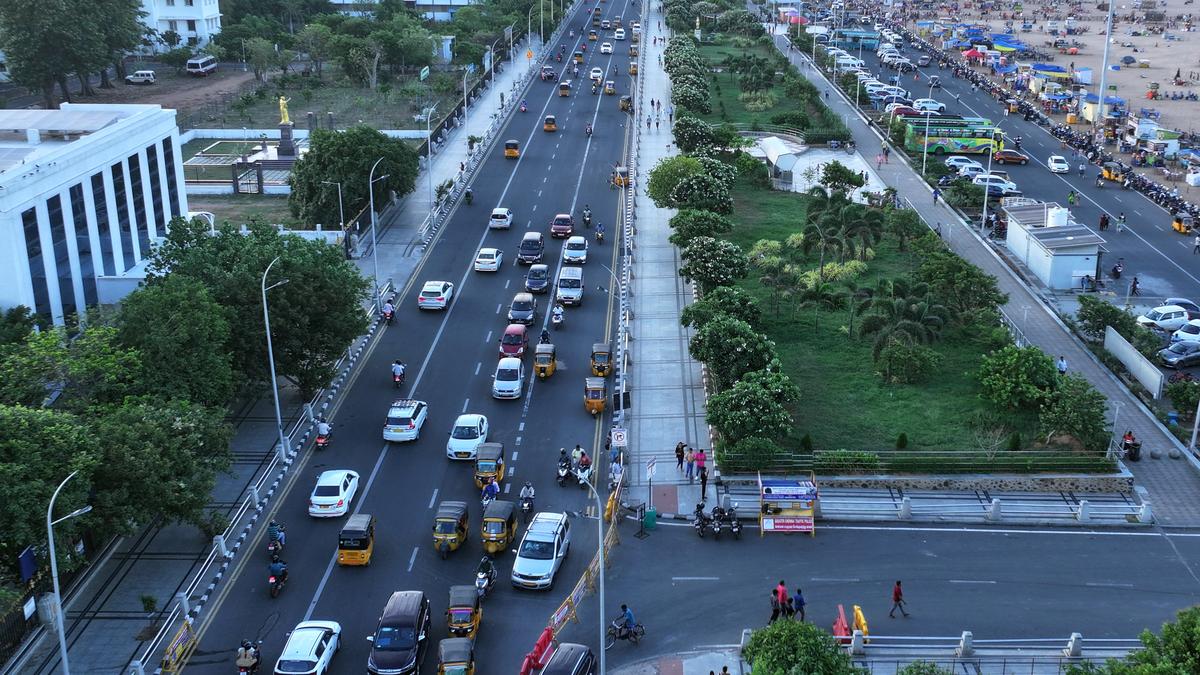
Greater Chennai Corporation proposes to widen Kamarajar salai by reducing the space in the park along Marina beach.
| Photo Credit: B. JOTHI RAMALINGAM
Chennai Corporation has proposed to widen roads including Kamarajar Salai along the Marina Beach to ease traffic congestion in the city.
Kamarajar Salai along the Marina Beach is likely to be widened to eight lanes with a width of 29 metres, by utilising 12595 sq m of space of the park on the eastern side of the road from Light House to Labour Statue. The existing width of the 2.8 km stretch is 23 metre. As many as nine statues along the Marina Beach will be shifted for the road widening project. The civic body will construct new pedestrian subways at various locations along the stretch, civic officials said.
In a bid to ease traffic congestion in Dr.Radhakrishnan Salai, the civic body intends to widen the MRTS Link Street. The bell mouth at the junction of Dr.Radhakrishnan Salai and Kamarajar Salai will be widened. Similarly, the bell mouth at the junction of V.P.Raman Salai and Kamarajar Salai will also be widened. However, the civic body will not widen Dr.Radhakrishnan Salai, which currently a width of 20 metre, officials added.
The civic body will utilise 540 sq m of land from Queen Mary’s College along Dr.Radhakrishnan Salai and 1785 sq m of land from Queen Mary’s College along the MRTS Link Street for the project. The widening of the bell mouth of V.P.Raman Salai at the junction of Dr.Radhakrishnan Salai will require 105 sq m of land from the State Commissionerate for Welfare of the Differently Abled.
Sardar Patel Road
The civic body will also develop slip roads for traffic to enter or exit major carriageways in the city.
As part of efforts to ease traffic congestion in Sardar Patel Road, GCC will develop a slip road from IIT Madras campus to Gandhi Mandapam Bus stop and Anna University Main Gate to Alagappa College of Technology. The width of Sardar Patel Road will increase from 26 metre to 40 metre. IIT Madras will lose 800 sq m of land, Gandhi Mandapam will lose 3800 sq m and Anna University 3800 sq m of land. GCC will also develop a slip road from the Alagappa College of Technology to Gandhi Mandapam Road. Another slip road has been proposed by taking 150 sq m of land in Central Leather Research Institute.
Anna University former professor of Urban Engineering K.P.Subramaniam said: “The primary purpose of the slip road is to segregate traffic on the arterial roads from the local traffic. The slip roads enable safer merging and diverging of local traffic with the arterials. Therefore, slips roads are desirable. Similarly, widening of the bell mouth portions of the junctions are also good. However, widening of the roads such as Kamarajar Salai and Sardar Patel Road throughout should be the last resort. Because, widening will provoke drivers to drive fast causing accident. It will also have a counter productive effect in the sense that it can be done only by reducing, removing or eliminating footpaths and other street furniture. Therefore, widening is not a sustainable solution”.
K.Kumar, former Chief Planner, CMDA and Visiting Faculty, Department of Planning, SAP, Anna University, said: “If every traffic congestion is met with road widening there is no end to it. The root of every traffic woe is the unbridled growth and use of cars. Until and unless the efforts and energies are directed at grappling with this, every investment made might be rendered infructuous.” He said it would be prudent not to do away with the three acre of land from the park on the eastern side along the 2.8 km stretch of Marina beach from Labour Statue to Light House for the road project
“A road with mixed traffic can be reconfigured to operate a high-capacity system. It could be a BRTS or LRTS. Alternatively it could also be the Autonomous Rail Rapid Transit (ART) system, a trackless, rubber-tyred, electronically guided system. It operates like a tram but runs on a virtual track. It is in operation in Zhuzhou, Hunan Province since 2018 and has expanded to other Chinese cities,” he noted.
Published – June 16, 2025 12:34 am IST
[ad_2]
The Hindu