[ad_1]
JSW Energy Ltd’s stock fell by over 6% on Wednesday after its December-quarter results came as a big disappointment even as power generation by the company shot up 10% year-on-year to 6.8 billion units.
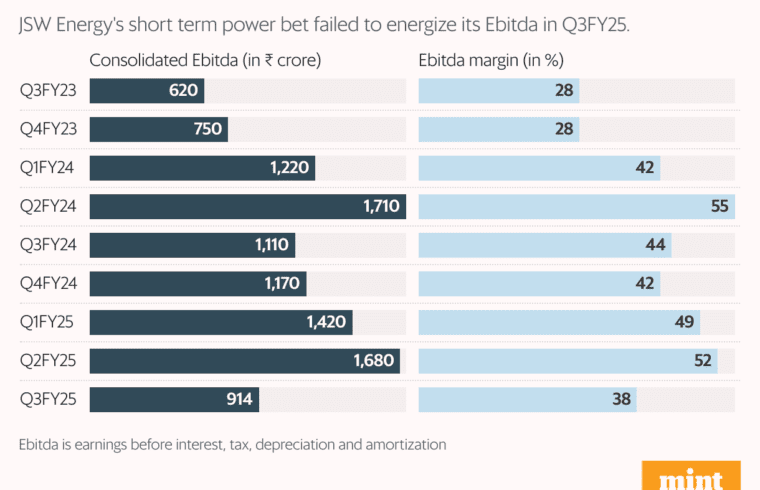
JSW Energy’s consolidated Ebitda fell as much as 18% year-on-year to ₹914 crore, with its margin slipping to 37.5% from 43.7% a year ago. The primary villain in this story was short-term power realizations, which fell sharply. Short-term power rates are volatile and impact profitability, even though most of JSW Energy’s capacity is locked in with long-term power purchase agreements.
Average merchant power rates in the third quarter at the power exchanges declined 26% year-on-year to ₹3.71 per unit owing to better availability of hydro power and firm power.
As such, JSW Energy has not disclosed its own merchant power realization per unit. Adding to its profitability woes was an 18% rise in employee costs and 26% in other expenses.
For the thermal capacity segment, operating revenue makes little sense because fuel cost is pass-through in nature due to the fluctuations in coal price. Simply put, higher coal prices means higher power rates (boosting sales) and vice versa. Thus, power generation volume and Ebitda are key numbers to track.

While long-term thermal power generation volume was up 4%, short-term thermal power generation grew by a robust 23% to 1 billion units. JSW Energy had additional volumes from unit 1 of the Utkal plant with a capacity of 350 MW. Still, thermal segment Ebitda fell 25% to ₹513 crore as the impact of higher volumes was offset by lower realization.
Thermal power generation volume should pick up in the fourth quarter as unit 2 of Utkal with 350 MW capacity was commissioned on 15 January. The acquisition of KSK Mahanadi Power Co., which has 3,600 MW thermal power plant in Chhattisgarh, should also offer a growth push.
Renewable power generation was up 18% to 1.6 billion units, but revenue fell 1% to ₹538 crore and Ebitda was down 2% at ₹382 crore. JSW Energy attributed the flat performance to lower revenue at hydro plants resulting from tariff revision.
Also read |Incentives and recoveries fuel NTPC’s Q3. Execution remains crucial
Lower capex
During JSW Energy’s post-earnings call, the management stated that the company could reach an operating capacity of 14 GW by June once KSK Mahanadi and O2 Power come into the fold. While the management did not give any guidance for incremental annual Ebitda from the KSK acquisition citing non-disclosure agreements, it could be around ₹2,600 crore, based on JSW Energy’s FY24 results.
Over the next couple of quarters, JSW Energy has to pay a total acquisition cost of ₹28,000 crore— ₹16,000 crore for KSK and ₹12,000 crore for O2. So, it was obvious to expect a scaling down of organic growth in capital expenditure. The management has lowered its capex target for FY25 to ₹10,000 crore from ₹15,000 crore.
After hitting a high of ₹805 in September, the JSW Energy stock has fallen by almost 40% in four months. The decline in shares post the third-quarter results was accompanied by frenzied trading activity in the stock, with volumes surging to three times the average trading volumes of 30 days.
Against this backdrop, Jefferies India has slashed its view on JSW Energy’s FY26-FY27 estimated Ebitda by 6-7% to account for lower merchant tariffs. The brokerage also cut its share price target for JSW Energy by 25% to ₹680. The stock ended Wednesday down 6% at ₹475 per share, while the benchmark Sensex index gained 0.83%.
Also read |Dahlias project sets the stage for DLF’s rosy FY25 exit
[ad_2]
Live Mint