[ad_1]

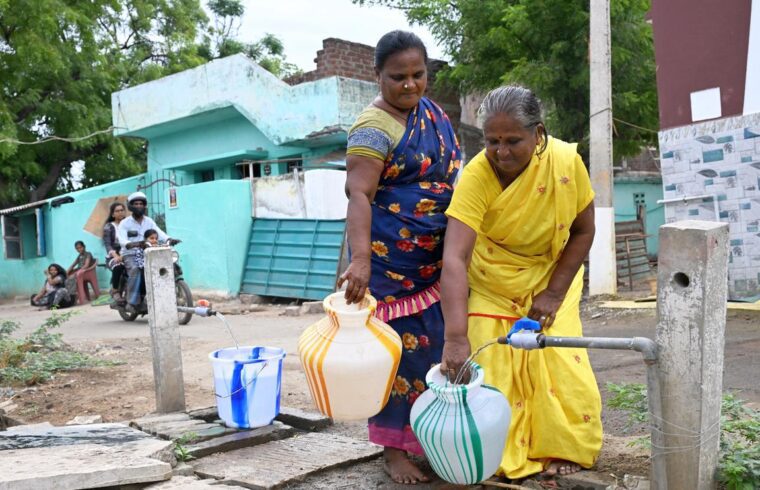
Woman fetching water through Jal Jeevan Mission pipes at Malaichamypuram near Y. Othakadai in Madurai.
| Photo Credit:
R. ASHOK
On a bright sunny day in Madurai, M. Malliga, mother of three children, with two water-filled pots, one on her head and the other in her hand, rushed to her house to pacify her child weeping in search of her mother.
She drew water from a nearby spring that remained in a waterbody after the water completely drained in the summer.
Though her home at Thenkudipatti in Kambur panchayat of Melur taluk has a water connection provided through the Jal Jeevan Mission, she relied on the natural water source for drinking and cooking purposes.
All the 100 houses in the village have water connections under the JJM scheme, but the reliance on natural water resources for the villagers continues.
JJM was envisioned to provide safe and adequate drinking water through individual tap connections to all households in rural India.
“The programme also aims to implement source sustainability measures as mandatory elements, such as recharge and reuse through grey water management, water conservation, rainwater harvesting. The JJM will be based on a community approach to water and will include extensive information, education and communication as a key component of the mission,” the official Government of India website said.
The project was reportedly announced with an estimated outlay of ₹3.6 lakh crore by Prime Minister Narendra Modi in 2019. The primary objective, as he said, was to provide Functional Household Tap Connections (FHTC), which provides at least 55 litres of water per person per day.
A JJM data pointed out that nearly 75% of rural homes now have water tap connections, but less than half the villages have 100% FHTCs.
According to Madurai Member of Parliament Su. Venkatesan, the scheme was not properly planned to be a holistic project to include all aspects of it.
Raising the inefficiency in implementing the project, Mr. Venkatesan, during a recent District Development Coordination and Monitoring Committee (DISHA) meeting in Madurai, directed the officials to find out the gaps in implementation and rectify it.
Despite the funds being allocated periodically and households being earmarked for the connections, many villages, despite having a tap connection, did not get water connections for more than three years.
S. Suresh, a resident of Keezhachinnampatti near Alanganallur, said that almost all 50 houses in their location got tap connections a year ago.
“Despite repeated petitions and requests to the officials, the residents got the water supply only a week ago,” he lamented.
Unlike residents of Thenkudipatti, the residents of Keezhachinnampatti who had no water sources other than a broken water pipe, spent hours together to even fill half their pots from leakage.
Mr. Suresh, who expressed a sigh of relief over getting the water supply, said though they were happy about getting water at their doorsteps, the quality of water was questionable.
“When we cook rice using the water we get from the tap, it turns yellowish. For drinking purposes too, it is unfit,” he added.
Noting that they use the water only for washing and bathing, he stated that they were buying water from the private water suppliers who visit their street every morning.
Though it costs them ₹30 per pot, they spend it for the well-being of their family and health, he said.
The Rural Evidence and Learning for Water (REAL-Water) programme for USAID published a report on JJM in 2013 questioning the long-term sustainability of drinking water schemes and their water sources.
It added that the rural drinking water progress was “hampered by a lack of local planning and rushed efforts to achieve 2024 deadline.”
Reflecting on the overall planning of the JJM, Mr. Venkatesan said that the execution part of the project was not planned as it was for distribution.
“It is not a road project where the only aim is to provide a transport facility,” he added.
Though it had worked well in a few places, it was a failure in a maximum number of areas. “The importance given to distribution was not given to deciding the water source and the quality of water,” he noted.
S. Saravanakumar, Senior Project Executive, DHAN foundation, said that the pipe installation works were mostly completed, but the project to match the water needs of public would take at least 10 years.
“Though we worry about the poor quality of water, the concept of safe drinking water does not exist anymore,” he added.
As both the Vaigai and Cauvery drinking water projects were not completed entirely, even most urban households depend on private water suppliers or purified water cans, he stated.
“Most of the JJM connections entirely get their water supply from either nearby water resources or bore facilities in the locality. So, no one can ensure that they get water with a drinking standard,” Mr. Saravanakumar noted.
However, District Rural Development Agency (DRDA) officials said that though many places were yet to get a water supply, it was an ongoing process.
As per the 2023 date of GOI, of the total 4.49 lakh rural households in Madurai district, 2.62 lakh households had potable tap water supply.
The DRDA official noted that the main aim of the project is to improve the tap water connections and the water source to the supplies will be reviewed periodically based on the needs.
Published – July 20, 2025 08:38 pm IST
[ad_2]
The Hindu