[ad_1]
The sun is already high in the sky, beating down fiercely on our heads, when we reach Tipu Sultan’s Summer Palace in Chamrajpet, Bengaluru. But inside the beautiful high-ceilinged structure, it is surprisingly pleasant, the interiors airy and light-filled. According to a plaque outside the two-storied edifice made out of wood, stone, mortar and plaster, construction here was started by Hyder Ali Khan in 1781 and completed by his son, Tipu Sultan, in 1791, eight years before the Tiger of Mysore would be killed by the British in 1799.
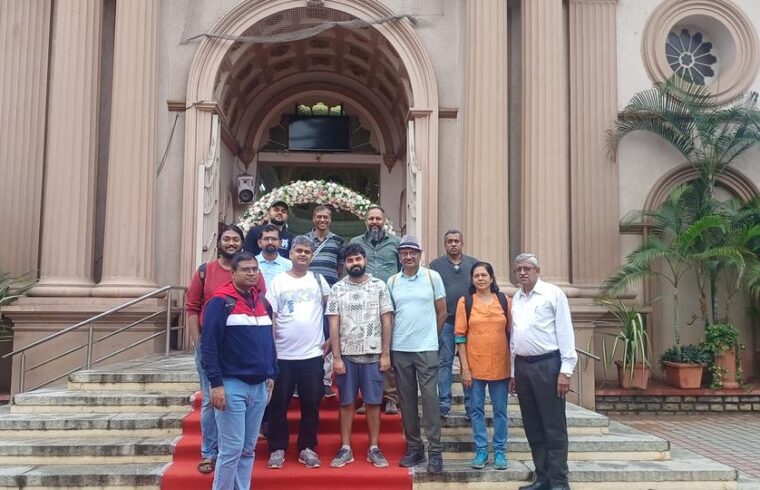
“It was finished just a few years before he lost the fourth Anglo-Mysore War. While he kept his zenana of women here, he was mostly out fighting various battles. So, he couldn’t enjoy it for long,“ says heritage enthusiast and fourth-generation Bengalurean Sunil Pichamuthu, who is leading this heritage walk titled ‘KYC Bangalore@ War Walk, ’ an exploration of the city’s fort and pete area and how British colonisation shaped them.
This walk, says Sunil, is part of a regular set of walks, which will cover both the cantonment and pete area. “There are a lot of history walks happening in Bengaluru now, but they often focus on the more popular locations. Many other aspects of the city remain uncovered,” argues Sunil, who has been interested in the city’s history since childhood, especially its colonial past. “If you look at it, Bengaluru has been largely shaped by it, whether for good or for bad. We have to acknowledge this,” he says.

Participants from KYC Bangalore@ War Walk.
| Photo Credit:
SPECIAL ARRANGEMENT
Tipu’s palace
At the palace, we walk past the intricately carved teak pillars, multiple arches and embellished walls so typical of Indo-Islamic architecture, pausing to admire the vestiges of floral motifs still lingering on the walls under the layers of grime and proclamations of endearing love (an unfortunate, somewhat ironical, contemporary addition to most Indian monuments) scratched onto them.
Adjacent to the palace is the Vijayanagara-style Kote Venkataramana Temple, the construction of which was completed by King Chikka Devaraja Wadiyar in 1689. Pointing to the temple, Sunil notes that Tipu himself was its patron, illustrating the complexity of the ruler’s religious policy that continues to shape modern rhetoric around his legacy.
Four intricately carved wooden staircases open into a large hall with four rooms believed to be the Zenana quarters, overlooking bright-green lawns.
“Did you know the British set up a gym in this palace?” asks Sunil, adding that it was supposed to be a way to distract and bring discipline to the officers. We spill down one of the wooden staircases and enter a small museum on the ground floor, crammed with artefacts, including old sketches of the palace by the military artist James Hunter and a replica of Tipu’s Tiger (the original is in the British Museum) depicting a man in European costume being mauled by a tiger, clearly emblematic of his deep hatred for the British East India Company.
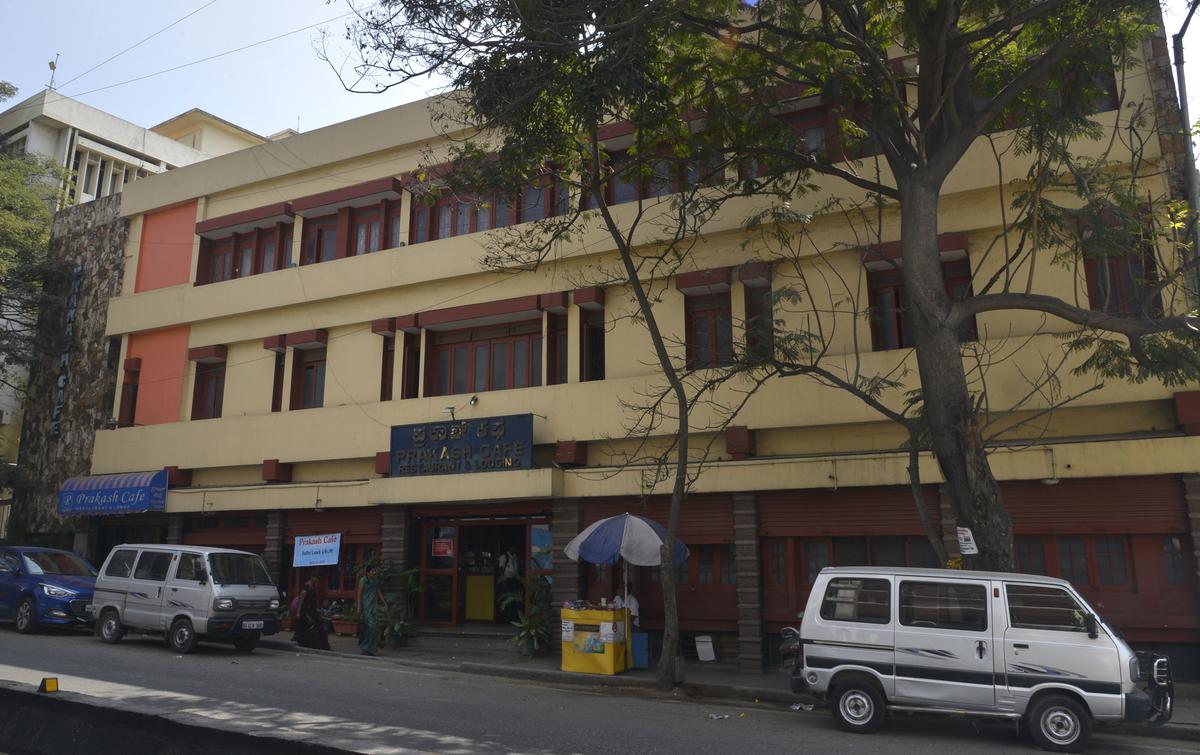
A file photo of Prakash Cafe in Chamarajapet.
| Photo Credit:
File Photo
Battles and more
The Kingdom of Mysore’s multiple battles with the British, not surprisingly, come up repeatedly on this walk, which traverses several important historical sites in the Chamrajapet and its surrounding areas, including St. Joseph’s Church at Briand Square, Prakash Cafe, the Bangalore Fort and Rice Memoria Church. Sunil touches upon the Anglo-Mysore wars the British East India Company fought, first with Hyder Ali and later his son Tipu Sultan. For instance, a small plaque at the fort highlights a breach in its walls where “the British assault was delivered” during the Third Anglo-Mysore War, fought between Tipu Sultan and the Company led by Lord Cornwallis.
After Tipu’s defeat and his death in the Fourth Anglo-Mysore War in 1799, the British restored the Wadiyar dynasty to the throne and established their garrison at Seringapatam (as Srirangapatna was called then by the British) before shifting their base to Bengaluru within a few years. “Initially, some of their troops were in the fort area, but after the Vellore Mutiny in 1806, they decided to move outside of the pete and set up a cantonment,” explains Sunil, adding that the cantonment was planned by Lieutenant John Blakiston who led the galloper guns from Bangalore to Vellore and put down the Vellore Mutiny, the first large-scale sepoy uprising against the British.
In addition to the feud between Tipu and the British, which has played such an enormous role in shaping the city’s built, political, religious, cultural and social histories, the four-hour-long walk also offered stories about other important historical destinations in the area. At St. Joseph’s Church at Briand Square, one of the oldest churches in the city, where the walk begins, we learn that it is the only one in the city with a crypt, while in Prakash cafe, a few yards away, we discover sepia-toned photographs of famous people, including Dr. Homi J. Bhabha, K. Changalaraya Reddy, Jayachamarajendra Wadiyar and Sardar Patel.
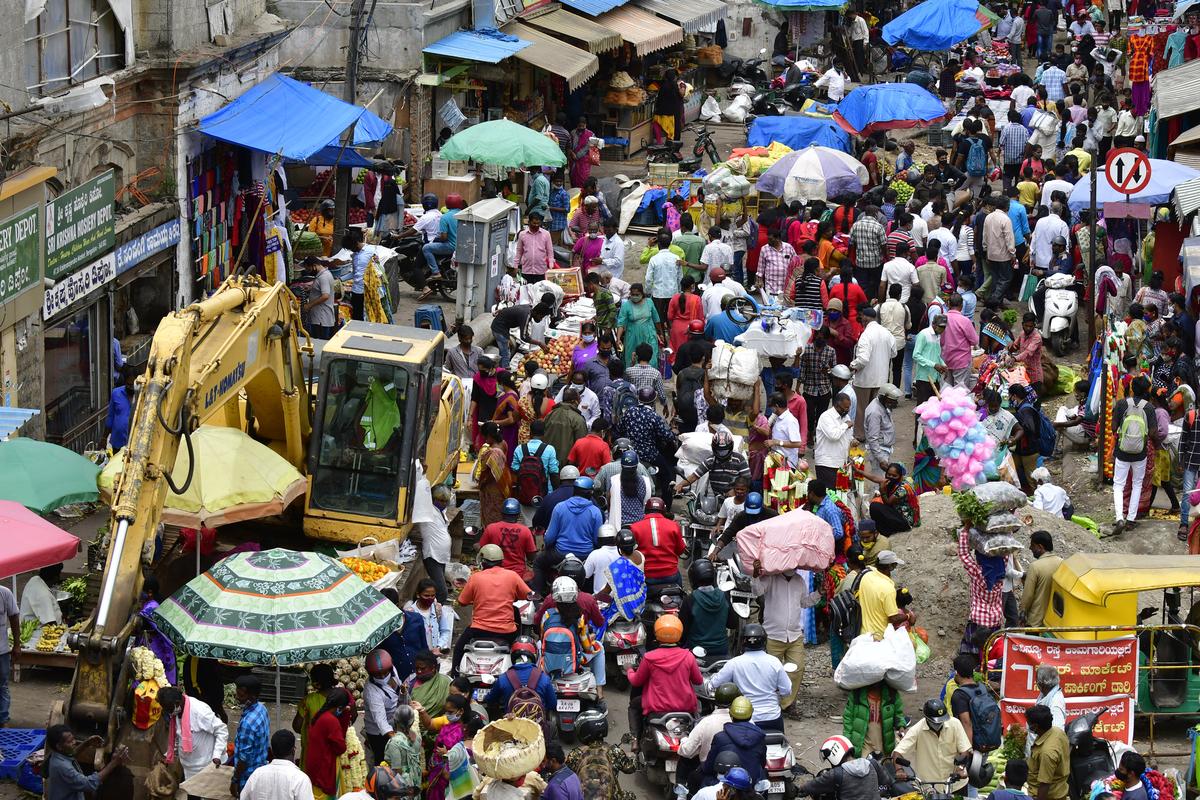
A file photo of K.R. market.
| Photo Credit:
File Photo
Other learnings
There were other discoveries made by the participants during the walk, including the legacy of the evangelist Christian Friedrich Schwartz, who often acted as the intermediary between Mysore and the British; the contributions of Dr. M. Mary Ratnamma Isaac, India’s first lady surgeon; and how many stones were taken from the fort were repurposed into other important buildings such as the Minto Ophthalmic Hospital.
We also stop to examine the Banni Nodi project at the K.R. market metro station, “a wayfaring and signage project (that) seamlessly integrates historical storytelling and functional navigation information to showcase the rich historicity of Bengaluru city and its evolution over the last five centuries,” says the curatorial note about the project. It adds that the fort area has “long been the epicentre of powerful dynastic influences, witnessing the realisation of their dreams and visions, which laid the foundation of the city we know today as Bengaluru.”
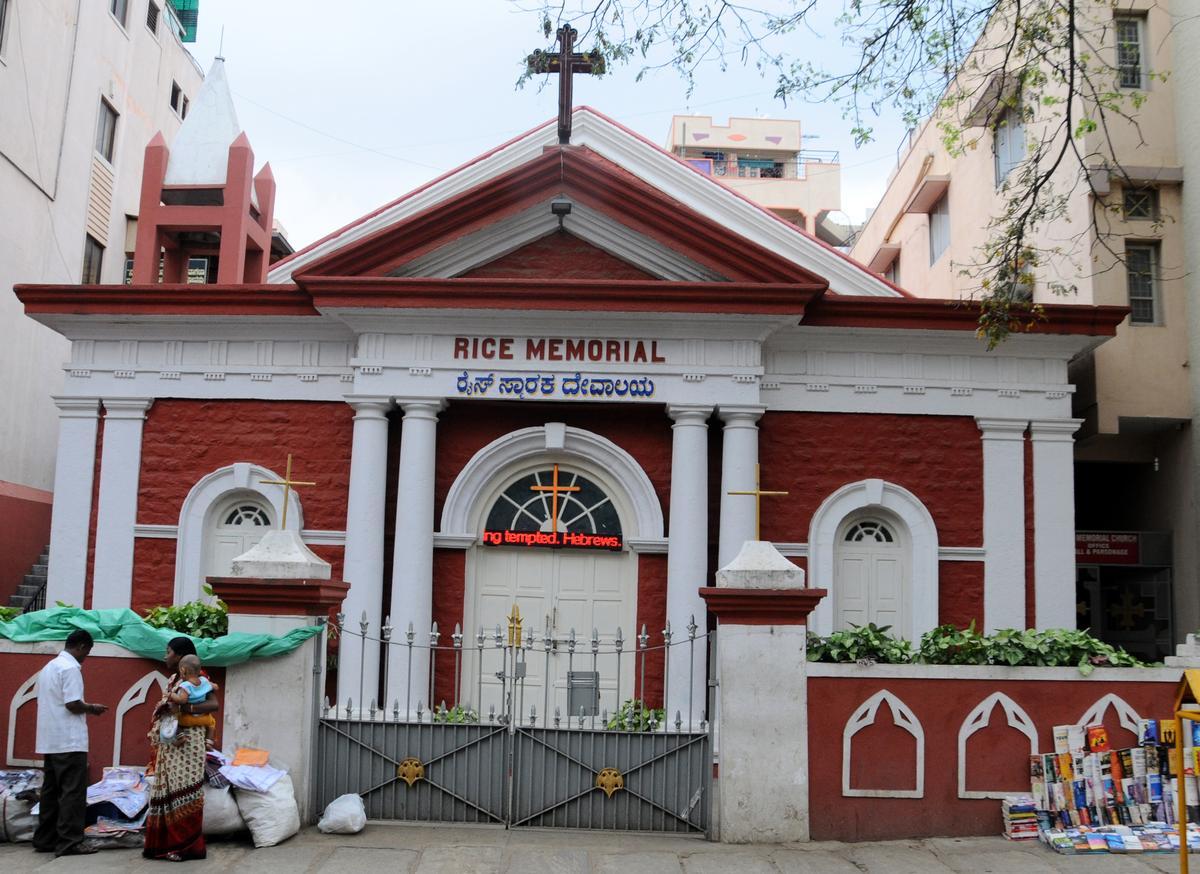
Rice Memorial Church on Palace Road in Bengaluru.
| Photo Credit:
FILE PHOTO
Remembering Rice
The walk ends at the CSI Rice Memorial Church located on the chaotic Avenue Road, a red-painted chapel built in the European Classical style, which is “sacred to the memory of the Reverend Benjamin Rice for 50 years missionary of the London Missionary Society in Bangalore,” says a marble plaque in the church, under a photograph of the man himself, referring to him as “an excellent Kanarese preacher.”
Sunil further explains that Rice, who taught himself Kannada, was instrumental in establishing the first Kannada church in Bengaluru (sermons are conducted in Kannada to this day). “He had gotten into the social fabric of India and was able to do a lot of translations, including the translation of the Bible into Kannada,” elaborates Sunil. In the 1860s, when Rice’s first wife passed away, he built a chapel in the pete area in her name. In 1917, when this chapel moved to its current location on Avenue Road, it “was in memory of Rev Benjamin Rice,” adds Sunil.
Published – March 27, 2025 09:00 am IST
[ad_2]
The Hindu