[ad_1]
The Delhi High Court will hear on Tuesday a plea by one of the 17 students of Jamia Millia Islamia (JMI) against her suspension. The students were suspended earlier this month for “protesting without prior permission” and “defacing public property”. They had been staging demonstrations against the university’s order banning protests and meetings without permission and the suspension of four PhD scholars for holding a demonstration on December 15, 2024, the fifth anniversary of clashes between the anti-CAA protesters and police on the JMI campus.
In her plea filed on March 1, Umehabbeeba Quadri, a second-semester BA (Hons.) student of Persian studies at the Faculty of Humanities and Languages, asked JMI to provide videos to substantiate the claims of vandalism and defacement. She also stated, “The atmosphere on the campus has become regressive, and denial of the freedom of speech has become routine. All attempts to obtain permission for holding meetings where speakers are invited to make presentations regarding human rights issues and other relevant issues are being denied.”
More students are expected to move the court over the coming days individually seeking the revocation of their suspensions.
Niranjan, another of the suspended students who identified themselves as the ‘Jamia Seventeen’ in their protests against suspensions, said, “Activities such as demonstrations or cultural discussions are not allowed on the campus.”
He added that JMI students used to commemorate the clash between the police and the students every year. “However, this is the first time that show-cause notices were issued by the university administration for observing December 15 as the ‘Resistance Day’.”
Mr. Niranjan also spoke about the lack of a representative student body at the university.
The JMI held the last student elections in 2005. The following year, it banned the poll, saying that the students’ union was “exercising power in areas where it had no jurisdiction”. In 2011, a student went to court against the university’s decision. The matter is still sub-judice.
‘Attack on dissent’
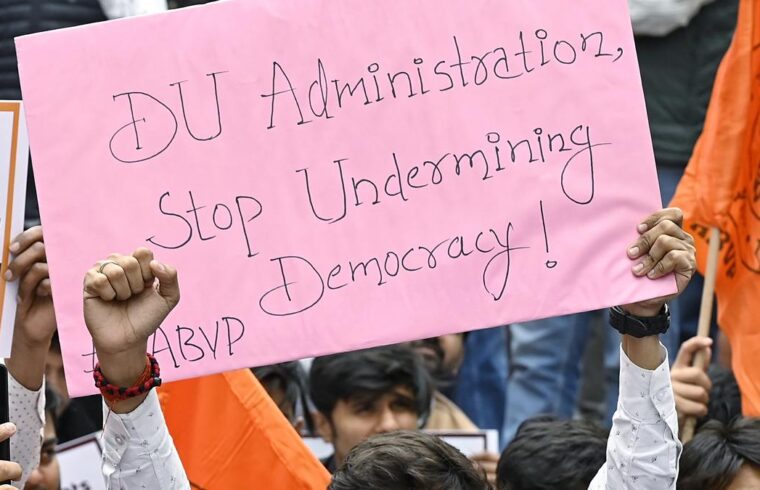
Students at Jamia say theirs is not an isolated case. They cite instances like the Delhi University administration considering “two-tier, indirect” student union elections and Jawaharlal Nehru University (JNU) delaying the notification of the student body polls to argue that the space for democracy and dissent on campuses is shrinking.
“Till now, the students of JNU and DU were being illegally detained. Now, the system is coming after us. The action against us is a direct attack on the voices of dissent. The government wants to finish democratic spaces on campuses,” said Uthara, a suspended JMI student.
Speaking about the alleged delay in conducting the JNU Students’ Union (JNUSU) polls, its current president, Dhananjay said, “This is reflective of a larger trend where universities across the country are making excuses to delay or not hold student union elections.”
The JNUSU held a torchlight protest on the campus on February 24 over the alleged delay in notifying the JNUSU elections. Last year, the notification was issued on January 23, with the polls being held on March 22 and the results being announced two days later.
When reached for comment, the university said it had filed a petition before the Delhi High Court seeking clarity over the Lyngdoh Committee Report on the conduct of the student poll.
The JNUSU members also decried the administration’s 2023 notification imposing a ₹20,000 fine on students who participate “in a hunger strike, dharna or any other form of protest within 100 metres of any academic and administrative complex” to argue that “demonstrations are now becoming increasingly difficult to organise”.
Echoing his sentiments, Moushumi Basu, the JNU Teachers’ Association president, said a teachers’ union election has not been held since 2022.
Two-tier polls
Meanwhile, in the case of the DU Students’ Union (DUSU), the Delhi High Court, in November last year, suggested two-tier elections in order to prevent the defacement of public property and “money and muscle power”. The university’s Executive Council presented this suggestion in the minutes of its January 17 meeting. The proposal came up for discussion in the EC’s meeting last week, leading to an outcry among students and teachers.
Under the proposal, colleges, departments, centres, and institutes may hold elections at their own level, following which the presidents and central councillors would participate in the election for the DUSU panel.
The vice president of the All India Students’ Association’s DU unit, Sanatan, said, “This proposal stems from the Centre’s anti-union stance. Most educational institutions don’t have a union as of now, and the Centre knows that it can’t disband DUSU so easily, so it is introducing this model to hollow out the students’ union.”
Speaking on the issue, a university official said that the reforms were suggested by the High Court and added, “But the democratic process will continue.”
Officials did not confirm whether the proposal will be discussed further.
Ashish Lamba, president of the Congress-backed National Students’ Union of India, alleged, “Students are being intimidated not just through the fear of being implicated in fabricated cases, they are being kept away from protests by teachers threatening to deduct the marks of those seen at protests.”
Published – March 04, 2025 01:30 am IST
[ad_2]
The Hindu