[ad_1]
In stark contrast to the names of social reformer E.V. Ramasamy alias Thanthai Periyar and Hindu ideologue V.D. Savarkar being taken mostly on political platforms, the Madras High Court former Chief Justice (CJ) A.P. Shah discussed their ideologies at a legal gathering in Chennai on Thursday.
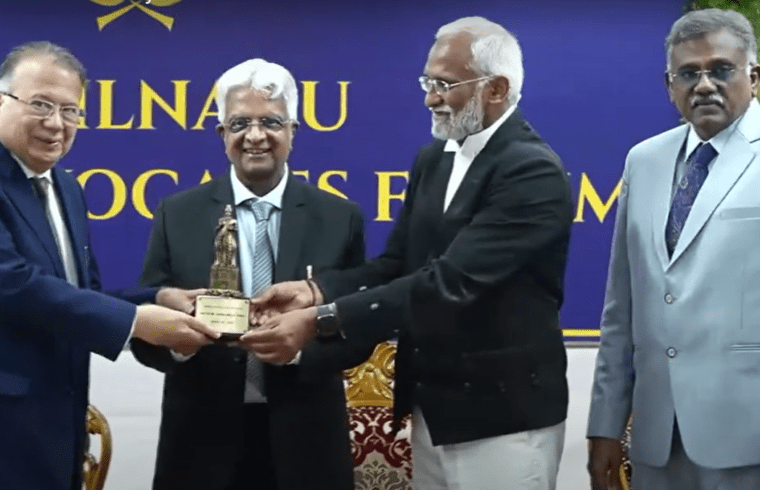
Delivering a lecture organised by Tamil Nadu Senior Advocates Forum (TNSAF) on ‘Constitution, Secularism and the Supreme Court,’ Mr. Shah said, the topic of the lecture was of paramount importance in a diverse and pluralistic society and that secularism in India was very different from its western counterparts.
“India’s secularism is complex and multi dimensional. It is much more than tolerance and certainly not merely Hindu tolerance. It represents equal respect to all and equal treatment of all, regardless of their religious beliefs thereby activley promoting social justice,” he said.
Periyar’s secularism
Stating that his visit to the Madras High Court, after about 16 years since he served as its Chief Justice between 2005 and 2008, made him recall the views of Periyar on the subject, the former CJ said, Periyar approached secularism less as a political ideal and more as a prerequisite for social justice and equality.
“Periyar’s nationalism was rooted in its critique of Brahminical domination and religious superstition. He emphasized on the paramount importance of reasoning and the intelligence born out of dissentment. For him, secularism was linked to this rational faculty which made people question oppressive social norms and religious dogmas that perpetuated inequality, Justice (Retd.) Shah said.
He went on to state: “For him (Periyar), true social reform entailed a secular, rationalist approach that challenged traditional power structure. Periyar’s secularism difered greatly from that of the Constituent Assembly which focused on the State’s neutrality towards religion and protection of religious freedom. Periyar spoke of an individual’s right to be free from constraints by religion. Periyar’s secularism, while perhaps less concerned with the Constituent Assembly, reminds us that the true purpose of secularism is to create a society where everyone is treated with dignity and respect regardless of religious beliefs.”
The former Chief Justice told the gathering that with increasing religious extremism, communal tensions and the politicisation of faith taking place at present, a renewed focus on secularism’s core value and the constitutional framework becomes imperative. He said, the Constitution of India was designed to navigate the complexities of State impartiality and protection of religous freedom and equality, regardless of faith.
Constituent Assembly debates
Referring to the Constitutent Assembly debates, he said: “Secularism was foundational to the idea of India as the only way to forge a united nation from a diverse populous. Political leaders, particularly with partition, recognised the need to transcend religious and communal divisions. Secularism was thus not just a political expediency but a moral imperative.”
Indian constitutional secularism was not just unique but had also exhibited polarisation. “A framework for religious harmony has perversely fueled endless conflict. Differing interpretations have led to disputes around religious conversions, uniform civil code and the management of religious institutions. These are not mere academic debates but flashpoints of deep seated societal divisions. Political actors stoop and exploit religious sentiments blurring lines between faith and electoral strategy,” he lamented.
Justice (Retd.) Shah went on to exhort: ‘Promises of equal treatment ring hollow for religious minorities facing marginalisation. Sectarian nationalism is pushing for a majoritarian agenda. Surely, this is a crisis that demands immediate examination. And surely, there is no better time than now to confront fundamental questions about the viability of secularism in India.”
Supreme Court’s role
The Supreme Court plays a pivotal role in defining religious boundaries and shaping India’s secular landscape, but its interventions were not seamless, and sometimes inconsistent, thereby inviting an examination into its roles in upholding secular principles, he said.
Recalling the 1994 landmark decision of a a nine-judge Bench of the Supreme Court in S.R. Bommai’s case, he said, while validating the dismissal of three BJP ruled State governments following the Babri Masjid demolition, that judgement enshrined secularism as a part of the basic structure of the Constitution. He rued that the judgment was being often overlooked in contemporary discourse.
Highlighting that the judgment made crucial observations regarding separation of religion and the State, the former CJ said: “Those words just ring true today. The rise of fundamentalism and communalisation of politics are anti secularism.”
Justice (Retd.) Shah also discussed the verdicts delivered by the Supreme Court in Shirur Mutt case (1954) which laid down the essential religious practices (ERP) test, Sri Venkataramana Devaru case (1958) and the three significant judgements delivered by former Chief Justice of India P.B. Gajendragadkar in Dargah Committee versus Hussain Ali (1961), Sri Govindlalji versus State of Rajasthan (1963) and Shastri Yagnapurushadji versus Mooldas (1966) with the last case famously known as the Harijan entry case.
“These marked a notable shift in defining and regulating religious practices. For the first time, a distinction was made between superstitious beliefs and religious practices. This was a move towards judicial rationalisation and willingness on the part of judges to challenge traditional interpretation of religious practices,” he said.
Supreme Court’s intervention in religious matters peaked between the 1960s and 1990s. The 1990s saw a spate of litigations involving shrines like Tirupati, Vaishno Devi and Kasi Vishwanath. The court was pretty consistent in upholding nationalisation of temples. “In my view, this temple takeover is a project which needs to be revisited because it has led to politicisation of sacred spaces,” he added.
Savarkar differentiated between Hindutva & Hinduism
Referring to a set of seven verdicts, popularly referred to as the Hindutva cases, delivered by the Supreme Court between 1995 and 1996, Justice (Retd.) Shah said, then, Justice J.S. Verma had controversially equated Hindutva with Hinduism and with Indianness and described it to be a way of life and not a political or religious agenda. He had relied on an inclusivist understanding of Hinduism that emphasized tolerance and universality.
“Justice Verma’s interpretation problematically ignored the stand of Hindutva as articulated by V.D. Savarkar and M.S. Golwalkar. As an young adult, I have read all of Savarkar’s works in original. My maternal grandfather was a president of All India Hindu Mahasabha. So, Savarkar’s concept of Hindutva was fundamentally territorial,” Mr. Shah said and quoted from an essay penned by Savarkar on Hindutva.
“He defined the Hindu as the one whose land of ancestary (i.e., pithrbhumi) and of religion (i.e., punyabhumi) lay within the geographical boundries of India. In contrast, Muslims and Christians are foreigners for they are not indigenous and their religion originated in a different land. Savarkar himself said that Hindutva is not identical with what is vaguely indicated by the term Hinduism… Ignoring Savarkar’s own distinction, Justive Verama conflated the terms. His judgement failed to recognise Hindutva as a political ideology, a fact recognised even by its proponent Savarkar,” Justice (Retd.) Shah said.
This distinction was vital since equating Hindutva with Hinduism blurs the line between religious identity and political agenda. ‘The way of life’ metaphor helps legitimize the Hindu nationalist narrative with Hindutva equalling Indianness. This judgement of Justice J.S. Verma allowed Hindu groups to claim that their ideology was merely of Indian culture and not any distinct political agenda.
“Now, see the effect. This marginalised minority identities and perspectives as the Indian way of life becomes synonymous with Hindu cultural norms. So, you will see that a Uniform Civil Code is practically the implication of the Hindu law. Ultimately, Justice Verma’s decision demonstrates the difficulty in interpreting complex socio political terms within a legal framework. While his intentions might have been to prevent the misuse of religious rhetoric, in effect, it created more ambiguity and potentially legitimised communal appeals,” Justice (Retd.) Shah opined.
Ayodhya, Gyanvapi cases
Expressing his disppointment over the Supreme Court’s Ayodhya verdict too, the former Chief Justice said: “When the five-judge Bench delivered the judgement, it appeared like a definitive end to a 135-year-old legal saga. The subsequent construction of the Ram Mandir with its pran prathistha, a grand spectacle attended even by some of the judges who authored the verdict appeared to signal closure. But the Ayodhya chapter is far from closed. It demands critical examinaiton especially at a legal gathering like this… Despite the temple’s construction, the issues that fuelled the dispute continue to simmer reminding us that we may still not have achieved complete societal reconciliation.”
“The Supreme Court ultimately held that the Babri Masjid (mosque) was constructed in 1558 but rejected the claim that it was constructed after demolishing a temple which was reportedly in existence over there. So, the whole political narrative that a Masjid came after demolishing a Ram Mandir was rejected by the Supreme Court. It also firmly accepted that overnight, in December 1949, Hindu idols were installed in the mosque and that the 1992 demolition of the mosque was unlawful,” Justice (Retd.) Shah pointed out.
He expressed shock over a 116-page addenda having been added to the Ayodhya verdict without disclosing which of the five-judges in the Bench had authored it. “We don’t know who that judge was among the five. Such an addenda according to me is highly unusual and impermissible and unknown to judgement wirting in India,” the former CJ said.
Observing that the Ayodhya verdict had done little to quell underlying socio political tensions, he said, it could be seen in a host of other cases such as the Gyanvapi mosque case that had arisen now.
Constitutional patriotism is true nationalism
Further, referring to the triple talaq and the Karnataka hijab ban cases, he said: “Cases like these are not just legal battles. They define the very soul of our nation. Delays on issues like constitutional validity of the Places of Worship Act or the Citizenship Amendment Act or the unresolved constitutional validity of Love Jihad laws have all been lingering for years. They erode public trust and create climate of fear.”
In these situations, the Supreme Court’s role as a guardian of fundamental rights becomes absolutely crucial. “Protecting secularism, the bedrock of our Constitution, is the greatest challenge and the geatest responsibility of the Supreme Court. But laws alone cannot create a truly secular society… We must challenge forces of religious orthodoxy and communalism. True nationalism is not about erasing history or rewriting narratives to fit particular agenda. True nationalism is about embracing our diverse heritage, foistering empathy and respecting the right to dissent. It is also about constitutional patriotism. A deep seated fidelity to constitutional principles, not blind loyalty to the State or its current leaders,” he said.
Justice (Retd.) Shah concluded his lecture by urging: “We cannot allow ourselves to be consumed by endless debates about our historical grievances and religious disputes when far more pressing issues like poverty, unemployment and social inequality demand urgent attention. We owe it to the future generation to build a nation where the principles of secularism, democracy and freedom are not merely abstract concepts or words on paper but lived in reality by every citizen regardless of their background or belief.”
Published – March 14, 2025 04:17 pm IST
[ad_2]
IThe Hindu