[ad_1]
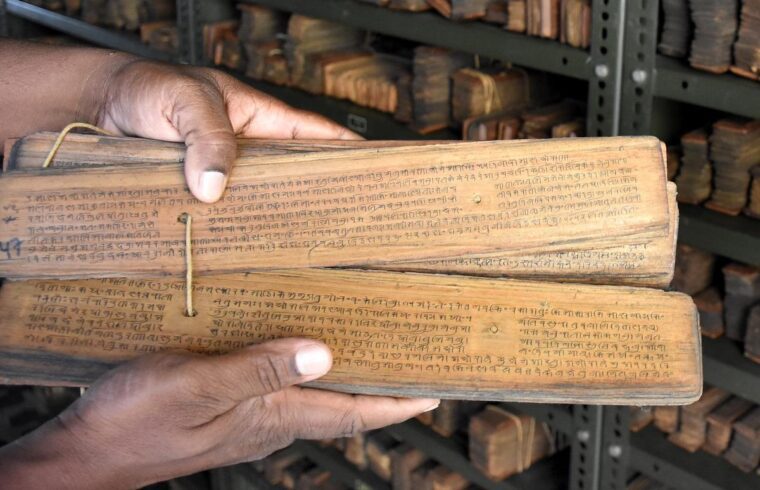
The Oriental Research Institute in Mysuru, which has a vast collection of centuries-old palm leaf manuscripts, is set to unlock a slice of India’s ancient knowledge to scholars around the world for research and further studies.
For, the project to digitise the palm leaf manuscripts – which contain a wealth of Indological material ranging from Indian culture, philosophy to science and literature – and taken up by the Mythic Society, Bengaluru, is nearing completion.
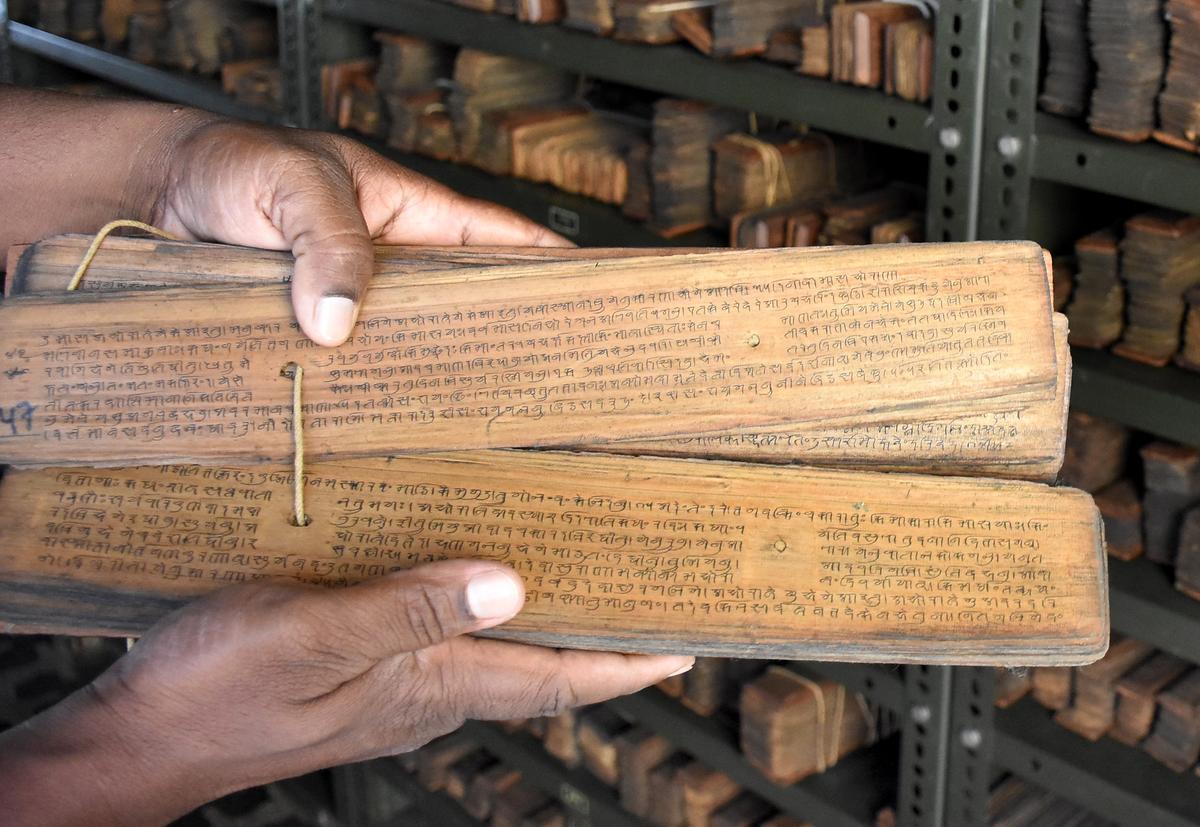
A sample of a manuscript inscribed on palm leaves and preserved at the Oriental Research Institute in Mysuru.
| Photo Credit:
SRIRAM MA
15,000 bundles
The ORI is a repository of nearly 15,000 bundles of palm leaf manuscripts enshrining nearly 70,000 works of a bygone era. The collection encompasses a wide gamut of subjects that constitute a slice of human and India’s intellectual heritage, and is country’s priceless asset.
The palm leaf manuscripts are entirely in Sanskrit though the script is Kannada, Tigalari, Granthalipi and Nandininagari according to ORI Director D.P. Madhusudhanacharya who pointed out that the literary works encapsule a range of subjects from Vedanta and Upanishads to Rasayanashastra or ancient Indian chemistry; Ramayana and Mahabharata to Bhagavad Gita, Mathematics to art and architecture.
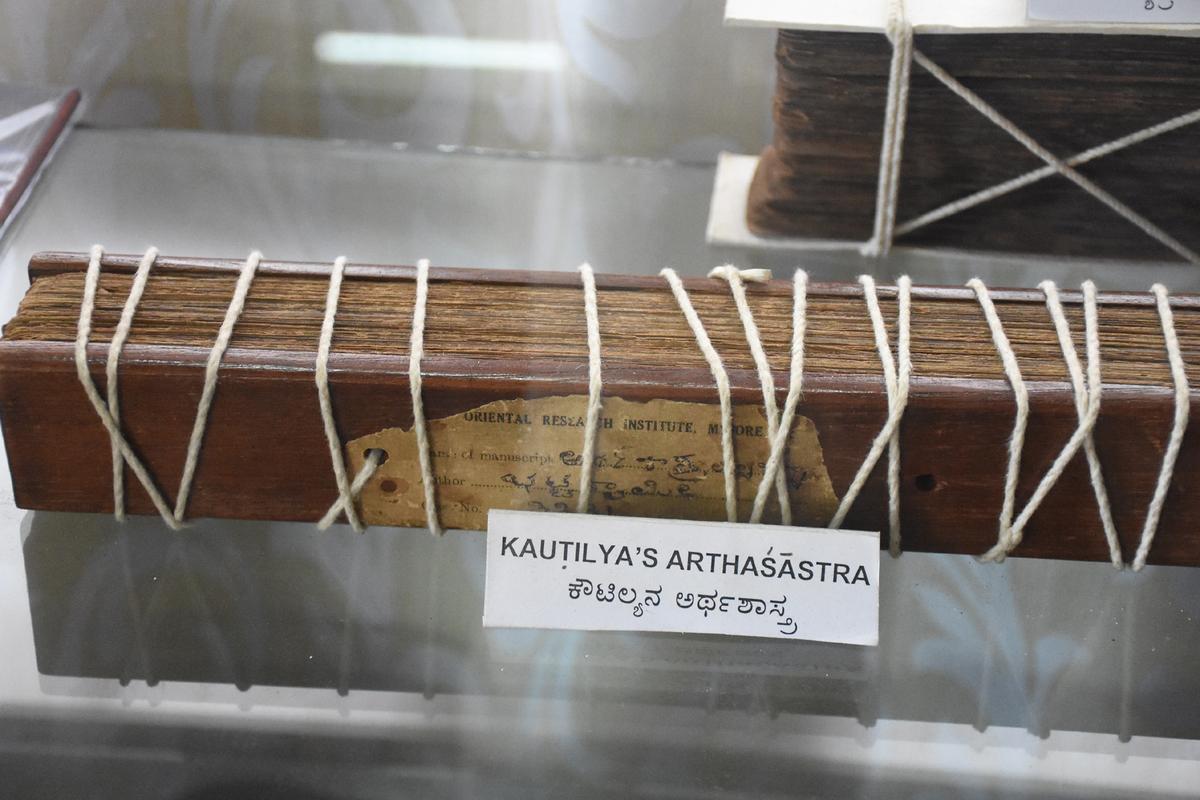
Palm leaf manuscript of Kautilyas Arthashastra preserved in Oriental Research Institute in Mysuru.
| Photo Credit:
SRIRAM MA
A key find
But it was the discovery of Kautilya’s Arthashastra by renowned scholar Dr. Rudrapatna Shamashastry in 1905 that catapulted the ORI into international prominence.
It was first published in Sanskrit in 1909 and in English in 1915 and changed the western and prevailing notion among historians, that ancient India lacked political statecraft or sound governance rooted in codified treatise.
The original work is believed to correspond with the date of the rule of Chandragupta Maurya in the 4th century BCE and is attributed to Chanakya or Kautilya. However, scholars are divided over both the date and the authorship and aver that it was the work of several authors spanning centuries.
Some of the manuscripts at ORI are nearly 800 years old but most of them are 300 to 500 years old. And there was the possibility of the manuscripts being lost to posterity as they tend to become brittle over time and decay due to natural process.
It was then that the digitisation project was conceived and after many false starts, it was finally taken up in association with the Mythic Society, Bengaluru.
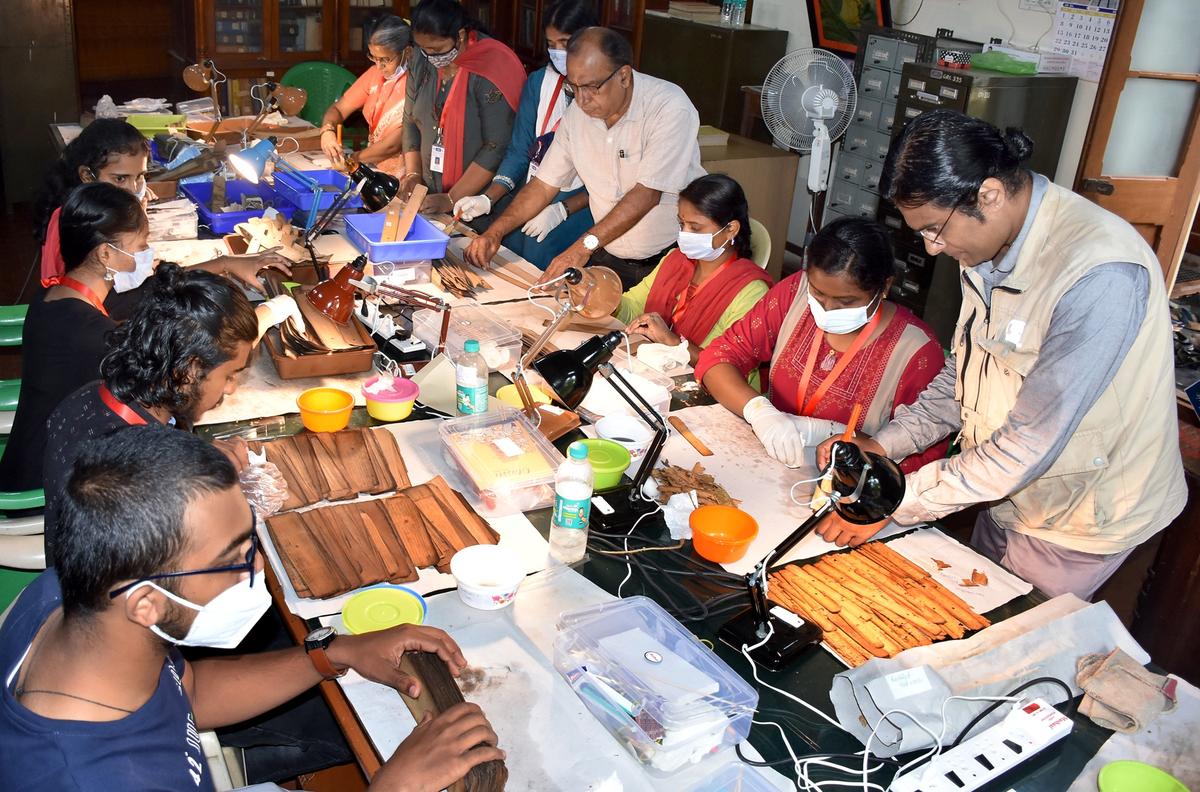
Treatment of palm leaf manuscripts as part of the digitization project at the Oriental Research Institute in Mysuru.
| Photo Credit:
SRIRAM MA
Technical guide to project
S. Ravi, Secretary of the Mythic Society said that the ORI – which functions under the University of Mysore – entered into a memorandum of understanding with it in 2022 and technical methodology was approved after a lot of research by S. Subbaraman who is the technical guide for the project.
A Padma Shri awardee, Mr. Subbaraman, who is in his 90s and retired as the Superintending Archaeological Chemist from the Archaeological Survey of India, had worked in the restoration of Bamiyan Buddha in Afghanistan from 1969 to 1977, restoration of Ajanta paintings, conservation work at Jain caves of the 9th century near Vadamathimangalam, close to Tirumalai in Tamil Nadu etc.
The conservation methodology validated by Mr. Subbaraman, has been adopted for the treatment and preservation of the manuscripts and it entailed three stages, said Mr. Ravi. Cleaning using eco-friendly chemicals and applying lemon grass oil and making the scripts more readable, establishing a fumigation centre and finally digitizing the manuscripts, he added.
Then nearly 15,000 bundles of palm leaf manuscripts had about 12.50 lakh folios and as the writing was on both sides of each folio, about 2.5 million images had to be scanned, edited and the soft copies are now on hard disc, explained Mr. Ravi.
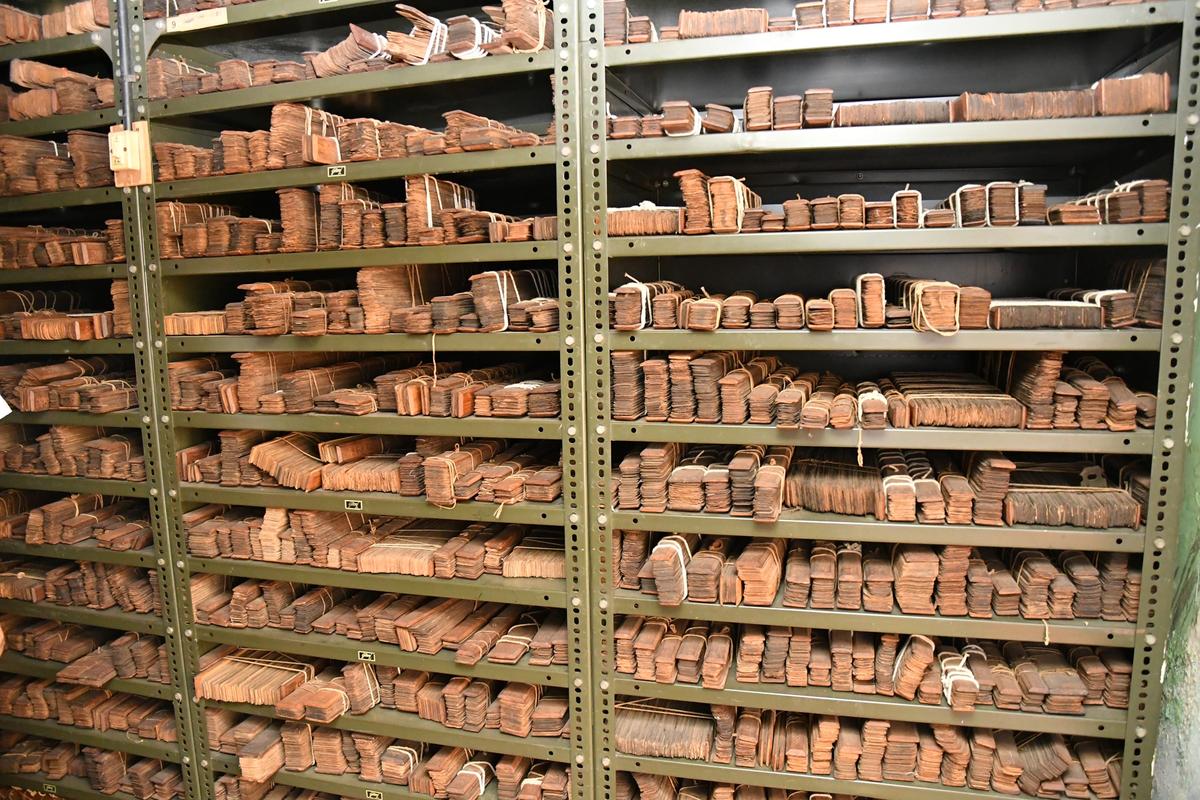
Palm leaf manuscripts are classified and arranged in bundles at the Oriental Research Institute in Mysuru.
| Photo Credit:
SRIRAM MA
Paper manuscripts too
But not many are aware that apart from palm leaf manuscripts, the ORI also possesses about 5000 paper manuscripts and they are now in the process of being digitised. Described as one of the biggest digitisation exercises taken up in India, the Mythic Society has invested more than ₹2 crore on the project.
Nearly 40 women – who were trained – and came from economically weaker section of society – were trained in conservation exercise and deployed by the Mythic Society, and this also enabled the workers to earn a living.
Dr. Madhusudancharya said that once the digitisation project is completed – within the next few months – the ORI, which has already prepared a detailed catalogue of the works in its collections, will upload it (catalogue).
‘’This will enable scholars and researchers from anywhere in the world to scour through the list and place a request for any work to take up further studies or for use as reference. But it will come with a fee to be fixed by the University of Mysore,’’ he added.
Long overdue
One of the most ambitious projects undertaken in the field of digitisation of palm leaf manuscripts, the exercise was long overdue as the folios were getting brittle due to repeated physical handling and the process of natural decay.
And notwithstanding the physical conservation of these priceless manuscripts taken up in the past, there was a threat that it could be lost to posterity.
But with the digitisation exercise almost completed, it will help extend the lifespan of these manuscripts as the availability of the soft copy will also obviate the need to handle them physically.
And apart from safeguarding the centuries of scholarship of ancient India and a slice of intellectual heritage enshrined in these manuscripts, the digitisation will also make the works available for a wider audience and promote further studies and research, to understand the past.
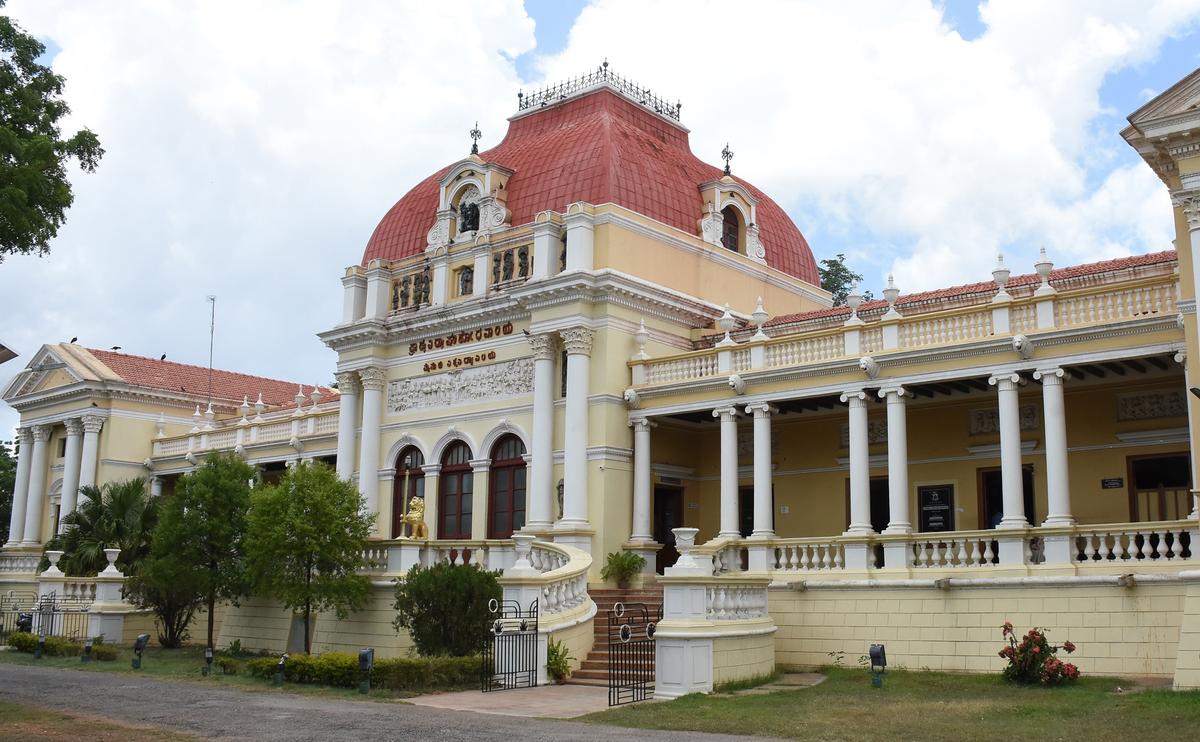
The Oriental Research Institute in Mysuru which has a treasure trove of palm-leaf manuscripts in its collections.
| Photo Credit:
SRIRAM MA
Treasure trove of 50,000 books
The Oriental Research Institute (ORI) which is known for its collection of palm leaf manuscripts, also has 50,000 books most of which are out of print, or difficult to come by and access, in the present times.
The books are in various languages and these works too will be digitised and uploaded to the website to enable scholars to access them for reference and research. The ORI has signed an MoU with Chennai-based Save Our Country Foundation for the purpose and the project will take three years to be completed.
As a research centre, the ORI also intends to publish many works that are out of print and bring out new releases from its archives, according to Pandit D.P. Madhusudhanacharya, Director, ORI.
The Central Sanskrit University, Delhi, has donated ₹45 lakh under Ashtadasi scheme to publish Jagannatha Vijaya and Tattwa Chintamani which are being edited and translated by well-known Sanskrit scholar Dr. H.V. Nagaraja Rao. Almost, 50% of the editing and translation is complete.
The Indian Knowledge System of the Ministry of Education, Government of India, has donated ₹12 lakh to publish rate books that include Rajadharma Sangraha, Dasharathanandana Charitam, Bhojaraja Charucharya, a treatise on health by the 11th century CE scholar king of Malwa region; and Vedanta Siddhantamutavalli. These rare works are slated for release in June 2025 and already four scholars are working on it.
Another rare work of great scholarship is Sritattvanidhi authored by Mummadi Krishnaraja Wadiyar (1794-1868) who ruled over Mysuru kingdom for almost 70 years. It is a unique encyclopaedia with illustrations and is in 9 parts.
The ORI has already published four parts of the treatise and the fifth one is due for release in February. The remaining four parts will be ready for print within a year and scholar T.V. Satyanarayana Rao, and others are working on it. Besides, the first three volumes of Sritattvanidhi are out of print and Ms.Sudha Murthy, author, philanthropist and Rajya Sabha MP, has donated ₹10 lakh for their republication, said Dr. Madhusudanacharya.
A heritage structure from Wadiyar era
The Oriental Research Institute was established by Chamaraja Wadiyar in 1891 and was originally known as The Government Oriental Library. It was under the Department of Education, Government of Mysore, and housed in the Jubilee Hall whose foundation was laid in 1887, to mark 50 years of Queen Victoria’s accession to the British throne. It was inaugurated in 1891.
Evolution of the institution over time
The Government Oriental Library was subsequently brought under the University of Mysore which was established in 1916. In 1946, the name was changed to Oriental Research Institute. A micro-film section was established in 1954 to preserve the palm leaf manuscripts and more than 4000 of them, were microfilmed before digital technology evolved.
It houses some of the rarest books
The ORI shot to international fame when a fully extant copy of Kautiyla’s Arthashastra was first discovered by Rudrapatana Shamashastry in 1905; it was published in Sanskrit in 1909 and in English in 1915. The ORI has thousands of works on different subjects and this includes Lilavathi, a mathematical treatise by Bhaskara II, who lived in the 12th century CE.
Several esoteric books in library
Other rare works in ORI include Ashvavaidyam, whose author is not known, and it a book on treatment of horse diseases; Suryasiddhanta, dealing with celestial objects; Gajayurveda, which deals with therapy for treating elephants; Mayamata, dealing with architecture and description of books, and Kashyapasamhita, which deals with treatment of bites of poisonous reptiles, to name a few.
Help from the U.S. Consulate General
The leaks in the heritage building threatened the safety of the manuscripts and in 2012, the US Consulate General, Chennai, made a grant of 50,000 dollars for renovation. On March 31, 2015, Mr. Richard Verma, who was at that time the US Ambassador to India, inaugurated the renovated building.
Published – January 24, 2025 09:00 am IST
[ad_2]
IThe Hindu