[ad_1]
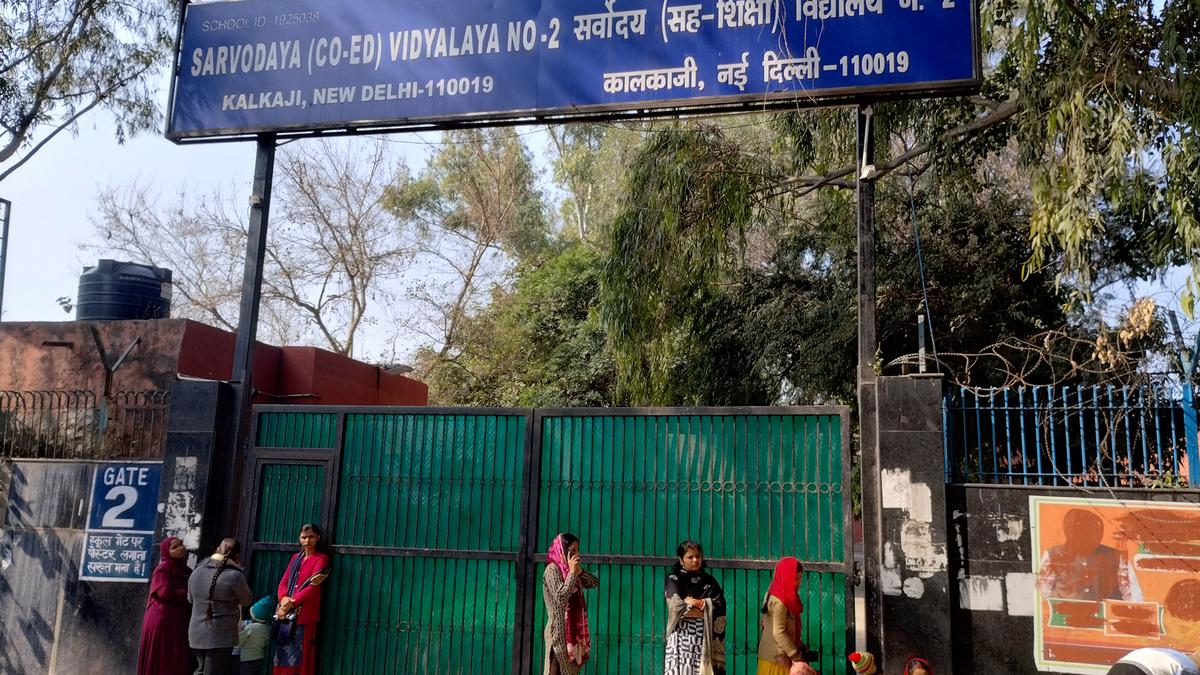
Parents waiting for their children outside a Delhi government school in Kalkaji, the constituency of Delhi Chief Minister Atishi, who also holds the education portfolio.
| Photo Credit: Ashna Butani
One of the major highlights of the “Delhi model”, which the Aam Aadmi Party (AAP) leaders have emphasised in every election campaign, is the “education revolution”.
The party has credited its three-time Patparganj MLA Manish Sisodia, who has held the education portfolio for most of the past 10 years, with bringing about the “revolution”. In February 2023, shortly after he was arrested in an excise policy case, Mr. Sisodia was replaced by Kalkaji legislator Atishi (subsequently appointed the Delhi Chief Minister) as the Education Minister.
While Mr. Sisodia has decided to fight the February 5 Assembly election from Jangpura, for voters in east Delhi’s Patparganj, where AAP has fielded civil services tutor Avadh Ojha this time, the state of schools remains an important issue.
“Schools in our area have been transformed over the last 10 years,” said 32-year-old Kalpana Das, who was waiting for her daughters outside the Delhi Board of School Education (DBSE) in I.P. Extension. “I will vote for the party that will do the most for the future of my children,” she said.
Ms. Das is a homemaker. Her husband works in a private company. “My eldest daughter is studying fashion as a skill subject, and she is interested in pursuing a career in it,” she said, crediting AAP with improving the state of government schools.
However, she is apprehensive about the school’s change of curriculum from the Central Board of Secondary Examination (CBSE) to the DBSE in April last year.
Referring to competitive examinations like CUET, which use the CBSE syllabus, she said, “I am worried because my neighbours have told me that studying from a CBSE school is more helpful when students apply for admission to colleges. But my daughters say that the DBSE prepares them for the future just as well.”
Irshad Ali, 31, a resident of Patparganj’s Kotla village, who works as a shuttle driver for a private school, said, “Education and health are important while voting, but so are the conditions of roads and open drains.” He added that the civic infrastructure in the area was deficient in many aspects. He hopes to admit his children, aged 4 and 5, to “good schools” next year and is open to exploring both government and private schools.
While Mr. Sisodia decided to change constituencies for the upcoming election, the CM, who was elected from Kalkaji in 2020, has stayed put in the south-east Delhi seat. The state of schools is just as prominent in conversations in Patparganj as it is in Kalkaji.
When Chanda Devi came to Delhi from Bihar’s Dharbanga 13 years ago, she did not intend to settle down in the city. However, she changed her mind when it came to taking a call on her daughters’ education. Two of her daughters have graduated from Delhi government-run Sarvodaya Vidyalaya in Kalkaji while two are still studying there.
“The building of the school where my daughters study right now used to have only one floor. Now, it has three. The infrastructure and quality inside has also improved a lot,” she said.
There are two co-ed government schools and one Dr. B.R. Ambedkar School of Specialised Excellence in the same colony.
‘Pursuing their dreams’
“My eldest daughter pursued the commerce stream and came first in her college. My other daughter is now in a Delhi University college and has gone for her exam today,” said Ms. Chanda, adding, “I never got to study, so I’m really happy to see them pursuing their dreams.”
However, several area residents say many other factors, other than education, will decide their vote. For 42-year-old businessman Puneet Singh, who runs two restaurants in Kalkaji, inflation and devaluation of the rupee is a key factor.
Meanwhile, in Jangpura, where AAP won the last two polls, 77-year-old shop owner Ramesh Saini said “broken roads, overflowing sewage, and lack of potable water” are more important to him. After a little thought, he added, “But if Sisodia wins, maybe the focus will shift to schools once again.”
Published – January 27, 2025 01:52 am IST
[ad_2]
The Hindu