[ad_1]
What does it mean to be a lecturer without vision and hearing? Interviewing 45-five-year-old Miranda Tomkinson, who recently was among the awardees at the 23rd edition of the CavinKare Ability Awards, was a humbling experience for this journalist.
Miranda Tomkinson is a lecturer (on contract) in the Department of Special Education at National Institute for Empowerment of Persons with Multiple Disabilities (NIEPMD), taking classes for diploma, B.Ed and M.Ed courses with a majority of the class being populated by able-bodied students.
Miranda speaks fluent English but cannot hear. He is independent and uses public transport for the commute to his workspace in Muttukadu on East Coast Road from his home in Kottivakkam.
Miranda navigates the world of communication with special tools, which include a “refreshable braille” that helps him with text messages, and quick application of mind in sticky situations. While on the telephone with him, he would not want the one on the other side of the line to speak as he can only hear vibrations when someone is talking. If the person wanted to say something, he would want them to type in the message. He could however respond to the message by speaking over a voice call.
Miranda’s story is one of sheer grit. He was born blind and found difficulty in hearing during his middle-school days.
“Teachers those days were not trained to handle students like me but I was good at studies,” says Miranda, adding that his father was deafblind like him.
A happy-go-lucky youth who loved adventures, Miranda studied sociology at Loyola College following which he went on to pursue a B.Ed programme.
“That is when I realised that my hearing loss had gone from bad to worse and I could not listen to lecturers in class,” he recalls.

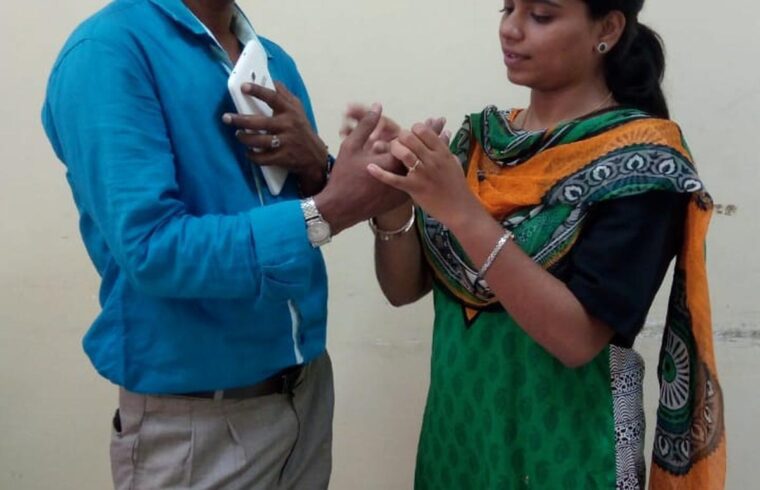
Miranda Tomkinson and Rexy Vinotha
Miranda switched to distance learning but that also was not easy. “I studied public administration but took five years to complete it as I used human readers to help me with subjects. It was a struggle with technology use not being so prevalent back then,” he says.
Search for a job
Then came the challenge in finding jobs. NIEPMD faculty members helped by connecting him to factories but when that was not successful they encouraged him to pursue a masters programme in education (M.Ed) in special education in multiple disabilities. They would help him by getting copies of the notes and converting it into Braille.
Miranda holds three postgraduate degrees and has cleared the UGC NET exams in Sociology and Education.
In 2013, The Hindu wrote about the protracted battle Miranda fought to get a question paper in Braille for an examination conducted by University Grants Commission.
A host of representations to the UGC, an RTI and a case in the Madras High Court paved way for this victory.
However, because of the delay in this case, he lost a fellowship.
“I was also selected for Junior Research Fellowship (JRF) but it turned out to be of little use as I had reached the upper limit,” he says.
The pandemic years were a real struggle for Miranda as he was without work and faced isolation and social distancing.
“I developed a lot of skills because of the challenges I faced, each giving me an opportunity to learn,” says Miranda who dabbles in poetry during his free time.
“In 2022, NIPEMD took me back as a lecturer on a contract basis,” he says.
New teaching methods
With the support of his wife, Miranda has been adopting new teaching methods. Through his blog, YouTube channel, and upcoming book, Miranda advocates for greater inclusion and awareness for individuals with deafblindness and multiple disabilities.
Miranda’s wife Rexy Vinotha, who works in the field of rehabilitation, is overjoyed with this award by Ability Foundation. “Many people questioned my choice when I married Miranda, who was diagonised with Usher Syndrome, so a honour for him is a recognition to me as well,” Rexy says, adding how she has been helping him reach a larger audience through his YouTube channel.
Miranda has been advocating for greater inclusion and awareness for individuals with deafblindness and multiple disabilities through different mediums including books, one on inclusion of deafblind in higher education. “I am working on a book that will feature extraordinary persons with disabilities in India, so I want to collect such success stories,” he says.
The lecturer wants to become an author like Helen Keller. “The United States supported Helen Keller. Who will support me?” he asks.
As of now the director and faculty at NIEPMD have been supporting Miranda in many ways including pushing for the four percentage reservation in government jobs for persons with disability to be implemented so that Miranda would at some point get a permanent job.
K. Balabaskar, a lecturer in Adult Independent Living at NIEPMD, says Miranda has come a long way by virtue of his perseverance and resilience. “For persons with multiple disabilities to grow it is equally important that society extends them compassion,” says Balabaskar.
Published – March 02, 2025 11:15 am IST
[ad_2]
The Hindu