[ad_1]
Chennai Corporation will increase its own source of revenue in the year 2025-2026, with a rise in tax revenue, fee and user charges.
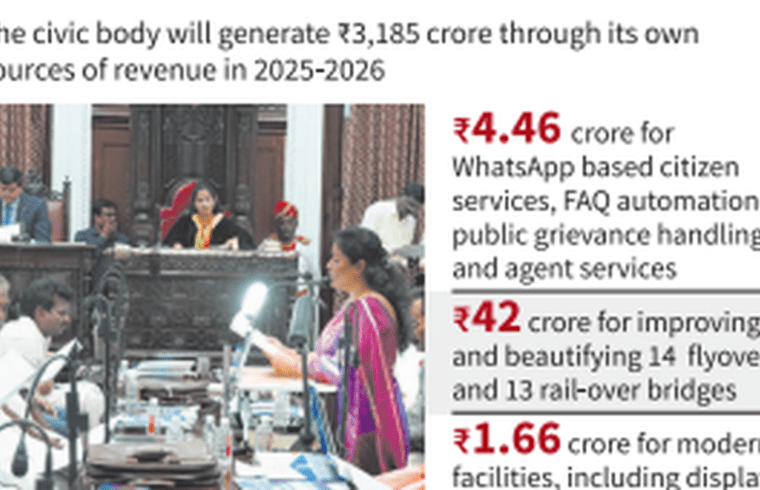
In the ₹8,897-crore Budget 2025-2026 with a deficit of ₹378 crore, the civic body will generate ₹3,185 crore as its own source of revenue in 2025-2026 and will be less dependent on fiscal transfers from government grants for implementing civic infrastructure projects and welfare schemes for residents.
Owing to the steps taken by Chennai Corporation to increase the property tax revenue, the own source of revenue of the civic body has increased from ₹1,615 crore in 2021-2022 to ₹3,052 crore in the revised estimates for 2024-2025.
According to the Budget estimates for 2025-2026, 63% of the Chennai Corporation’s own source of revenue is expected to be generated by the collection of property tax from residential and commercial buildings, while 19% will be through professional tax, 11% user charges and 7% other income.
In 2025-2026, the civic body will mobilise most of the money from tax revenue that is 35%, while loans constitute 15%, capital grants 18%, revenue grants 5%, non-tax revenue 7%, and assigned revenue 20%.
Over 41% of the money will be spent on capital expenditure, particularly for flood mitigation, roads, hospitals, schools and bridges, 24% on operation and maintenance expenses, 29% on establishment expenses, 4% on administrative expenses, 1% on other expenses and 1% on interest and finance charges.
The Comptroller and Auditor General of India had stressed the need for improving the own source of revenue as the Chennai Corporation was able to generate only 53% of its own source of revenue as a percentage of revenue receipts between 2015-2016 and 2019-2020.
Challenge ahead
In recent years, there is a rising trend in the own source of revenue as a percentage of total revenue receipts estimated at 62% in 2025-2026, when compared with 61% in 2024-2025 and 56% in 2023-2024. However, challenges in collecting tax, fee and user charges are expected to affect revenue as protests have intensified ahead of Assembly elections 2026 against any hike in taxes or fees.
The State government has already stopped reassessment of property tax for under assessed buildings in the city owing to protests by local residents. This week, the State government has relaxed rules pertaining to trade licence fees following protests from traders.
Residents have also complained about a rise in property tax demand in the past few years in the city. As the Assembly elections will be held in 2026, new decisions by the State government to relax norms pertaining to tax collection following residents’ protests is expected to reduce its own source of revenue, officials said.
Published – March 20, 2025 12:19 am IST
[ad_2]
The Hindu