[ad_1]
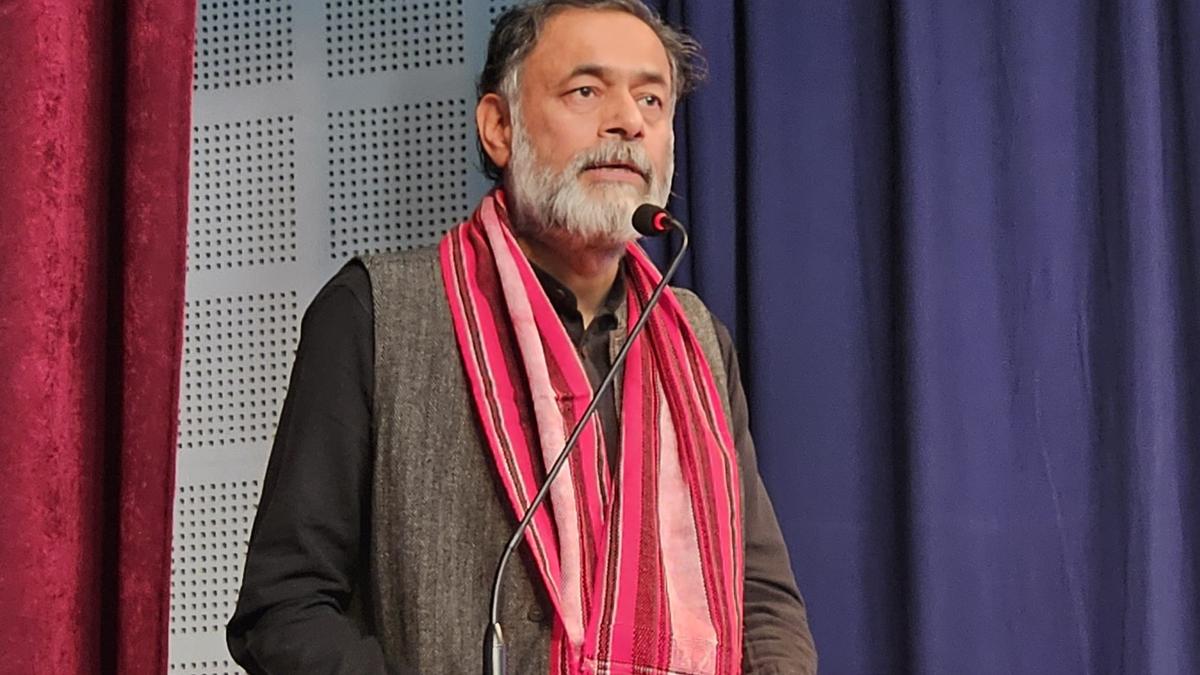
Yogendra Yadav speaking at an event in Bengaluru on Friday.
| Photo Credit: Special Arrangement
Those in power at the Centre have “institutionalised a system of loot” and there is a real possibility today for “economic inequality to be turned into a major political question”, said political analyst and activist Yogendra Yadav.
Speaking at an event to remember the legacy of former Prime Minister Manmohan Singh, organised by Jagrutha Karnataka in Bengaluru on Friday, he said, “Less tax for corporates will not result in higher investments. What’s been happening in the last five years is loot; Corporate taxation must go up.” He advocated for wealth tax for revenues beyond ₹ 100 crore.
Prof. Yadav further said that today the biggest strike is not being carried out by working class, but by the capitalist class who threaten to shift their FDIs to another country.
“Economic inequality to be turned into a major political question is a real possibility today. Odd as it may look, Indian political is ready for a sharp left turn,” he said.
MSP for farmers
Prof. Yadav pointed out that MSP for farmers was raised significantly during Manmohan Singh-led UPA rule, in a manner not done before or after that. Agricultural growth during the period was unprecedented, he said. While Singh focused on growth, his government also ensured safety nets in the form of MNREGA and the Food Security Act.
Noting that Singh was a consultative leader who respected dissent and differences, Prof. Yadav said, “He was being guided by someone whom the people of this country voted for, not by a businessman from Ahmedabad… You cannot make a decision like demonetisation if you have someone sane guiding you.”
“What is considered his biggest weakness is to my mind his biggest strength. It is not great if any Prime Minister takes a decision themselves. Coalition is the most natural condition of power in a civilization like India,” he said.
Architect of liberalisation
While Singh was known for opening up the Indian economy and widely criticised by Left factions for the same, Prof. Yadav suggested that what Singh offered was a “different version of capitalism” and he was not a free market fundamentalist.
While he admitted that the gap between the rich and the poor increased post-liberalisation, Prof. Yadav said that despite that, it helped improve the economic conditions of the poorest of the poor.
“Singh’s policies invite us to think fresh because we operated within the binary of capitalist and socialist. We did not see the range of capitalist shades and the political possibilities each shade offered.”
“Today, however, one cannot be sure of the statistics being provided by the Union government. GDP is being inflated. I’m worried that some benefits of opening up of the economy that we saw for 15-20 years may be disappearing,” he said.
Boost for agriculture
L.K. Ateeq IAS, who worked with Manmohan Singh in PMO for five years, noted that he used to surround himself with a lot of expertise. “The Planning Commission then had lot of experts unlike the current Niti Aayog which is consultant driven,” he said.
Mr. Ateeq remembered how Singh, an economist by training, surprised everyone in 2008 by deciding to offer farm loan waivers.
“We usually expect economists like him to not agree to it. But he said the balance of terms of trade is traditionally tilted against farmers and in favour of industry, as a result of which farmers are burdened with loans. Hence, he said, we must waiver the debts of farmers once in a while.”
Mr. Ateeq further stressed on the importance given to health and education when Singh was helming the government.
“Between 1960 and 2005, no new IITs were established in the country. It was during Singh’s time as PM that new IITs came up,” he pointed out.
Published – January 04, 2025 12:31 am IST
[ad_2]
The Hindu