[ad_1]
A game of spring bingo is underway at Cubbon Park on a pleasant Sunday morning. The players fan across the park’s lush lawns and thickets of trees, dodging other Sunday regulars (walkers, joggers, readers, skaters, dogs, lovers ambling hand-in-hand) as they attempt to identify specific things in the park: new leaves, flowering trees, spiderlings, edible leaves and birdsong. Once they cross out most of the items on their respective bingo cards, they sit in a circle under a large tree, ready to share insights and meet other like-minded people.

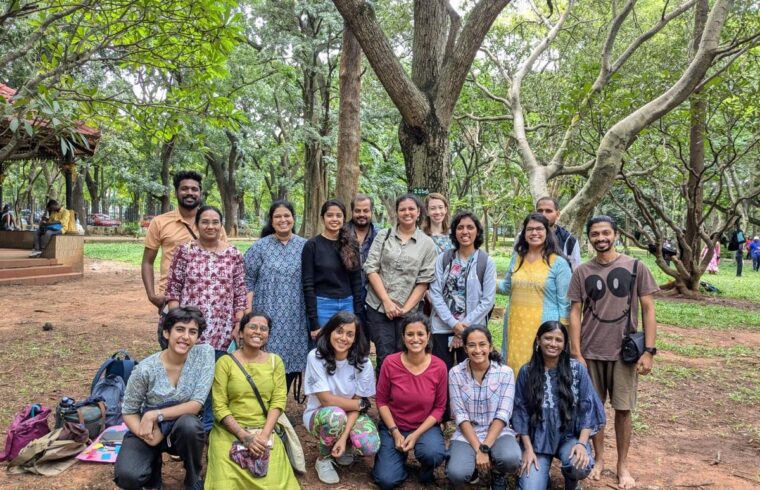
Participants from a nature educators session.
| Photo Credit:
SPECIAL ARRANGEMENT
Now in its 10th edition, this monthly event is a nature educators’ meet-up, an informal convening of people in or interested in the nature learning space. These meets, an initiative of the Nature Conservation Foundation’s Nature Classrooms, is a space “where people can feel free to come, share their work, collaborate, network and give nature education a voice,” says Priyanka Prakash, a project manager at Nature Classrooms.
According to nature educator and ecologist Vena Kapoor who founded and heads Nature Classrooms, an initiative to link everyday learning and education to the natural world, this idea of an informal meet-up was seeded from a casual conversation during a team meeting. “My colleagues and I were discussing how many people reach out to us, saying that they are also interested in nature education and asking if they could meet us,” she says. This casual conversation led to them thinking that it would be “nice for people from the nature education space to catch up occasionally, just to discuss each other’s work, see if we want to share resources, figure out what is happening in this space and help each other.”

From a natures educators session.
| Photo Credit:
SPECIAL ARRANGEMENT
First meetup
In April last year, a call was put out on the Nature Classrooms Instagram page announcing an in-person meeting for nature educators in Bengaluru.
The turnout at the first meetup, which was held on April 21, at Cubbon Park, was impressive, which surprised them, recalls Veena. “Some people who came were just curious and wanted to know what other people were doing. Or there were people who were planning to get into nature education and wanted to meet people who were already doing nature education,” she says. What also became evident was that people were just happy to see the number of other people working in this space, she believes. “It made them feel less alone.”
During this meetup, many participants also told the organisers that they wanted a more consistent engagement, so this first informal meeting became the first of a series of regular events at Cubbon Park. “We decided that we will all meet on the last Sunday of every month and stick to that so automatically people will be able to add it to their diaries,” says Vena. Since then, this informal meetup has occurred every month, except for one month, during the Deepavali break.

Participants bring in their own perspectives, ideas and experiences, with the focus of the conversation hopscotching from the use of effective nature-based education tools to the problems of parachuting in and out of communities.
| Photo Credit:
SPECIAL ARRANGEMENT
At a session
A spirit of camaraderie is visible among the group under the large tree at Cubbon Park, with green grapes and cookies being passed around and plenty of side talk. Manini Bansal, a visual communication designer and animal-lover, who is facilitating this session, then takes over, beginning by talking about her own journey.“I am someone who grew up just enjoying nature and loving being outdoors…constantly looking for creatures…bringing random animals into the house,” she confesses, with a laugh, recalling how her grandmother used to call her Mowgli.
Manini goes on to trace her career path, starting with her training at design school, her first job at a design studio (“I absolutely hated it”) and her experience of working as the managing editor of Current Conservation, a not-for-profit quarterly print and online magazine focusing on conservation. Back then, only people from the conservation space knew about this magazine, so her goal was to engage the larger public “to make sure that the magazine was out there through different ways of design and communication,” she says. In keeping with this goal, the magazine often conducted events for the public, including nature education workshops for children, she says, describing some of them. She then raises a very germane question: How do you talk about nature to children from different socioeconomic backgrounds?
The rest of the group starts chiming in with their own perspectives, ideas and experiences, with the focus of the conversation hopscotching from the use of effective nature-based education tools to the problems of parachuting in and out of communities, the scope of nature journals, whether taking a utilitarian human-centric perspective is the best approach to conservation, among other things. Other specific issues, like the impact of the proposed Sharavathi project in Karnataka on the endangered lion-tailed macaques and how development often severely impacts insect diversity, were also discussed at the session.
“We were very conscious, right from the beginning, that we didn’t want it to be a unidirectional lecture-based session. We wanted it to be a community space for what we thought we wanted out of these meetings,” says Vena. While the Nature Classrooms team facilitated the first few meetings, other participants from the larger community have also been volunteering to facilitate these meet-ups. “So, every session has been very different in terms of topics we have chosen to discuss,” she says, while Priyanka adds, “It is just us trying to see the diverse conversations we can have around nature education and how we can bring people to share their work and lead some of these sessions.”

Growing the tribe
Priyanka feels that nature education is gaining some momentum now, with many educators developing their own resources and content. But it is still somewhat happening in pockets, which can be isolating, according to her, and so, “we feel it would be so nice if we can come together and exchange our work with one another,” she says. “I think this space needs a lot of partnerships and collaborations with people bringing in diverse expertise because education requires different approaches.”
Murtuza Khetty, a freelance trainer, educator and theatre professional who has been regularly attending these meetups right from the beginning, agrees. “Not many institutions look at working with nature as part of their whole curriculum,” says Murtuza, who has also moderated one of these sessions. In his opinion, there are a lot of people in the nature education space who are doing good work, but they’re all working in silos. “Being part of this community is helping people get new ideas and collaborate,” he says, an opinion also echoed by artist and educator Antara Mukherji. “I get to meet this tribe of people that I connect with immensely and can relate to,” says Antara, who especially likes the group’s diversity. “The connection-building and opening of another perspective helps; sometimes I feel very secure in my opinion, but then getting another perspective opens up the mind,” she says.
There is also strength in numbers, says Vena, who believes that creating a collective will lead to more voices speaking together on nature education in a manner that is “much more powerful and effective than working with silos,” she says. She hopes that, at some point, the group can come together to create a resource or intervention collaboratively “that all of us can use…something designed in such a way that it can be tweaked for different geographies and cultural contexts.”
Vena also believes that, over time, nature educators will be able to open different chapters of this meetup in other parts of the country. “We’ve got people from outside the city who’ve heard about these meetups and planned their trips to Bengaluru to ensure they attend them. The hope is that this model can be taken to other cities and towns.”
To know more, follow the Nature Classrooms Instagram page.
Published – March 24, 2025 09:00 am IST
[ad_2]
The Hindu