[ad_1]
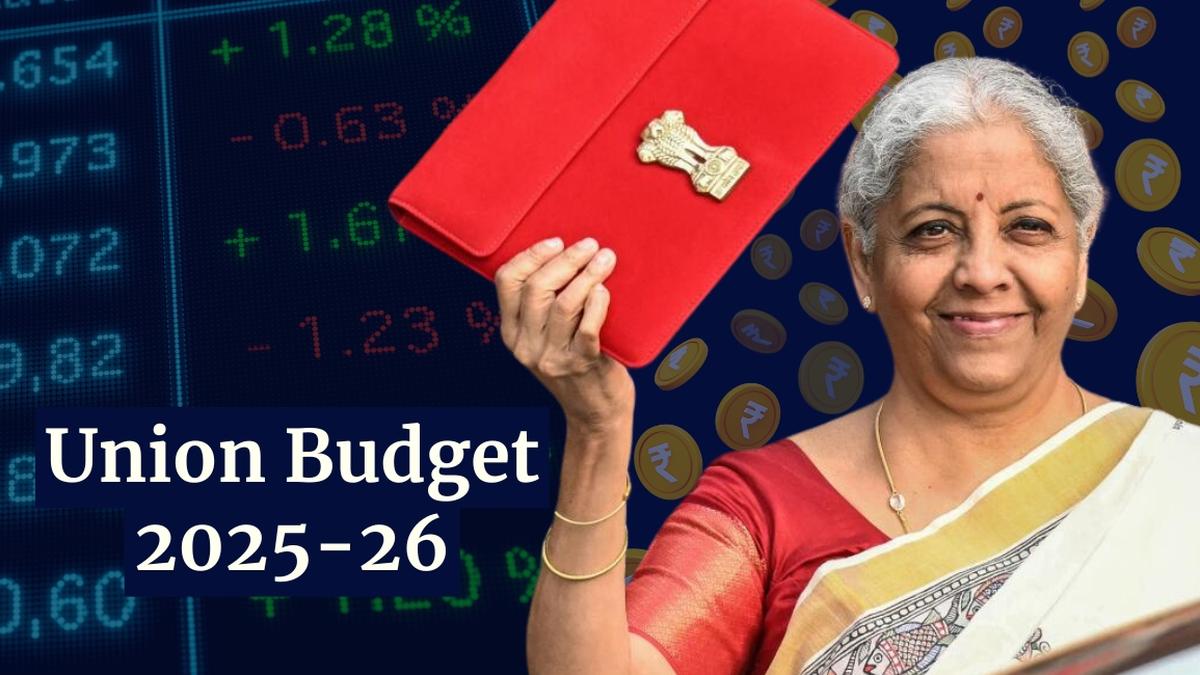
Union Finance Minister Nirmala Sitharaman with Union Budget 2025-26.
Sitharaman tabled the Union Budget for 2025-26 in Parliament on Saturday (February 1, 2025), laying out the government’s planned income and expenditure over the next fiscal year in addition to expectations for the fiscal deficit.
Union Budget 2025 LIVE updates
Here are some key numbers presented in the Budget.
Income tax
In her budget statement, Nirmala Sitharaman declared that under the new tax regime, those earning up to ₹12 lakh would not be obliged to pay taxes. For incomes up to ₹12 lakh ( ₹12.75 lakh for salaried taxpayers with a basic deduction of ₹75,000), the new tax regime gives 0% income tax. She has also announced new tax slabs, aiming increased household consumption, savings, and investment.
Where the money comes from
For every rupee in the government coffer, the biggest pie of 66 paise will come from direct and indirect taxes, according to the Union Budget 2025-26 documents. Around 24 paise will come from borrowings and other liabilities, 9 paise from non-tax revenue like disinvestment, and 1 paise from non-debt capital receipts, the Budget documents said.
Direct taxes, including corporate and individual income tax will contribute around 39 paise, while income tax will yield 22 paise, while corporate tax will account for 17 paise. Among indirect taxes, goods and services tax (GST) will contribute the maximum 18 paise in every rupee of revenue. Besides, the government is looking to earn 5 paise out of every rupee from excise duty and 4 paise from customs levy.
Where the money goes to
On the expenditure side, the outlay for interest payments and states’ share of taxes and duties, respectively, stood at 20 paise and 22 paise for every rupee. Allocation for defence stands at 8 paise per rupee. Expenditure on central sector schemes will be 16 paise out of every rupee, while the allocation for centrally-sponsored schemes is 8 paise. The expenditure on ‘Finance Commission and other transfers’ is pegged at 8 paise. Subsidies and pension will account for 6 paise and 4 paise, respectively. The government will spend 8 paise out of every rupee on ‘other expenditures’.
Fiscal deficit
On fiscal consolidation, the fiscal deficit for FY25 has been pegged at 4.8% of GDP and at 4.4% for FY26. Fiscal deficit is the difference between the government’s expenditure and its income.
Capital expenditure
Capital expenditure or capex for FY26 is estimated to be ₹15.48 lakh crores, which is at 4.3% of the GDP. The estimate for FY25 is revised to ₹13.18 lakh crores (from ₹15 lakh crores) which is at 4.1% of the GDP.
Tax receipts
Tax receipts are estimated to increase to 12% of the GDP for FY26, as compared to the revised estimate of 11.8% of GDP during FY25. The share of direct tax receipts is estimated to be around 59% of the total tax receipts, which consolidates at 7.1% of GDP, while indirect tax is the remaining share which amounts to 4.9% of GDP.
Allocation to major ministries
Defence was allocated over 6.8 lakh crores in the Budget, followed by Road Transport Highways and Railways. In last year’s interim budget, the Defence Ministry was allocated 6.2 lakh crores.
Transfers to States and Union Territories
Around 25.6 lakh crore was budgeted as transfers to States and Union Territories. Of this, 14.2 lakh crore came from devolution of State’s share in taxes. Another 1.32 lakh crore came from Finance Commission grants. Scheme-related and other transfers amounted to 10.05 lakh crores.
Published – February 01, 2025 05:08 pm IST
[ad_2]
The Hindu