[ad_1]
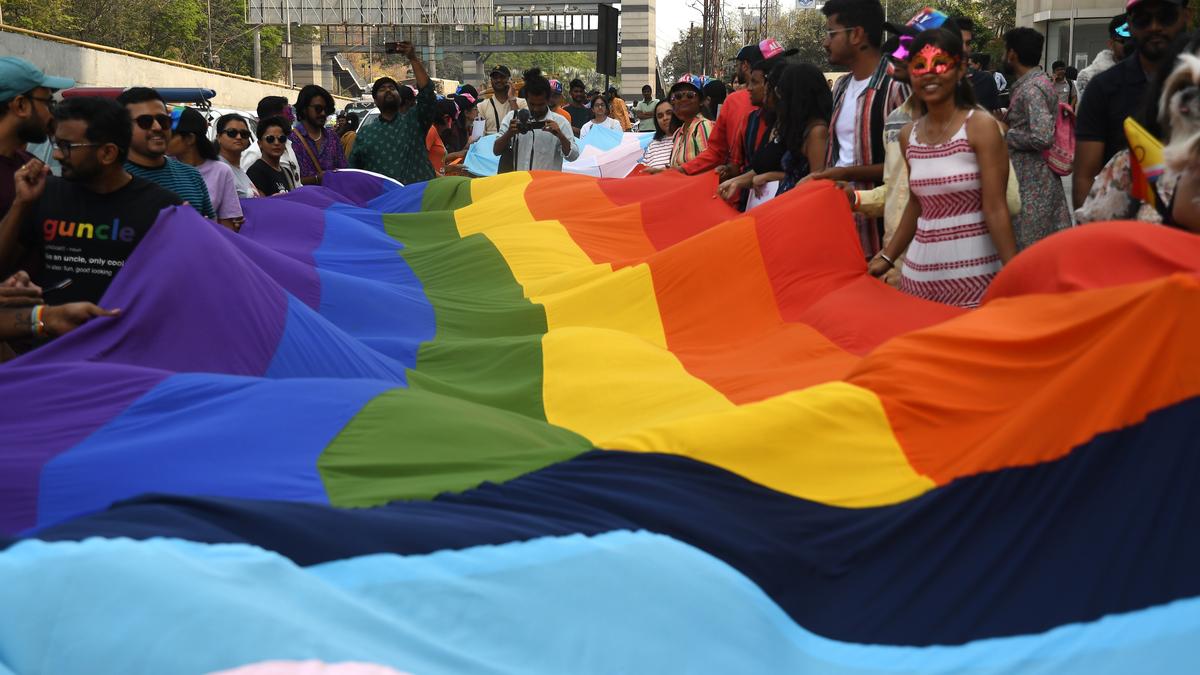
The detailed policy brief with proposed action addressing hundreds of issues faced by the LGBTQIA+ community was submitted to the high-powered committee and the Cabinet Secretary in April this year, and the policy briefs on each of these areas are scheduled to be publicly launched on Saturday (July 12, 2025) in New Delhi.
| Photo Credit: RAMAKRISHNA G
A new civil union framework to recognise “non-marital intimacies”, horizontal reservations for transgender people in education and jobs, “safe and inclusive” access to washrooms, amendments to marriage, succession, and tenancy laws among a gamut of other laws, and a ban on treatments like “conversion therapy”, are just some of the recommendations and suggestions submitted to the Union government’s high-powered committee that has been looking into issues faced by queer persons on account of their identity and non-recognition of queer relationships.

After months of deliberations, public consultations, and expert inputs with and from the queer community, activists, lawyers, civil society, the policy think tank Vidhi Centre for Legal Policy, in collaboration with NGO Keshav Suri Foundation, has sent in a detailed policy brief proposing executive and legislative actions for at least 12 Union Ministries and dozens of statutory bodies in the areas of recognition of queer relationships and families, discrimination in access to goods and services, queer affirmative healthcare, and prevention and prohibition of violence.

These areas of concern were identified by the Supreme Court in 2023, when it decided the same-sex marriage case and the court had recorded that the Union government would form a committee to address issues persisting in these areas. Last April, a six-member panel headed by the Cabinet Secretary was formed to this end.
The detailed policy brief with proposed action addressing hundreds of issues faced by the LGBTQIA+ community was submitted to the high-powered committee and the Cabinet Secretary in April this year, and the policy briefs on each of these areas are scheduled to be publicly launched on Saturday (July 12, 2025) in New Delhi.

Among the recommendations made to the government are ones that call for amending the Special Marriage Act and the Indian Succession Act to make them gender-neutral; repeal the “objection and notice regime” for the registration of marriages; “move away from a gendered approach” to determining vulnerability in case of divorce proceedings; and recognising “compulsory shares for all children” to prevent parents from discriminating on grounds of sexual orientation or gender identity.
Residence rights
In addition, the recommendations call for a “reform” of the Transgender Persons (Protection of Rights) Act, 2019, suggesting that the law needed “to rehaul its approach to the residence rights of transgender persons”. This includes the proposal to introduce horizontal reservation for transgender people in jobs and education and removing the requirement of medical procedure to identify within the binary genders of man and woman and setting up grievance redressal mechanisms to address private discrimination.

The policy brief goes on to suggest amending criminal laws to protect people members of the LGBTQIA+ community from sexual violence, also recommending the re-introduction of the equivalent of Section 377 of the IPC so that non-consensual same-sex sexual violence can be provided for while leaving consensual same-sex intimate activity de-criminalised. It has also called for amendments to laws dealing with workplace harassment to be inclusive of queer individuals and fresh laws that comprehensively cover discrimination against them.

The recommendations call for reservation for transgender persons in school education, higher education, and employment, also proposing their inclusion in school processes and student grievance redressal cells, building inclusive curricula, recognising and prohibiting discrimination against queer persons. They also call for ensuring that teachers in schools and universities are “queer affirmative”, and inclusion of transgender persons in “gendered activities”, including “gender-based sports teams” as per their chosen gender identities, and the introduction of an “open sports” category, along with many others.
The brief also recommends amendments to tenancy laws, and cooperative society laws to prohibit discrimination on grounds of gender identity or sexual orientation. In addition to suggesting the country-wide expansion of the government’s Garima Greh scheme for transgender people, the brief also calls for similar shelter homes for non-transgender LGBTQIA+ individuals who might need a safe space.
The policy brief has also gone on to propose the banning of all forms of “conversion therapy”, prohibiting “unnecessary intersex surgeries”, and remove the blanket ban on blood donations for transgender persons, men who have sex with men, and female sex workers.
The brief has also recommended the government to use its executive powers to issue clarifications and orders that provide for nomination benefits for people in queer relationships and families, urging the government to recognise queer relationships for the purposes of financial services, and proposing a nomination regime for social welfare benefits and in the labour and employment sectors.
Published – July 11, 2025 11:47 pm IST
[ad_2]
IThe Hindu