[ad_1]
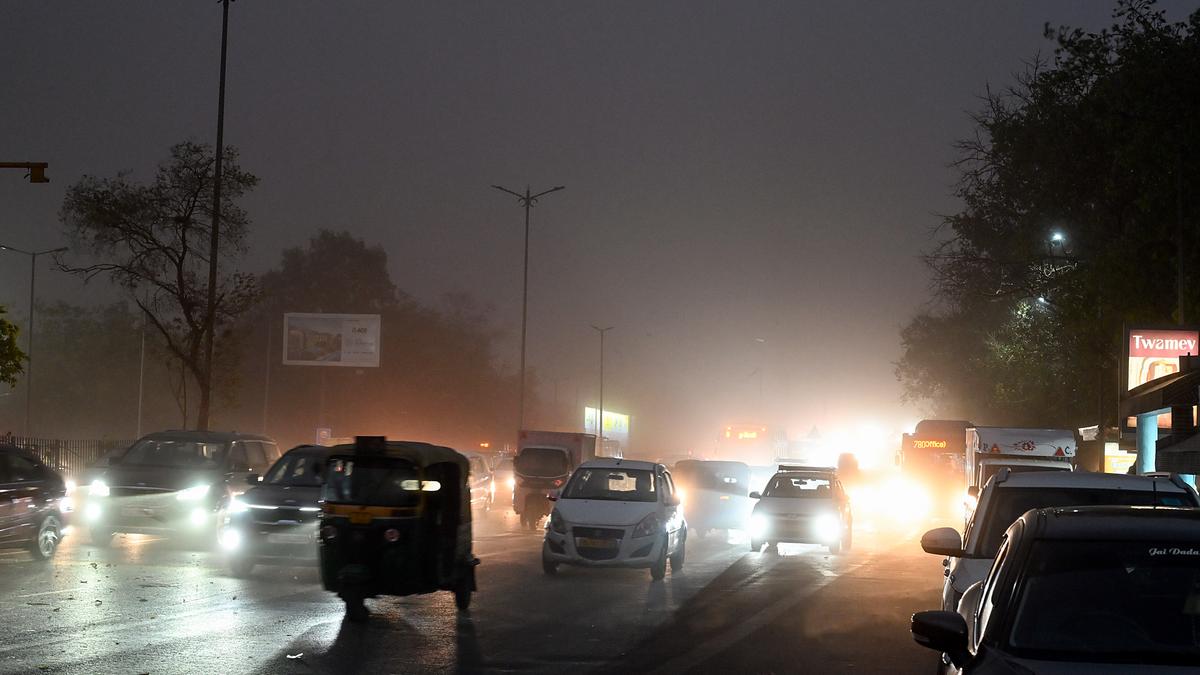
Representative image
| Photo Credit: ANI
Air quality of Delhi and other parts of the National Capital Region (NCR) are in the upper end of the “poor” category on Thursday (May 15, 2025), as per Central Pollution Control Board (CPCB) data. A layer of dust blanketed Delhi-NCR on Thursday (May 15, 2025) morning following overnight dust storms, which reduced visibility and caused a drop in the air quality.
“Dust advected from North Pakistan towards Delhi NCR across Punjab and Haryana under the influence of strong lower level westerly winds over Punjab and Haryana. It has been gradually moving eastwards leading to improvement in visibility over Palam (in Delhi) which is currently reporting 4000m,” an IMD official said.
However, this dust is gradually moving eastwards, improving visibility in the region. Palam, for instance, is currently reporting visibility of 4,000 metres.
Poor AQI in Delhi due to dust storm
The dust storms were triggered by gusty winds sweeping at 30 to 40 kmph, according to the India Meteorological Department (IMD).
Visibility at the Indira Gandhi International Airport dropped from 4,500 metres to 1,200 metres between 10 pm and 11:30 pm on Wednesday.
Following the storm, calm to weak wind conditions ranging from 3 to 7 kmph have prevailed, preventing the dispersion of dust particles.
As a result, visibility continues to be poor, fluctuating between 1,200 and 1,500 metres at both Safdarjung and Palam airports, the IMD added.
Thirteen air quality monitoring stations in Delhi are witnessing “very poor” air quality, even as the overall air quality of the city remains in the upper end of the “poor” category.
According to the Central Pollution Control Board, the AQI was recorded at 2:36 at 8 a.m.
Meanwhile, the weather department has predicted strong surface winds during the day.
Long-term damage due to dust storm
Delhi residents are advised to exercise caution as the dust can cause long-term damage. The particulate matter can lodge deep in the lungs, potentially causing progressive lung diseases, a Lok Nayak Hospital (LNJP) doctor told PTI.
He further suggested avoiding stepping out during such a dust storm, and that people with existing respiratory conditions must be cautious.
“Masks can help filter out dust particles but they should fit snugly. Keep windows and doors closed, or use an air purifier at home. Avoid rubbing your eyes as it may lead to injury. If there is irritation, wash the eyes thoroughly with plain water. It’s also important to stay well-hydrated at all times,” the doctor added.
PM2.5 and PM10 particles are considered hazardous because of their respirable size. Breathing in air laced with dust particles can lead to both short-term and long-term health issues, depending on the level and duration of exposure.
(With inputs from PTI)
Published – May 15, 2025 04:29 pm IST
[ad_2]
The Hindu