[ad_1]
A recent de-weeding operation at Bengaluru’s Madiwala lake revealed a startling amount of submerged waste, including a double-door refrigerator. Meanwhile, residents around Mailasandra lake in the city have long been fighting against encroachment and pollution issues and demanding immediate and effective lake rejuvenation efforts. Amidst all these concerns, as the summer heat intensifies, more than 50 of the city’s 183 lakes maintained by the Bruhat Bengaluru Mahanagara Palike (BBMP) have dried up, with lake water levels plummeting to just an average of 35%.
While this has raised concerns about groundwater scarcity and environmental degradation, lake experts and conservationists suggest that the seasonal drying of lakes is not only natural, but also beneficial for the health of these water bodies. What is worrying is not the seasonal drying up but the continued pollution.
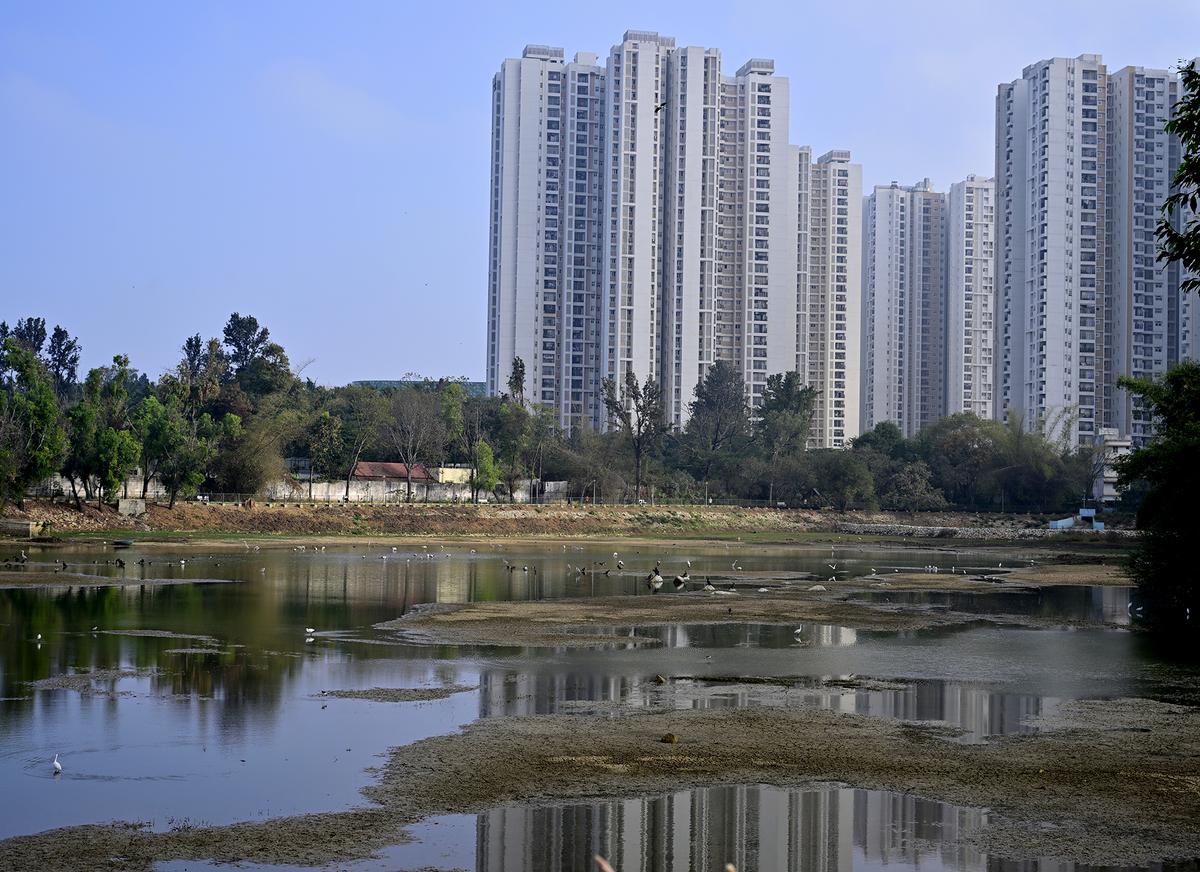
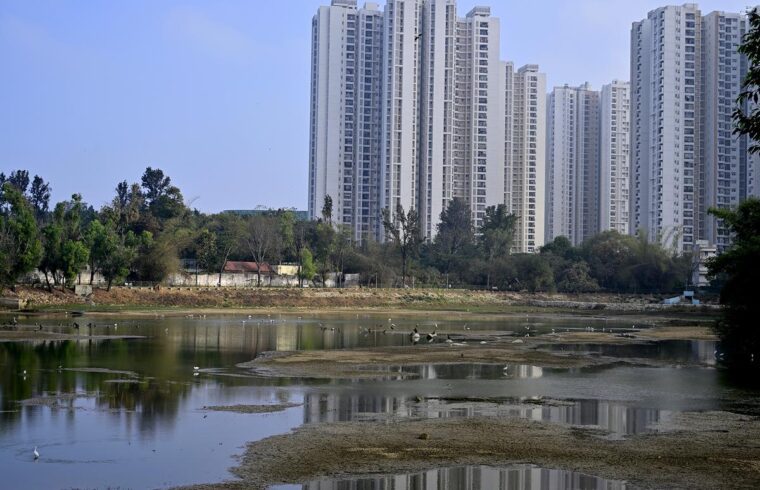
In the R.R. Nagar zone, 12 of 33 lakes have dried up, with 393.59 million litres remaining out of a total storage capacity of 3,032.31 million litre.
| Photo Credit:
File Photo
Current water storage
According to BBMP data for the month of April, the city’s lakes, with a collective storage potential of 31,505.48 million litres, are holding 10,980.01 million litres, that is roughly 35% of their full capacity. This steep decline has affected groundwater recharge, especially in neighbourhoods near dried-up lakes. In the Mahadevapura zone, for instance, 19 out of 50 lakes have run dry, leaving only 2,110.43 million litres in reserve from a total capacity of 9,493.35 million litres. The situation is similar in the Yelahanka zone, where 12 of 27 lakes are dry, and current water levels stand at 4,276.61 million litres, less than half of their 9,214.08 million-litre capacity.
In the R.R. Nagar zone, 12 of 33 lakes have dried up, with 393.59 million litres remaining out of a total storage capacity of 3,032.31 million litres. Dasarahalli zone has seen half of its 12 lakes run dry, leaving only 140.62 million litres available from a possible 1,740.31 million litres.
The South zone’s seven lakes currently hold 911.56 million litres of water, well below their full capacity of 1,339.26 million litres. In the East zone, two out of five lakes have dried up, and the remaining ones are storing 2,725.10 million litres out of a potential 4,882 million litres. The West zone, which has only two lakes, is in a relatively better position, with 351.07 million litres of water available from a total capacity of 453.12 million litres.
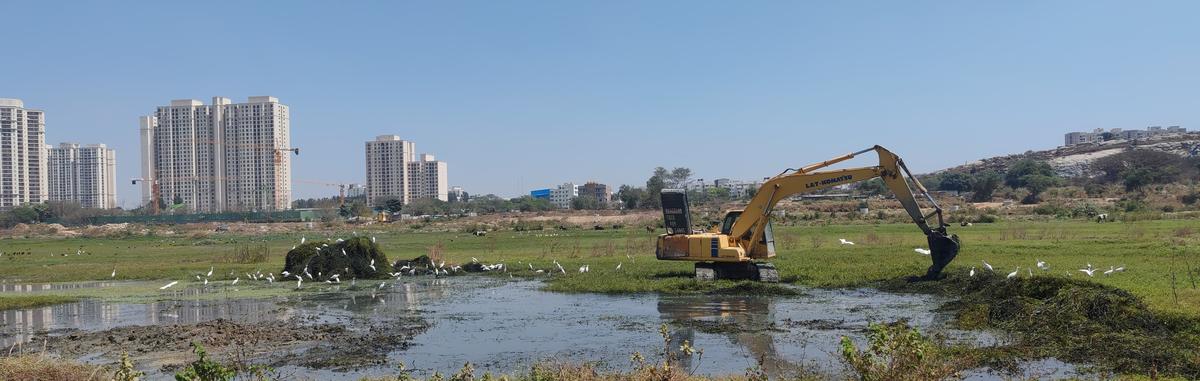
File photo of Hulimavu lake in Bengaluru.
| Photo Credit:
FILE PHOTO
An opportunity
Speaking to The Hindu, Vijaykumar Haridas, Chief Engineer for the BBMP’s Lake Department, said most of the lakes have dried up due to the summer heat. “Around 53 out of the 183 BBMP lakes have dried up due to the weather conditions in the city right now. It may affect groundwater levels, but will not lead to scarcity at this point. It is normal for lakes to go dry in the summer and they will be replenished once the monsoon arrives. This is a good time for us to rejuvenate the lakes and focus on lakes that need more attention. The Hulimavu lake is one among the 53 lakes that has dried up completely, and major rejuvenation work is happening at the lake, which will be completed by the end of May,” he said.
“Out of the 183 lakes the BBMP looks after, 136 lakes are already fully developed and do not require any extra work this summer. We will have to do rejuvenation work for the remaining 47 lakes, which will be a work in progress. For now, we will focus on lakes that need immediate rejuvenation,“ he added
Haridas said that controlling sewage flow into the lakes is one of the major processes in rejuvenation of lakes. “We will construct sewage diversion flows to make sure it does not affect the main water body. The most important component of rejuvenation is desilting and conservation of wetlands. The wetland is a small water area close to the lake where water comes in first and held at the area. This wetland lets the water rest for a while and helps suspend solid particles settle at the bottom, after which the clean water on top of the wetland will enter the lake. Fencing, bund formation, pathway and plantation development are also part of rejuvenation,” he explained.
According to experts, many of Bengaluru’s lakes are seasonal by design, and their annual drying allows for natural cleansing, sediment oxidation, and the regeneration of aquatic life once the rains return, making it a crucial part of the ecosystem’s rhythm rather than a crisis.
Raghavendra B. Pachhapur, senior lead projects of ActionAid Association and a well-known lake conservationist said, “Lakes drying up should not be seen as a negative sign. It is a reset when the summer is at peak. Everything goes dry, organisms die and there is a new start during the monsoon,” he added.
Pachhapur said that the BBMP should take this opportunity to rejuvenate lakes. “The BBMP has constraints in its funds and cannot do much on the rejuvenation front. They can currently focus only on a few lakes. As lakes have dried up, they can focus on clearing silt. The authorities during this time must focus on constructing suspension ponds around the lakes during this period. Suspension ponds are 10% of the land of the larger lake that absorbs all the storm water and suspends solid waste that comes inside the lake. But most lakes in Bengaluru do not have these suspension ponds,” he observed.
Varying depths
The lake conservationist said that this is also a good opportunity for the BBMP to make varying depths in lakes. “The BBMP usually while rejuvenating makes a flat lakebed to retain more water through out the year, but during summers it goes completely dry. However, having varying depths in lakes, i.e. one side higher and the other lower, help save some water. When water reduces during summer, a small amount of water is retained in the lower side of the lake that can help smaller organisms or birds to continue feeding from the lake as 70% of the biodiversity depends on shallow water,” he explained.
Pachhapur added that the BBMP must also make provisions to divert rainwater directly to the lakes. “Most lakes are in the lower areas, that are also surrounded by residences. Whenever it rains, lower areas lose a lot of rainwater, and the majority of the water goes into the storm water drains that are mixed with sewage. If there are provisions to make pure rainwater directly enter lakes, this will help in the rejuvenation of lakes and increase groundwater levels for the rest of the year,” he said.
Pachhapur added that lakes filled with water from sewage treatment plants (STP) like Dorekere lake, Uttarhalli lake and others, need immediate attention as the quality of the water is not up to the mark, and the fate of these lakes have been stuck between the BBMP passing the baton to the BWSSB and vice versa.
Published – May 02, 2025 07:42 am IST
[ad_2]
The Hindu