[ad_1]
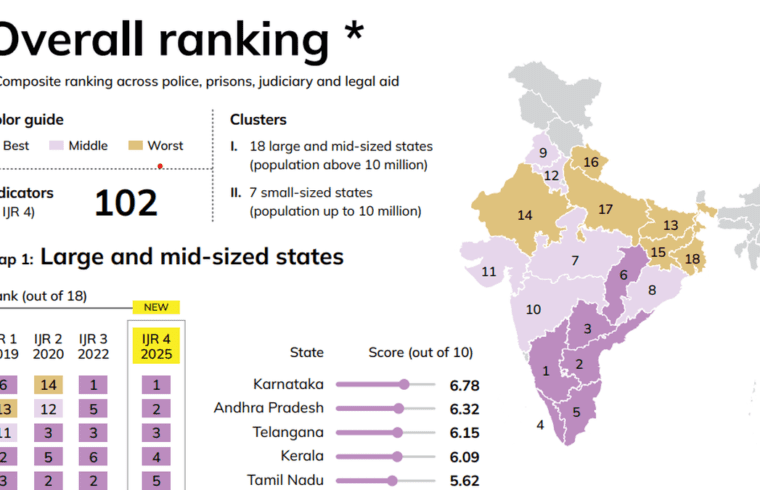
Telangana has retained the top spot in India for police performance, according to the India Justice Report 2025, which evaluates States based on their structural capacity to deliver justice. While Telangana’s strength in law enforcement propelled it to the third position overall among 18 large and mid-sized States – behind only Karnataka and Andhra Pradesh – the report also highlights stark imbalances across the broader justice system.
The India Justice Report, now in its fourth edition, evaluates 18 large and mid-sized States (with a population above 10 million) and seven small-sized States (with population up to 10 million). It measures performance across four pillars: police, judiciary, prisons, and legal aid across indicators including human resources, budgets, infrastructure, workload, and diversity. Telangana, which ranked 11th in 2019, steadily rose in the rankings over the past five years to now stand as the third-best performing large State.
Telangana stands out in policing
Telangana has retained its number one rank in the policing parameter, driven by improvements in infrastructure, training, increased public access to services and robust inclusion of marginalised communities.
Telangana is also among a handful of States that have met or exceeded reservation targets for Scheduled Tribes and Other Backward Classes (OBCs) in the police force, with constabulary-level representation exceeding 100% of the mandated quotas.
Gender representation remains a concern
However, gender representation remains a concern. Despite some progress, Telangana is far from achieving the Centre’s 33% benchmark for women in police forces. At the current pace, the State will take over 22 years to meet this target—compared to just three years in Andhra Pradesh and Bihar, the report noted.
As of January 2023, the average number of women sub-inspectors per police station stood at 0.5, and women constables at 4.9, significantly below the Ministry of Home Affairs’ recommended figures of 3 and 10, respectively.
Workload reduces with increase in training facilities
A major contributor to the State’s performance is its emphasis on training. Training facilities rose from six in January 2022 to 33 by January 2023, and workload was significantly reduced. In 2021–22, Telangana allocated 1.17% of its total police budget to training, achieving nearly 90% utilisation. The State spent ₹9,849 per police personnel—well above the national average of ₹8,343—and reported 92% utilisation of modernisation funds, outpacing most other large states.
Judiciary: Progress on gender, but overloaded
The judiciary presents a mixed picture. Telangana, with the second rank nationally, stands out for gender representation at the High Court level, with over 30% of judges being women—a distinction shared only with Sikkim.
As of January 1, 2025, over half of the pending cases in the Telangana High Court remained there for more than five years, while 36.2% of cases in subordinate courts remained pending for over three years. The average number of pending cases per judge has increased since 2017, pointing to rising caseloads and a slow-moving system.
Despite investments in court infrastructure and digital systems like e-filing and video conferencing, these advancements remain unevenly distributed, especially in rural areas. Another critical bottleneck, noted by the report, is the near absence of forensic staff. Telangana has a staggering 91% vacancy in sanctioned scientific personnel, one of the highest in India, affecting both the pace and quality of criminal investigations and trials.
Prison system: underfunded and overburdened
Telangana’s performance in prison management places it seventh among 18 large States. While the State’s average occupancy rate stands at 81%—lower than overcrowded States like Uttar Pradesh (180%) and Delhi (184%)—it still indicates a stressed system.
Worryingly, the State spent less than 1% of its prison budget on medical care for inmates in 2022-23, with 541 inmates per medical officer, way above the 300 inmates per medical officer benchmark set by the Model Prisons Manual, 2016. The sanctioned strength of psychologists/ psychiatrists remains lower than the Prison Manual’s benchmark of one for 500 prisoners and expenditure on vocational or educational programmes was negligible.
The report exposed a wide disparity in the daily spend per inmate (food, clothing, medical care, vocational and educational activities, welfare activities) with Andhra Pradesh spending ₹733 per inmate per day while Maharashtra only spends ₹47 and Telangana spending ₹91 as of 2022-23, dropping from ₹99 in 2021-22. The State spent ₹33,277 per annum per prisoner, as compared to the national average of ₹44,109. This signals a lack of focus on prisoner rehabilitation, with prisons functioning more as holding cells than reform institutions.
Legal aid: accessibility still elusive
Legal aid is Telangana’s weakest pillar, ranked tenth out of 18. The State struggles with both outreach and resourcing. One legal aid clinic is expected to serve an average of 440 villages—nearly three times the national average of 163, making it hard for rural and marginalised communities to access basic legal support.
Although Telangana utilised more than 100% of its allocated State legal aid budget in 2022–23, its per capita spending was under ₹10—placing it among the lowest in the country. The number of paralegal volunteers (PLVs) has also declined over the years, reflecting a drop in broader community-based legal awareness efforts.
The report notes that Telangana’s model reveals a skewed focus on front-end policing without a proportional strengthening of the broader justice ecosystem.
Published – April 16, 2025 02:19 pm IST
[ad_2]
The Hindu