[ad_1]
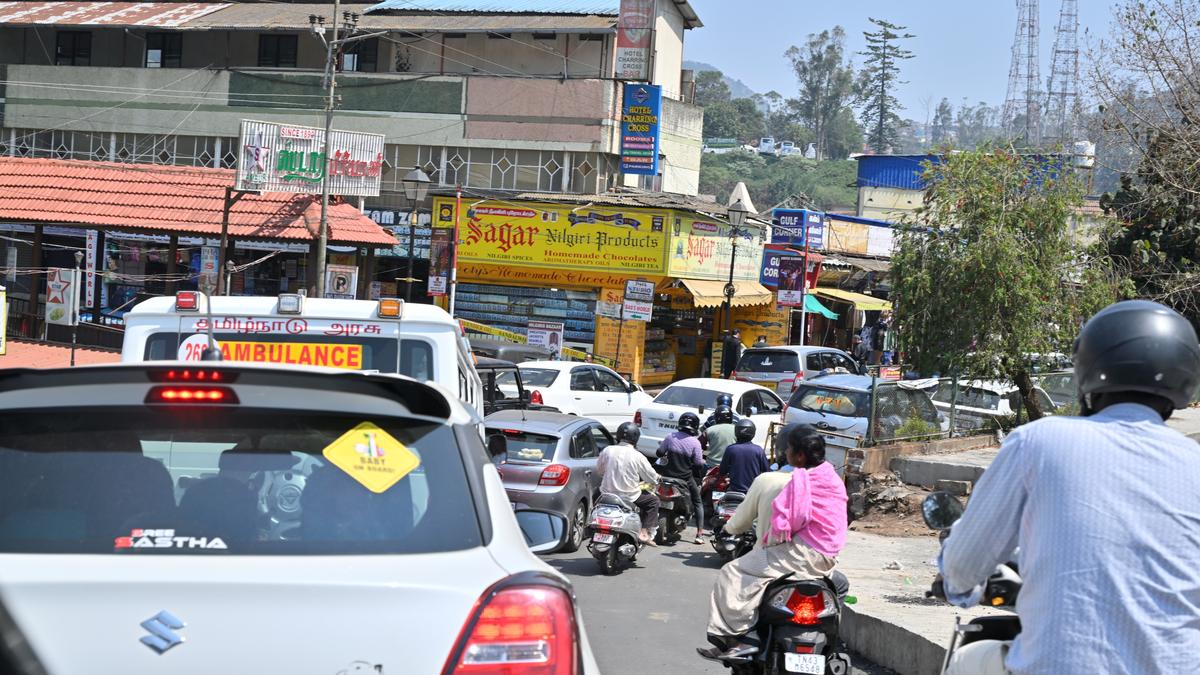
The Madras High Court-mandated e-pass system to restrict the number of tourist vehicles will come into force in the Nilgiris and Kodaikanal on April 1. The photo shows the traffic stagnating at Charing Cross in Udhagamandalam on Monday owing to the large number of tourists visiting the hill station for Ramzan.
| Photo Credit: M. SATHYAMOORTHY
The new e-pass system, restricting the number of tourist vehicles, as mandated by the Madras High Court, will come into operation in the Nilgiris and Kodaikanal on April 1. It will remain in force till June 30.
In a banner, the Nilgiris administration announced that only 6,000 vehicles would be allowed into the district on weekdays and 8,000 vehicles at weekends.
Vehicles for medical or other emergencies, government buses, goods vehicles, and district vehicles are exempt from the purview of the system.
However, potential travellers are puzzled about certain aspects of the system, even as the link (https://epass.tnega.org) for travellers to register themselves for e-passes was unveiled on Monday.
The application form has a field for users to specify the fuel their vehicle uses: petrol, diesel, CNG, electric, or hybrid. The High Court had specified that vehicles using sustainable and non-polluting fuels should be given priority in the grant of e-passes.
Dindigul Collector S. Saravanan recently told The Hindu that the Chief Secretary had conducted a meeting to discuss the modalities for implementing the court order. He pointed out that last year, the administration had noticed the cancellation of about 15% of the e-passes granted. This deprived genuine tourists of a chance to visit the hills. Hence, the administration has planned to keep a buffer for those seeking e-passes against cancellation.
Among the other measures, bulk bookings would come under the scanner. As the e-passes would be checked at the foothills, traffic congestion on the ghat road, especially at the Silver Cascade, would be avoided. The Collector admitted that there would be glitches in the first 15 days, but they would be rectified at the earliest.
The Nilgiris district administration did not specify how many of the 6,000-8,000 vehicles would be private buses, mini-buses, vans, cars, and two-wheelers.
The court had also directed the Nilgiris administration to identify parking space at the foothills for private vehicles to be stopped and electric vehicles to be operated to the most popular tourist spots. However, the administration did not spell out whether or not the parking lots were ready.
Merchants, business-owners, taxi-drivers, and hotel- and restaurant-owners said they planned to support the call for a bandh across the district on April 2 to protest against the court order. A meeting with the Nilgiris administration was held in Udhagamandalam on Sunday, wherein the business-owners were requested not to go ahead with the bandh.
Suresh Nair, president of the Nilgiris Hotel and Restaurant Association (NHRA), said hotels had already taken bookings (for April 2); hence, they would be unable to turn away customers. Nonetheless, NHRA would support the bandh, though the hotels would remain operational. Mr. Nair said they had shared their concern with the district administration about the vehicles of residents being included in the number of tourist vehicles being allowed to enter the district.
“Many people in the Nilgiris have cars registered in other districts and have families living here. We highlighted our concern that their cars will also be counted as tourist vehicles. This means fewer e-passes will be issued to actual tourists,” he said. He added that the Collector assured them that she would convey their concern to the government.
S. Senthil, a resident of the Nilgiris, whose car is registered in Karnataka, said he was worried that residents like himself would not be allowed to enter the district as his car was registered outside the Nilgiris. “Though I have identity cards to prove my registered address in Udhagamandalam, I am concerned that my car will be stopped on the border as it has Karnataka number plate,” he said.
There is an air of discontent in the Kodaikanal hills too. Some say the number fixed by the court (4,000 vehicles on weekdays and 6,000 at weekends) may have been arrived at by taking into account the number of registered hotels, cottages, and homestays, which comes to over 7,000. But the hills have numerous unlicensed accommodations.
Activists like Avijit Michael say that tourism cannot be the only cash cow in Kodaikanal. Alternative sources of livelihood should be looked into for the locals. Things like cottage industries should be tapped into so that there is a year-long source of income for the locals. Hence, the restriction should be seen as a beginning that can bring about more changes in the lives of the people in the hills.
Published – March 31, 2025 09:38 pm IST
[ad_2]
IThe Hindu