[ad_1]
Pointing to the high-rises under construction, 70-year-old Muniyamma recalled a starkly different Bagaluru, an urbanised village, off Ballari Road in Bengaluru North taluk. Fifteen years ago, it was a quiet expanse where only a handful of men and women toiled on fertile farmland. But in just over a decade, the village panchayat’s landscape has morphed into an urban sprawl.
Lured by what was then called a “good price” by real estate agents, Muniyamma’s husband sold the small landholding he had for a pittance compared to land prices now. Muniyamma has embraced the inevitable, setting up a small tea stall to sustain her family. “The fields are gone, industries have taken over, and the village’s population has surged beyond anything I could have imagined,” she said.
The catalyst? — Kempegowda International Airport (KIA), established in 2008, at Devanahalli. “Once the airport came up industries followed, paving the way for real estate. The airport is barely 15 km from here, and we are absorbed into Bengaluru,” she said.
Like a cinematic time-lapse capturing the shifting geography of a place, Muniyamma narrated the transformation of Bagaluru: “In the lands where farmers were ploughing to cultivate paddy, clusters of high-rise apartments are being constructed. The billboards have replaced tall trees, narrow roads are widened, and land rates are soaring and with this, the panchayat is absorbing people from outside. The population has increased from about 2,500 to 15,000,” Muniyamma said in one breath.
Integration of villages
The tale of Bagaluru is not very different from the stories of 23 other villages around Bengaluru that the State government is planning to integrate with the city’s municipal limits under the proposed Greater Bengaluru Governance Bill, 2024, recently passed in the legislature but now sent back to the government by the Governor seeking clarifications.
These 24 villages remain villages only on paper and are, in fact, completely urbanised, with large tracts of land alienated from agriculture. They now have industries, tech parks, educational institutions, gated communities, and apartment complexes dotting their landscape. The influx of urban migration for work has brought with it a host of urban problems like traffic congestion, heavy loads of sewage and solid waste being generated among other issues.
The rural and town municipal governance structures for these areas are not equipped to handle them. However, the rationale behind the proposal to include these villages in Bengaluru’s civic limits also includes their revenue-generating potential, given the real-estate and development stagnation in the core areas of Bengaluru in the long run.

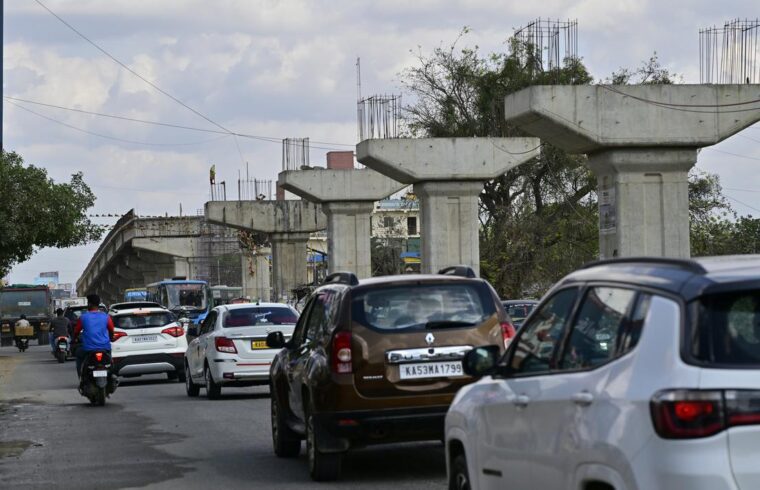
The incomplete Dommasandra flyover in Sarjapur has become a bottleneck causing long traffic jams in Bengaluru.
| Photo Credit:
K. MURALI KUMAR
Back in 2008
This offers a sense of deja vu, as in 2008, Bengaluru’s civic administration expanded from the erstwhile 225 sq.km. to 708 sq.km. by incorporating seven City Municipal Corporations and one Town Municipal Corporation apart from 110 villages, forming the Bruhat Bengaluru Mahanagara Palike (BBMP). The GBG Bill, 2024, argues this experiment has been a failure and opts for multiple corporations to govern the city.
“A lot of Bengaluru’s woes result from haphazard development in these erstwhile peripheral areas — engulfed rural and urban settlements, and large new developments put up by developers for thousands of new residents and offices in the middle of panchayat areas. And they continue to grow beyond BBMP today,” said V. Ravichandar, member of the BBMP Restructuring Committee, which has recommended a municipalisation commission to deal with peripheral growth of the city.
“According to a study by the World Resources Institute, India, nearly 30% of growth in large cities is outside the statutory boundaries of municipal corporations. These involve multiple authorities and differing legal frameworks with varied infrastructure norms and limited interest in environmental concerns. It is necessary to proactively plan these outlying areas developing urban characteristics if we are to conserve ecologically sensitive areas such as wetlands, respect nature’s contours and make for future liveable cities,” he argued.
One of the key drivers of this change is the availability of empty plots of land for development, a resource that is severely stressed within the present city. In most Western cities, the downtown (core city) gets commercialised with workspaces and shopping hubs, even as residences are thrown to the suburbs.
However, when the IT boom knocked on the doors of Bengaluru, space was premium in the core, pushing for these new workspaces that drive large-scale migration to this day, coming up in the suburbs – mainly due to the availability of land. However, this development was completely market-driven with the government regulation playing catch up, leading to haphazard development, encroachment of water bodies and storm water drains etc. What is unfolding now is no different.

Jigani town, on the Bannerghatta-Anekal road, has a thriving stone industry with dealers offering a wide variety of natural stones like granite, marble, and limestone, for construction.
| Photo Credit:
K. MURALI KUMAR
Contrasting Realities
The villages now slated for official inclusion into the city offer a picture of contrasting realities — swanky tech parks housing IT giants, commercial shopping hubs and luxury villas and apartments on the one side, besides problem-ridden village pockets that house people who have sold their lands for a pittance. Many of them, in the same breath, talk of their idyllic past with nostalgia, even as they see a glimmer of hope of a better tomorrow with them joining Bengaluru. Right now, they are struggling to make ends meet.
Jigani, an industrial town 28 km from the city’s centre, in Anekal taluk, is run by a Town Municipal Council. Dotted with small and large-scale automobile engineering industries, packaging and granite industries providing employment to thousands of people, Jigani has seen a huge influx of urban migration of not just the labour force, but upper-middle-class sections as well. One sees apartments and gated communities springing up everywhere. The town’s population density has shot through the roof. The roads in the industrial area are in a bad condition everywhere.
Krishnan Unni, a manager in an automobile parts manufacturing industry, said, “The area needs good roads, improved underground drainage system, uninterrupted power supply to homes, improved markets, vending zones, and public education infrastructure. Upscale housing units will go unsold in the absence of proper civic infrastructure.” He hopes joining the bandwagon of Bengaluru will bring the desired change.

Water being filled in tankers at Hennagara in Bengaluru.
| Photo Credit:
K. MURALI KUMAR
Only a short distance away, Lakshman M. was grazing his sheep, inhabiting a different world. He said urbanisation had not brought any change in his life. Apart from some locals who work as domestic workers in the nearby villas, many are still unemployed, he said. “The industries employ outsiders for work despite them standing on the land the locals provided for meagre compensation. We can neither afford to buy land that costs about ₹1.5 crore per acre nor rent a space to do business. We can only graze sheep to survive,” he solemnly said.
Twelve years ago, 75-year-old Sardar, a longtime resident of Sathanur village in North Bengaluru, parted with his 3.5-acre land for ₹3,80,000, a decision that haunts him to this day. What seemed like a fair deal at the time has become his big regret, as the land’s value has soared beyond imagination, leaving him with nothing but memories of what once belonged to him.
An acre of converted land now costs ₹1 crore. Although apartment complexes are yet to make their way into the village, people are constructing three-floor houses to generate revenue through rent. With a private university and an upscale school close by, the village is fast embracing development. The paying guest accommodations is a lucrative business, and so are eateries that cater to students. Sardar walking down memory lane says ragi and paddy cultivation has vanished in less than two decades but firmly says transformation is inevitable.
In the villages planned for integration into Bengaluru, the farmers have either sold or have been selling lands for layouts, housing projects and industries. Some also say this is an opportunity to make money and invest in profitable businesses. Shivashankarappa, a former member of Bommasandra Town Municipal Council said, “We have sold the land for reasonable compensation for industries. The locals here have now engaged in business activities, an opportunity came along with the establishment of industries.” But he laments that the infrastructure of the area is crumbling.
The land prices in areas like Attibele, Bommasandra, Chikkajala, and Sarjapur are even higher. The towering IT giants of Sarjapur and Bommasandra rise amidst sprawling tech parks, standing as symbols of rapid urbanization fueled by a booming real estate market and a thriving job sector.
The economic ripple effect is evident — trendy pubs, upscale restaurants, and bustling eateries are springing up, eager to cater to the growing workforce and affluent residents of the area. In some pockets, the transformation is so profound that they mirror Bengaluru’s Central Business District, pulsating with energy, commerce, and urban sophistication.
In Attibele, although the layouts are carved and villas are built in places tucked away from the bustling commercial establishments, the silence lingers. Ashwith P., a resident in Attibele said: “Till date, the population density is still low. In the gated communities of Chandapura, there are hardly 10 families. But these are luxury villas that offer quietude. But the rapid pace of development engulfing the area will soon overtake this as well,” he said.
Unlike the congested city centre, Attibele and Chandapura still offer vast spaces, paving the way for high-rise buildings. These towering structures will attract a larger influx of people, businesses, and corporate establishments, particularly IT firms seeking expansion beyond traditional tech hubs. Then the urban cacophony will surely take over, Ashwith said.
These quiet villages are now emerging as the next major hotspots for real estate and business.

High-rises in North Bengaluru.
| Photo Credit:
Shreyas H.S.
Will joining Bengaluru fix problems?
Today these urbanised villages are overwhelmed. Panchayats and town municipalities are grappling with key challenges such as fund mobilisation, traffic management, waste management, and underground drainage systems, among others. Will joining Bengaluru fix the problems, is the moot question. Though many are hopeful, there have been dissenting voices as well.
A panchayat official in Sarjapur said the village panchayat is struggling to keep pace with rapid urbanisation. With the rise of apartments, layouts, and IT companies, the population has grown by leaps and bounds. As a result, the village must expand underground drainage, meet rising water demands, and manage the increasing generation of solid waste. The gram panchayat has limited avenues for revenue generation, leading to poor civic infrastructure.
This is not unique to Sarjapur. Several village panchayats and town municipalities face similar issues, with waste management becoming an enormous challenge. Shivashankarappa, a former member of the Bommasandra Town Municipal Council, noted that due to poor infrastructure, waste is often dumped in vacant sites or stormwater drains. Bommasandra’s rapid expansion left the municipality struggling to manage waste effectively. The local body lacks sufficient vehicles for waste collection and does not have a proper dumping site.
They believe merging with Bengaluru is the only solution as it will provide them more funds, urban planning and engineering expertise they do not have and this would fix the infrastructure woes of these villages. More significantly, it will provide a more suitable urban governance structure for these areas. For instance, Karnataka State Police is presently considering adding several of these rural police stations to Bengaluru City Police Commissionerate, as the population density has increased and the nature of crimes in these police station limits has clearly changed, with increasing occurrences of urban crimes like robbery, chain and mobile snatchings, rowdy activities tied up with real estate dealings and cyber crimes among others.
Is GP better option?
However, some believe village panchayats are a better bet to handle these crises at the local level than get subsumed in Bengaluru.
Sampath Ramanujam, a gram panchayat member from Seegehalli, pointed out that using the same argument BBMP was born subsuming 110 villages, 7 CMCs and 1 TMC. “These areas continue to suffer from neglect even today. The government has yet to provide even basic facilities like water and sewage networks nearly two decades after they joined Bengaluru. The BBMP administration is so far away from these areas that it is a herculean task to even catch their attention. Residents of these areas have been arguing about going back to local corporations, indicating this experiment has failed. Then integrating more villages may not be practical,” he argued.
He said despite some challenges, smaller panchayats can implement better plans. Seegehalli, with 14,000 residents and about 40 apartment complexes and layouts, benefits from its compact size and manageable governance. The panchayat has incentivised solar installations by providing a property tax rebate which has been effective. Besides regular revenue, they also mobilise funds through corporate social responsibility initiatives. Merging villages with the corporation could undermine their autonomy, forcing residents to travel farther to resolve civic issues. Panchayat offices, currently within walking distance, offer accessibility that would be lost, he said.
As quibbles continue over the right way ahead, the march of Bengaluru seems unstoppable.
Published – March 28, 2025 06:52 am IST
[ad_2]
The Hindu