[ad_1]
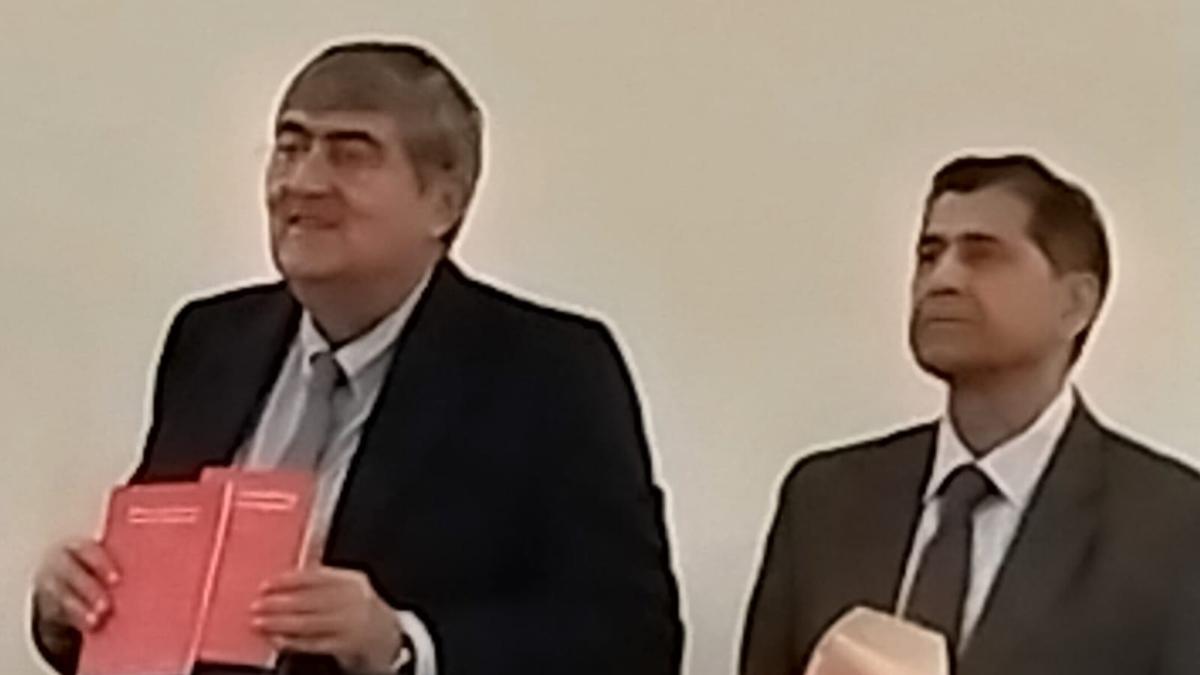
Supreme Court former judge Sanjay Kishan Kaul and Senior Counsel Arvind P. Datar launched Vidhi Centre for Legal Policy’s book titled ‘15 Legal Reform Ideas for Tamil Nadu’ in Chennai on March 8, 2025
| Photo Credit: Mohamed Imranullah S.
If the Centre is unhappy with striking down of National Judicial Appointments Commission (NJAC) Act of 2014 by the Supreme Court, it can enact a new law for appointment of judges to higher judiciary than adopt the present practice of perpetually sitting over the recommendations made by the collegium, said retired Supreme Court judge Sanjay Kishan Kaul in Chennai on Saturday, March 8, 2025.
Delivering the first ‘Rule of Law’ annual lecture organised by Vidhi Centre for Legal Policy, an independent think tank involved in legal research, he said, the government’s reluctance to accept names recommended, and even reiterated, by the Supreme Court collegium would only lead to an undesirable situation of the executive exercising an upper hand over judicial appointments.
Mr. Kaul said, issues related to judicial appointments have been persisting since Independence with even a democrat like the first Prime Minister Jawaharlal Nehru not being in favour of Justice Mehr Chand Mahajan becoming the Chief Justice of India. Thereafter, a tussle between the judiciary and the executive began since the imposition of Emergency between 1975 and 1977.
He said, the original constitutional scheme of the government appointing judges to the higher judiciary, in consultation with the Chief Justice of India (CJI), worked well for quite some time and produced some great judges like V.R. Krishna Iyer who despite having been a politician, in his previous avatar, ended up gaining great respect from the Bar as well as the general public.
However, when it was felt consultation with the CJI alone might not be sufficient, it gave rise to the collegium system of the CJI and two other senior judges of the Supreme Court recommending names and even this system worked well initially. “In a democratic polity, when there is a coaltion government, it is easier to deal with them but when a strong government comes there is always a tussle,” he said.
Speaking from his experience of having served as a judge of the Delhi High Court (2001-2012) and then as Chief Justice of the Punjab and Haryana High Court (2013-2014) as well as the Madras High Court (2014-2017) before getting elevated to the Supreme Court and being a part of the latter’s collegium too, Mr. Kaul said, it was not easy to convince good lawyers to accept judgeship.
“Those who deserve to be judges, do not want to be judges and those who want to be judges, do not deserve to be judges,” he said and underlined that the reluctance was not only because of the monetary loss that one would suffer on accepting judgeship but also because of the uncertainty over the recommendation being accepted by the government and the consequent mental agony.
He insisted upon finding a solution to the long standing problem by making the executive and the judiciary to iron out their differences across the table. Subsequently, while taking questions from the audience, Mr. Justice Kaul said, while it was important to ensure social justice in appointment of judges to the higher judiciary, it was equally important to select the best among every section of the society.
Senior counsel Arvind P. Datar, Director, Vidhi Centre for Legal Policy, had organised the lecture at Chennai and the event was supported by Ajit Isaac Foundation. Mr. Kaul also launched Vidhi Tamil Nadu’s briefing book titled ‘15 Legal Reform Ideas for Tamil Nadu,’ which contained suggestions on removing legal barriers limiting female labour force participation, eradicating caste discrimination in prisons and so on.
Published – March 09, 2025 01:11 pm IST
[ad_2]
The Hindu