[ad_1]
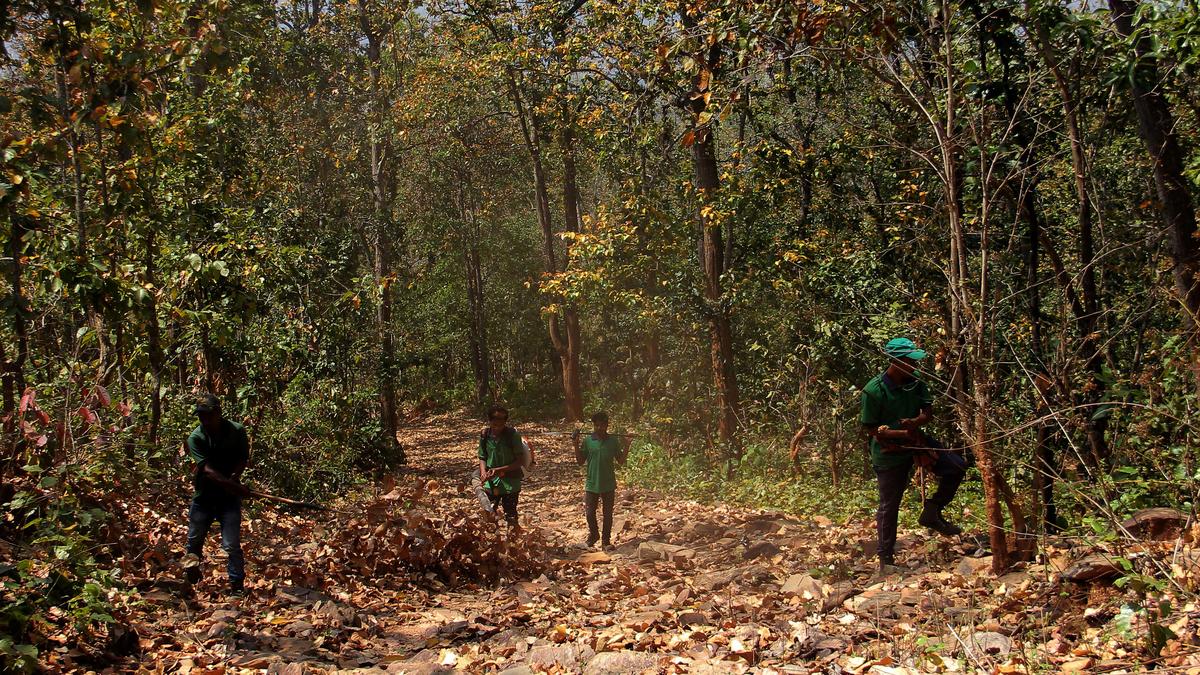
A file photo of Forest Protection Assistance workers inside Similipal Biosphere near Chahala forest range in Odisha.
| Photo Credit: BISWARANJAN ROUT
The Union Ministry of Tribal Affairs has directed the Odisha government to examine whether due process was followed in the eviction of Jamunagarh villagers from the core area of Similipal Tiger Reserve (STR). The directive comes after villagers lodged a complaint alleging that their sacred groves and burial grounds, protected under the Forest Rights Act, 2006, were bulldozed, excavated, and altered.
According to the villagers, their sacred sites were destroyed to make way for an enclosure housing Zeenat, a three-year-old tiger that had strayed into Jharkhand and West Bengal before being tranquilised and returned to STR.

Zeenat was originally translocated from Maharashtra’s Tadoba-Andhari Tiger Reserve to Similipal on November 14 as part of a strategy to enhance genetic diversity among the park’s big cats. However, its unexpected journey across State borders kept forest officials in Odisha, Jharkhand, and West Bengal on high alert.
“The State government must review the situation and take necessary action to safeguard the rights of tribal communities as recognised by law. In case of any resettlement, procedures detailed under the Forest Rights Act (FRA) and the Wildlife Protection Act needs to be followed,” said the Ministry in a letter to the Odisha government’s ST & SC Development Department.

After their annual rituals of visiting sacred groves in Similipal were halted by the State Forest department following the enclosure being erected for Zeenat, the villagers had shot off a complaint to the Ministry alleging that “the STR authorities have illegally and arbitrarily restricted villagers’ entry to the community forest right areas vested under FRA, 2006 and enclosures have been put in and around the sacred groves, the abodes of deities, and their sacred burial grounds”. They alleged that they were arbitrarily evicted from Jamunagarh without consent between 2015 and 2022.
The representation says claims that the District Level Committee, Mayurbhanj had previously acknowledged and granted the right to use the sacred groves and burial grounds of Jamunagarh village under FRA, 2006.
The Ministry has directed the State government to verify whether the process of vesting rights in Jamunagarh village has been completed. It has also sought confirmation that a necessary study was conducted to determine whether the presence of rights holders posed a threat to wildlife and made coexistence unfeasible.
Moreover, the Ministry has asked for informed consent for the proposed resettlement and the associated package. Furthermore, it has emphasised that the resettlement package should be designed to ensure livelihood security and be clearly communicated to each affected Gram Sabha member. Where the security of the re-introduced population is at risk from human activities, measures should be taken to minimise these in the re-introduced area.
If these measures are inadequate, the re-introduction should be abandoned or alternative release areas sought, it said.
“The tiger reintroduction programme must be clearly understood, accepted, and supported by local people to ensure its effectiveness and the lasting protection of the reintroduced population,” said Pradyumna Behera, a researcher on political economy.
Published – March 07, 2025 10:09 pm IST
[ad_2]
IThe Hindu