[ad_1]
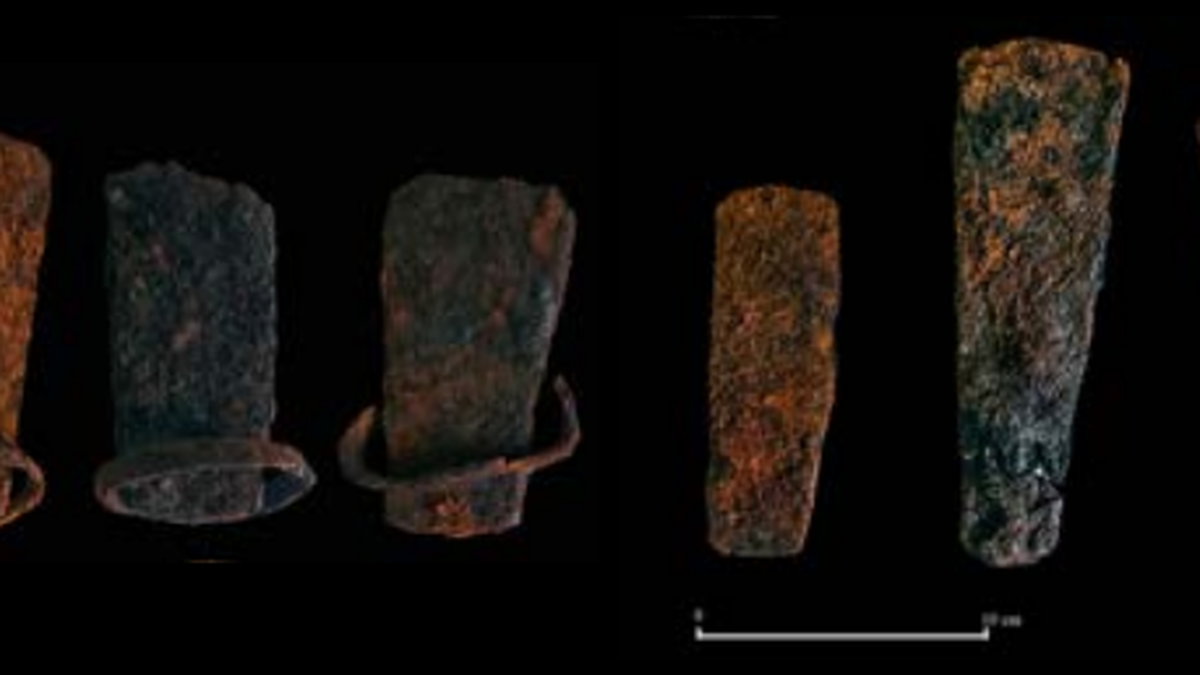
Iron chisels from graves, as shown in the report, ‘Antiquity of Iron: Recent radiometric dates from Tamil Nadu’.
The antiquity of iron in the Tamil landscape, dating back to the first quarter of the 4th millennium BCE, was based on samples drawn from archaeological excavations carried out by the Tamil Nadu State Archaeology Department at Sivagalai, an Iron Age habitation-cum-burial site in the Thamirabarani river valley in Thoothukudi district, between 2019 and 2022.
According to the report, ‘Antiquity of Iron: Recent radiometric dates from Tamil Nadu,’ by K. Rajan, Research Advisor, and R. Sivanantham, Joint Director, Tamil Nadu State Department of Archaeology, the excavations were carried out at eight locations, including five habitation mounds and three burial sites, in and around Sivagalai between 2019 and 2022.
The Iron Age urn burial site called ‘Sivagalai-parambu’, spanning 500 acres, lies in the northwestern part of the village, and the graveyard extends into the neighbouring villages of Petmangararam and Srimoolakarai. A total of 24 trenches were excavated at these sites which exposed nearly 160 urns, with the majority of them being red ware, the report said.
In one such urn unearthed from a trench, skeletal remains, iron objects and paddy grains were found. The urn was laid intact with a lid and no soil was percolated inside. The paddy sample collected from the urn dated back to 1,155 BCE. Encouraged from the results, the archaeologists sent charcoal samples from three other trenches for Accelerator Mass Spectrometry (AMS) analysis. It revealed that the age of the iron objects were falling between 2,953 BCE and 3,345 BCE, the report noted.
Further, the report also highlighted that Optically Stimulated Luminescence (OSL) analysis of samples collected from another urn in a trench also falls in the middle of 3rd millennium BCE displaying their consistency. Speaking to The Hindu, Professor Rajan said the Iron Age in ancient Tamil Nadu was contemporary to the Chalcolithic Age (Copper Age) in Indus Civilisation. “Now we have established that iron samples from Sivagalai and Adichanallur date back to 2,500 and 3,000 BCE. The way forward lies in exploring and excavating more sites not only in Tamil Nadu but in different places across the country to further strengthen what we have got till date.”
V. Selvakumar, Head, Department of Maritime History and Marine Archaeology, Tamil University, Thanjavur said the antiquity of iron in Tamil Nadu has given an important lead for further research. It also opened up a doorway for Tamil history and culture. Calling it a turning point, he also stressed the importance of further exploring and analysing sites which actually exist in the Tamil landscape.
Published – January 23, 2025 08:16 pm IST
[ad_2]
The Hindu