[ad_1]
Opening of the Yellow Line route of Namma Metro between R.V. Road and Bommasandra has eased traffic congestion along the stretch in south Bengaluru, reducing by 38% during morning peak hours and 37% during evening peak hours on weekdays.
These findings are based on an official study conducted by the Bengaluru Traffic Police (BTP). The report reviewed by The Hindu further notes that weekday non-peak hours saw an average congestion drop of 17%. Overall, the stretch has seen 30.6% drop in congestion and 37.5% during peak hours.
The 19.15 km-long metro line has had an even greater impact on weekends.
Insights from ASTraM system of Bengaluru Traffic Police
| Congestion time | Reduction |
| Morning peak hours congestion on weekdays | 38% |
| Evening peak hours congestion on weekdays | 37% |
| Non peak hours congestion on weekdays | 17% |
| Morning peak hours congestion on weekends | 69% |
| Evening peak hours congestion on weekends | 39% |
Congestion length: Morning Peak Hours
| Day | Median congestion before Yellow Line (km) | Median congestion after Yellow Line (km) |
| Monday | 26.02 | 24.03 |
| Tuesday | 31.56 | 17.62 |
| Wednesday | 37.02 | 26.79 |
| Thursday | 31.60 | 15.23 |
| Friday | 22.03 | 9.19 |
| Saturday | 6.69 | 1.79 |
| Sunday | 1.49 | 0.55 |
Congestion length: Non-peak hours
| Day | Median congestion before Yellow Line (km) | Median congestion after Yellow Line (km) |
| Monday | 19.02 | 23.73 |
| Tuesday | 20.21 | 12 |
| Wednesday | 20.95 | 25.25 |
| Thursday | 24.43 | 12.42 |
| Friday | 20.40 | 11.75 |
| Saturday | 54.86 | 24.47 |
| Sunday | 16.45 | 6.40 |
Congestion length: Evening peak hours
| Day | Median congestion before Yellow Line (km) | Median congestion after Yellow Line (km) |
| Monday | 51.77 | 35.17 |
| Tuesday | 49.71 | 24.48 |
| Wednesday | 64.10 | 40.67 |
| Thursday | 51.81 | 52 |
| Friday | 62.80 | 20.88 |
According to the BTP’s impact analysis, congestion reduced by 69% in the mornings and 39% in the evenings during peak hours on weekends. During weekend non-peak hours, congestion dropped by 58%.
The BTP studied congestion data recorded through the Actionable Intelligence for Sustainable Traffic Management (ASTraM) system, a smart traffic engine that gives insights on road traffic scenarios. For this study, data collected between August 11 and August 31 was compared with historical data. The analysis defined 7 a.m. to 11 a.m. as morning peak hours, 11 a.m. to 4 p.m. as non-peak hours, and 4 p.m. to 9 p.m. as evening peak hours.
Relief for smaller roads
Gopal M. Byakod, Deputy Commissioner of Police (DCP), (Traffic South), told The Hindu that the decline, particularly during peak hours, has made field traffic management easier. “The drop is a positive sign, especially since it comes despite fewer trains. Once BMRCL adds more train sets to reduce the headway, congestion is expected to ease further, addressing several hyper-local traffic issues at the lane level,” he said.
Another senior officer highlighted a more critical impact of the Yellow Line. “Major junctions usually face severe congestion daily, which in turn creates pressure on smaller connecting roads. Managing traffic on those roads is more important to clear bottlenecks. With fewer vehicles now, it has become relatively easier,” he said.
The new line has also helped reduce congestion on Hosur Main Road and at Madiwala, a key hub for inter-State buses., according to police.
Metro eases traffic at key junctions
The stretch covers four of the city’s most notorious junctions and nearly 10 bottlenecks. The usual notorious junctions – BTM Circle, Silk Board Junction, Hosa Road Junction, and Electronics City – have shown visible improvement.
According to the traffic police, these junctions typically see congestion because employees from central south Bengaluru travel daily to corporate hubs further south. The Yellow Line has established a crucial link, reducing vehicle density on the road.
Anusha M., who earlier commuted daily from BTM Layout to Electronics City by scooter, now prefers the metro. “Even with the wait time, it is more comfortable and time-saving. It’s better for health as well,” she said, adding that while many two-wheeler riders have shifted to the metro, some of her friends switched back due to overcrowding.
Wednesdays see higher traffic
The study also noted that Wednesdays continue to see the highest congestion among weekdays. Traditionally, morning peak congestion on Wednesdays stood at 37.02 km and evening peak at 64.10 km. After introduction of the metro, it was reduced to 26.79 km in the mornings and 40.67 km in the evenings. It should be noted that the congestion length is studied with data of not only main roads but also connecting roads.
Despite the overall improvement, non-peak congestion on Mondays and Wednesdays has risen by 25% and 21%, respectively, since the Yellow Line’s launch. Mr. Byakod urged commuters to use the metro as much as possible, as the BMRCL will be adding new train sets.
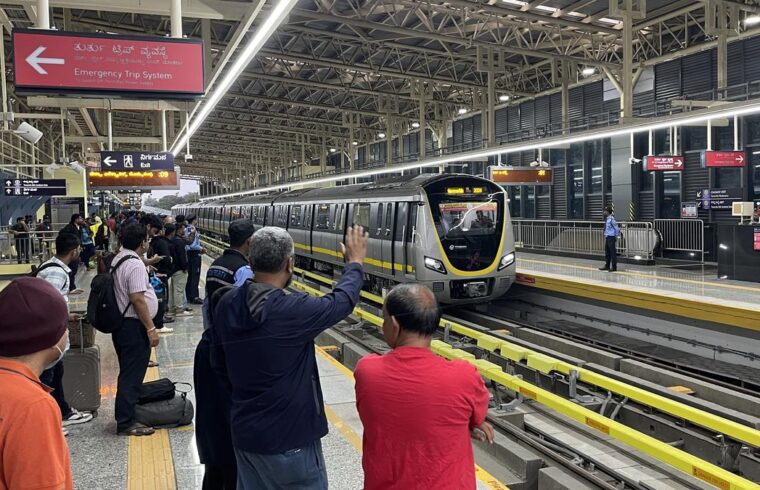
The much-awaited Yellow Line was inaugurated by Prime Minister Narendra Modi on August 10 and opened to the public the next day, after a delay of four years. However, services began with only three trains, leading to a long interval of over 25 minutes between trips. This limited availability of trains caused crowding at stations. On September 10, BMRCL added a fourth train set into service, reducing the interval to 19 minutes.
Published – September 17, 2025 01:25 pm IST
[ad_2]
The Hindu