[ad_1]
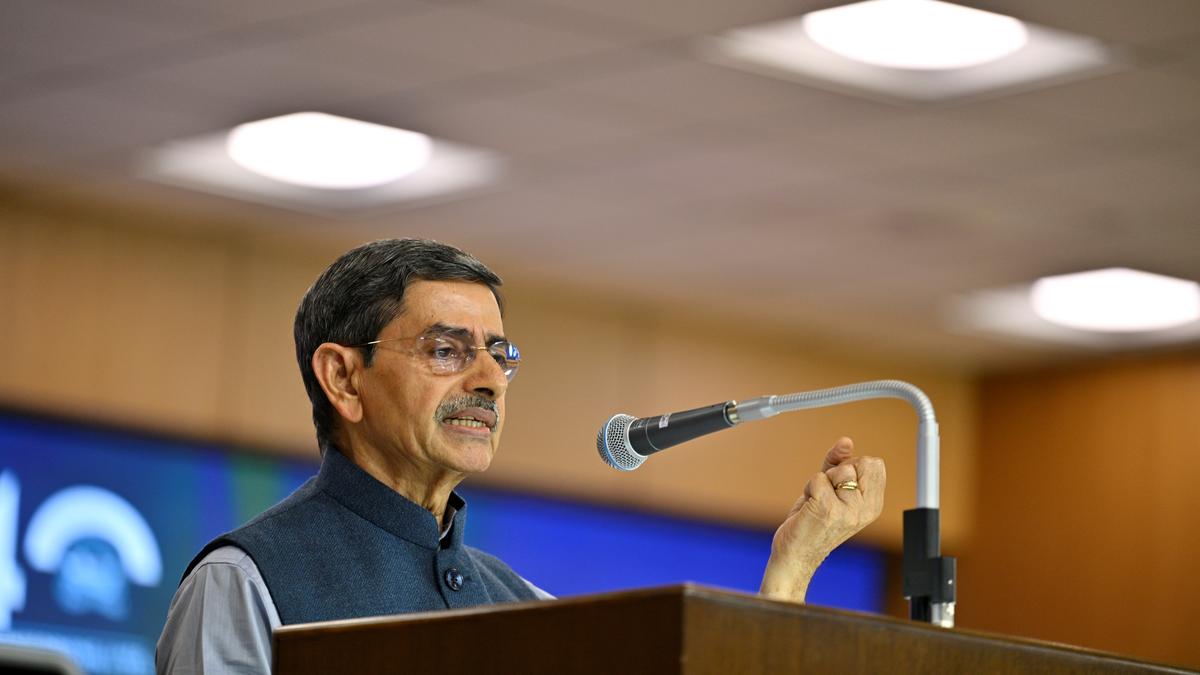
Tamil Nadu Governor R.N. Ravi.
| Photo Credit: C. Venkatachalapathy
The Supreme Court on Friday (January 17, 2025) orally asked Attorney General of India R. Venkataramani, appearing for Tamil Nadu Governor R.N. Ravi, to urge for a resolution of a continuing stalemate with the State government over the appointment of Vice-Chancellors in major State universities.
A Bench headed by Justice J.B. Pardiwala said the apex court would step in and decide the issue one way or the other unless the crisis was not resolved by the next date of court hearing.
“If it is resolved by next week, well and good. Otherwise, we will resolve it,” Justice Pardiwala said, posting the case next week.
The apex court is hearing multiple petitions filed by the Tamil Nadu government, represented by senior advocates A.M. Singhvi, Mukul Rohatgi, P. Wilson and advocate Sabarish Subramanian, about the conduct of the Governor regarding the grant of assent to key Bills on higher education, pending sanction of prosecutions, remission of prisoners, government orders, and the constitution of search committees for the appointment of Vice-Chancellors (V-Cs). Mr. Wilson said the Governor’s conduct suited a “political opponent”.
An application filed by the State government referred to the Governor’s insistence on including a nominee of the University Grants Commission (UGC) Chairperson in the search committees constituted to recommend a panel of names for V-Cs in various major State universities. Mr. Wilson submitted that some of these universities have been without V-Cs for three years.
The State’s application mentioned that the tug-of-war with the Governor was already affecting or would in the future impact V-C appointments to the Madras, Bharathiar, Anna, Annamalai, Periyar, and Bharathidasan universities, besides the Tamil Nadu Teachers Education University.
The court also agreed to hear an application filed by the Tamil Nadu government challenging the Governor’s decision to refer 10 re-enacted Bills, largely concerning higher education in the State, to the President on November 18, 2023 when the case was pending before the Supreme Court.
The State argued the decision of the Governor to reserve the case for the President’s consideration was “ex facie illegal, without jurisdiction and in gross violation of the Constitution”.
The President had subsequently assented to one Bill, rejected seven and not considered the remaining two proposed laws.
“The grant of assent to the Bill by Her Excellency, the Hon’ble President of India is unconstitutional and without jurisdiction. Instead, respondent number two (Union government) should have advised Her Excellency to return the 10 Bills back to the Hon’ble Governor as it is completely in gross violation of the principles of Constitution under the first proviso to Article 200,” the State government contended.
The State submitted the proviso to Article 200 retained the power and discretion over the fate of a Bill solely in the hands of the State Cabinet. The government referred to the top court’s judgment in the BK Pavitra case and those in similar cases which had categorically held the “Governor cannot withhold assent after a Bill is passed for the second time by a State Legislature”.
“It is not for the Governor to assess the necessity or suitability of a law. Such an assessment is within the sole prerogative of the elected representatives of the Legislature who are directly answerable to their constituents. The people are the ultimate sovereign… If an unelected figurehead, howsoever high in the Constitutional setup, interferes with the exercise of this sovereignty by the House of Legislature, it will lead to collapse of the parliamentary form of governance,” the State government submitted.
Urging judicial intervention, the State has urged the apex court to intervene against the conduct of the Governor. It said “the courts are not helpless when parties to the proceedings deliberately attempt to hoodwink and frustrate the process of court”.
Published – January 17, 2025 09:49 pm IST
[ad_2]
The Hindu